Wednesday, November 14, 2018

Astrology Signs to MLB Teams

UPDATE: I've decided to use this post as a hub for my Astrology Baseball 2018 Divisional Recaps. Here are the links, and you can read on below for an explanation of the process.


POSITIVE/MUTABLE
GEMINI - Pirates
SAGITTARIUS - Cubs

POSITIVE FIXED
LEO - Giants
AQUARIUS - Dodgers

POSITIVE/CARDINAL
ARIES - Phillies
LIBRA - Braves


NEGATIVE/FIXED
TAURUS - Athletics
SCORPIO - Angels/Rangers

NEGATIVE/CARDINAL
CANCER - White Sox
CAPRICORN - Tigers

NEGATIVE/MUTABLE
PISCES - Yankees
VIRGO - Red Sox


===


When organizing the 12 Astrology Baseball teams for fantasy sports purposes, I split them into four "divisions" with three teams each, based on the classical elements associated with each astrological sign: earth, air, fire, and water. However, I have to take a different strategy when using a video game to simulate a full astrology baseball season, since that involves picking a real-life team to stand in for each astrology sign's team, and the real-life divisions aren't easily divided into groups of four. Thankfully, 12 goes into six just as easily (remember, each of the two leagues in MLB has an east, central, and west division), and there are more ways to categorize astrological signs than just elementally.

First of all, there's polarity (i.e. positive and negative), which actually does correspond to the elements (air and fire are positive, earth and water are negative), but for our purposes, we can assign the two polarities to the American and National leagues (but not necessarily in that order). Additionally, each sign has one of three qualities: cardinal, fixed, and mutable, each of which describe four signs in total. This also corresponds to the elements, in that there is one sign of each quality in each of the four elemental groups. Looking at this through the lens of actual baseball, it's clear that each of the six divisions corresponds to a polarity/quality pairing (i.e. Negative/Fixed or Positive/Mutable), with only two of the teams in each division representing Astrology teams (and the other three able to be safely ignored for simulation purposes, because they're all but guaranteed to miss the playoffs).

Now the only question that remains is how to divide up the teams. While it's tempting to look for correlations between sign and team nickname - Gemini as the Twins, Pisces as the Marlins, Aquarius as the Mariners - I've found that that strategy dries up pretty quickly, and has no guarantee to create an easily-simulatable alignment. However, given that each sign is traditionally associated with a color, this is a much better place to start. While interpretations vary as far as which color goes with which sign, the custom caps that I designed for my Fantasy Astrology Baseball league show some of the most common associations. I've also introduced an additional layer by trying to limit myself to baseball's oldest teams, but I'm not requiring that the qualities remain in the same real-world geographical locations across both leagues. So with that in mind, let's look for some commonalities!


Red and blue are some of the most common colors associated with baseball teams, so it would be wise to leave aside signs like Aries, Virgo, Scorpio, Pisces, and even Aquarius, which I've also seen assigned to blue or indigo rather than the teal I used above. A good place to start is Leo, since
only two teams wear that sign's orange color: the Orioles and the Giants. Before looking at the other Positive/Fixed team that shares a division with Leo, let's check on any other standouts. Leaving aside the above mentioned team name correlation for Gemini, the only team with yellow as a prominent color is the Pirates. Similarly, there's only really one team that has the Taurus-associated forest green as its primary color: the Oakland A's. Sticking with things near and dear to my heart, my "home sign" Cancer links with the color silver. While every team wears gray on its road uniforms, but the only team that maintains a similar color palette at all times is the White Sox.

These last three choices seem to solidify National League as Positive and the American League as Negative, so let's follow this line of logic and see if we can make the rest of the teams work. Since the Pirates are the only color-coordinated real life team of the 2018 Astrology Champion Gemini sign, let's set the NL Central as the Positive/Mutable astrology division. Sagittarius is the the other sign in that division, and while there are no teams with the requisite purple in that division, the Cubs have both blue and red in their palette, which are the two component colors in purple. If we're going this route, then Leo, a positive sign, has to be the Giants, which again, doesn't leave a suitable light green team for Aquarius. However, I've read some sources that peg Aquarius as being associated with the color blue (because, you know, they are the Water Carriers), which opens the door for them to be represented by the division rival Dodgers. The last Positive division (Cardinal) includes two powerhouses, Aries and Libra, the first of which can pretty easily be linked to the Phillies (the only truly red team in the AL East). While the magenta/pastel color of Libra could fit with the uniforms of either the Braves or the Nationals, I picked Atlanta, one of baseball's three oldest teams, given that Washington has only played host to their team since 2005.

Moving to the Negative astrology league (i.e. the American League), and starting with the Fixed division (i.e. AL West), we now have to find a suitable Scorpio team to pair with the Taurus/Athletics combination. While the current version of the Angels has more red than any other team in the division, that doesn't quite work if we go back in time to the Disney era. Coincidentally, that was before the Rangers had transitioned from red to blue, so this sign is somewhat in flux. The White Sox are the best choice to represent Cancer in the Negative/Cardinal division (i.e. AL Central), there's not a clear brown team to act as Capricorn. I picked the Tigers, since every other team in the division is significantly more colorful. That leaves the AL East to act as our Negative/Mutable division, and thus the only options to represent Virgo and Pisces are the bitter rival Yankees and Red Sox. I could honestly go either way as to which team links with which sign, but I paired Virgo with the Red Sox, since their uniform (somewhat counterintuitively) has a fair amount of blue in it. Conversely, I feel like the Yankee pinstripes could be analogous to fish scales, which is of course the animal most associated with Pisces.

So, to recap, here's how I've arranged the teams/signs:


POSITIVE/MUTABLE
GEMINI - Pirates
SAGITTARIUS - Cubs

POSITIVE FIXED
LEO - Giants
AQUARIUS - Dodgers

POSITIVE/CARDINAL
ARIES - Phillies
LIBRA - Braves


NEGATIVE/FIXED
TAURUS - Athletics
SCORPIO - Rangers

NEGATIVE/CARDINAL
CANCER - White Sox
CAPRICORN - Tigers

NEGATIVE/MUTABLE
PISCES - Yankees
VIRGO - Red Sox


That's not to say that this is the only correct alignment, as there are other considerations to take into account. For example, the Twins and the Rockies have the purple color palette associated with Positive/Mutable Sagittarius, but the latter would mean flying in the face of my attempt to use MLB's older teams, and either choice would mean sacrificing the only yellow option for Gemini. Capricorn's brown color is most similar to the colors of the Padres or the Brewers, but then the challenge becomes finding a better silver team than Chicago AL for its fellow Negative/Cardinal sign Cancer. Then of course there are no true magenta/pastel-shaded teams for Libra (barring the Diamondbacks' late-90's throwbacks) or dark red/burgundy teams for Scorpio (barring the Diamondbacks' current uniforms), as they are of course one of baseball's two most recently-added teams.

Expect to see some of these team/sign pairings brought into a (simulated) reality upon the release of MLB The Show 19, but until then, I'll be posting some recaps of the 2018 Fantasy Astrology season from the perspective of these divisions. And I also have something else in the works that I won't go too in-depth about right now, except to say that it

Saturday, October 27, 2018

World Series 2018 Rosters - Dodgers Pitchers

After last night's marathon longest-ever-World-Series-game, the Dodgers have cut the Red Sox's series lead in half in the most dramatic fashion possible. Here are the pitchers that LA will use to try and pull even tonight.


In my last post, I suggested that Chris Sale might be the best lefty pitcher in the game right now, which is an assertion that Dodgers ace Clayton Kershaw would take issue with. Even given the injuries that have limited him to fewer than 25 stars per season over the last three years, his career-long history of excellence speaks for itself: seven consecutive All-Star nods from 2011 thru '17, three Cy Young Awards, one NL MVP, and even one Gold Glove to boot. Not to mention he's the active career leader in ERA (2.39), FIP (2.64), WHIP (1.005), win percentage (.689), shutouts (15), hits allowed per nine innings (6.7), and home runs allowed per nine innings (0.4). If there were no such thing as postseason demons, Kersh would have a practically flawless resumé - as it stands, he carries a 4.28 ERA over 23 playoff starts (and six relief appearances), which is not terrible by objective standards, but you would expect more from a future Hall of Famer. Unfortunately his pinch-hitting appearance in the 17th inning last night didn't do anything to bolster his postseason reputation, but at least he'll have another chance to pitch in Game 5.


Hyun-jin Ryu has had a rough go of it since making the jump from the Korea Baseball Organization to the majors in 2013 after seven years with the Hanwha Eagles. After a strong freshman and sophomore season, Ryu missed all of 2015 due to shoulder surgery, and then all but one game of 2016 because of an elbow injury. A groin issue limited him to just 15 starts in 2018, but they were some of the best of his MLB career, as manager Dave Roberts tabbed "Monster" as the Game 1 starter in the NLDS against the Braves, in order to take some of the pressure off Clayton Kershaw given his spotty postseason history. This tactic worked so well that Roberts did not repeat it in the NLCS or the World Series, where Kershaw took the loss in Game 1 of both serieses.


I think I remember hearing somewhere that Dodgers players have won the most Rookie of the Year awards out of any team in the majors. It's possible that 23-year-old Walker Buehler could have added to that total, if this weren't a season that saw the debuts of two of the hottest hitting young outfielders in recent memory (Ronald Acuna Jr. and Juan Soto). As it stands, the player who held the #13 ranking in Baseball America's top 100 prospect list heading into 2018 followed up his eight-game cup of coffee in 2017 with a 137.1 innings of 2.62 ERA pitching, and a fantasy points-per-game total that equalled ace Clayton Kershaw. It's hard to remember, because it seems like 1,000 hours ago, but Buehler pitched a seven-inning gem last night, even though the game didn't end until 11 innings after he came out of the game.


If you look up "journeyman" in the dictionary, you'd likely to see a picture of the smiling face of 38-year-old lefty Rich Hill. Or maybe you'd see him beating the tar out of a cooler full of candy in the Dodgers dugout. Here's the abridged version of D. Mountain's career: he came up for four seasons as a starter with the Cubs in his mid-20's, then struggled so badly in his lone season with the Orioles that the Red Sox converted him to a reliever. After pitching to a 1.14 ERA in 40 games over three seasons with Boston, the Indians took a shot on him as a lefty specialist, but were rewarded with a 6.28 ERA in his 38.2 innings over 63 games. He spent the next year managing only 5.1 innings between the Angels and the Yankees, before once again revitalizing his career with the Red Sox, this time as a starter. Although he only managed four starts in his second go-round in Boston, the 1.55 ERA he put up earned him a major league deal with the A's for next season. He only stayed in Oakland for one injury-shortened half that year however, as he was traded to the Dodgers while on the DL for blister problems. Hill re-upped with Los Angeles for three more years starting in 2017, where he has performed fairly well, both in the regular season (3.30 ERA) and in the playoffs (3.27 ERA), and will now be responsible for pulling LA even in the World Series tonight.


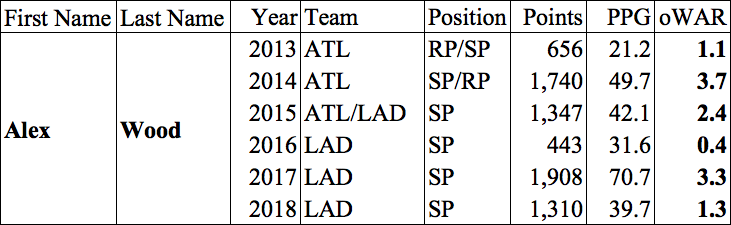
As with Eduardo Rodriguez in the Red Sox version of this feature, I'm putting Alex Wood here with the starters, even though he has been used exclusively in relief during the 2018 postseason. After struggling to find a role in Atlanta's pitching staff over his first two years, the Braves traded Wood to the Dodgers as part of a complicated three-team blockbuster with the Marlins that also involved Hector Olivera, Mat Latos, and Bronson Arroyo's contract, among others. AWood peaked in 2017 with a league-leading .842 winning percentage (16-3) and an All-Star berth, and is arbitration eligible for the third and final time this offseason.


You could say that what Clayton Kershaw has been for the Dodgers' starting staff, Kenley Jansen has been for their bullpen, at least over much of the same timeframe. Since taking over as the closer in 2012 (following a 25-game cup of coffee in 2010, and a 2011 season that he spent setting up for Javy Guerra) Jansen has racked up 259 saves, to go with a 2.21 ERA and a rate of 13.2 strikeout-per-nine-innings, making the All-Star team in the last three consecutive years. While Kenleyfornia had a troubling medical scare involving his heart while pitching in the rarefied air of Coors Field this year, that hasn't stopped him from continuing his dominance in the postseason, where he carried a 1.85 ERA heading into the 2018 World Series... although the home run he allowed last night ballooned that figure all the way up to 1.97.


If the Dodgers bullpen behind Jansen has been portrayed as a weakness for this club, it's due to largely unspectacular names like Pedro Baez serving as the primary setup options. That's no knock against Baez, with his career strikeout rate of nearly 10 per nine innings pitched, but he's not the type of shutdown arm that instills fear into opposing lineups when they see him warming up in the bullpen.


Well-traveled veteran Ryan Madson is the only member of this Dodgers pitching staff with a World Series ring in his career - two, in fact, as both his 2008 Phillies and 2015 Royals won championships. (Corner infielder David Freese holds that honor for the position player contingent.) The second of those two titles came after a stretch where Mad Dog was out of the majors for three years - after completing a three-year extension he signed with the Phillies, which he finished as the team's closer, Madson signed successive one-year deals with the Reds and the Angels, but didn't pitch for either club before latching on with the Royals on a minor league deal. His bounceback 2015 performance netted him a three-year deal with the A's, during the first of which he was the closer, and the second of which he was trade bait, in a deal that brought the A's their current (and far superior) closer. This year was the second in a row that Madson spent with two different teams, and he's evolved into Dave Roberts's "get out of trouble" guy during the World Series, despite the fact that he's allowed inherited runners to score both times he's been used in that role.


Normally I would put a starter-turned-reliever like Kenta Maeda in with the starting pitchers, but since his transition occurred well before the postseason started, he gets listed here with the rest of the bullpen. Maeda's embarrassingly cheap contract he signed prior to 2016 - on the heels of eight seasons pitching for the Hiroshima Carp in Japan's Nippon Professional Baseball - includes escalators based on games started, so I'm sure he and his representatives were less than thrilled when Maeken was bumped from the rotation this year. But it's hard to argue with his results compared to the performance of breakout rookie Walker Buehler, and baseball is a business after all.


Relative unknown Dylan Floro would not have made my database if I considered only his time with either the Reds or the Dodgers, but taking his combined work into account actually shows a very solid 2018 performance. Floro was actually drafted by the Tampa Bay Rays, with whom he made his debut (a 12-game cup of coffee) in 2016, which he followed up with three games of long relief for the Cubs the following year, before having his first qualifying season this year. F Loro is not even arbitration eligible until 2021, so he could be a long-term piece for the Dodgers bullpen if the organization so chooses.


Scott Alexander broke onto the scene with the Royals in 2017 and was acquired by the Dodgers in the offseason, where he went through a bit of a sophomore slump. The lefty specialist had one appearance in the 2018 NLDS, before being left off the NLCS roster in favor of Julio Urias, and then subsequently being added back to the roster prior to the World Series, replacing rookie Caleb Ferguson. Scottie Boy did give up the lead in the earlier part of extra innings last night, but fortunately circumstances played out in such a way where he didn't have to take the loss.


The above-mentioned Julio Urias didn't pitch enough in 2018 to qualify for my database (minimum 40 innings pitched) due to a potentially career-threatening shoulder issue, but he returned for four shutout innings towards the end of the season, and has continued his dominance into the playoffs. With a healthy Urias joining exciting young options such as Buehler and Ferguson, this Los Angeles rotation promises to have some bright years in 2019 and beyond.

Friday, October 26, 2018

World Series 2018 Rosters - Red Sox Pitchers

As the Red Sox venture deep into enemy territory and try to continue with the boring, dull, methodical decimation of their opponents that you would expect from a team that won 108 games in the regular season, let's take a look at the pitching staff that got them there. This commentary was written during the travel day on Thursday, so it will reflect the results for the first two games of the World Series.


Is Chris Sale the best left-handed pitcher in the game right now? Not according to 2018 fantasy points, where that honor goes to breakout Rays ace Blake Snell (2,668 points / 86.1 points per game). Although it's conceivable that Sale would have surpassed his AL East rival had The Conductor not been bitten by the injury bug, which limited him to 27 starts and 158 innings - 22 IP fewer than Snell and a career-low since he became a full-time starter in 2012. (Sale spent his first two seasons coming out of the bullpen, including a 21-game cup of coffee in 2010 where he failed to reach the requisite 40 innings pitched to qualify for my database.) It's a different story over the course of his career, with seven consecutive All-Star appearances, six consecutive top-six finishes in the Cy-Young Award voting (2018 results have, of course, not yet been released), and the all-time career records in both strikeouts per nine innings pitched (10.862) and strikeout-to-walk ratio (5.309). He doesn't have a terribly successful track record in the postseason, as he only made his first playoff appearance last year after a trade to the perennially contending Red Sox, but hopefully this World Series doesn't end in a sweep and he'll have one more shot to prove his case.


Can you believe that heading into the 2018 playoffs, David Price had made nine postseason starts and won none of them? He did pick up two wins pitching in relief, first in 2008 after a 14-game cup of coffee for the World Series runner up Rays (in the ALCS against Boston, ironically enough), and later in 2015 during Toronto's ALDS win over Texas. Consider his postseason demons exorcised, however, as Slam Dunkin Price came out on the winning end of a start once in each of the last two serieses: first in the decisive ALCS Game 5 against the Astros, and then in Wednesday's World Series Game 2 against the Dodgers. Unlike Sale, the well-traveled left hander does have a Cy Young Award to his name (in 2012 with the Rays, represented by the "^" symbol) to go along with six All-Star appearances and two midseason trades (both to playoff-bound teams, where he continued to rack up October ghosts). With four years left on the massive contract he signed prior to 2016, Price figures to be a fixture in the Red Sox rotation through at least 2022.


Like the previous two pitchers on this list, Nathan Eovaldi saw the majors before his first qualifying season: a six-start, four-relief-appearance cup of coffee in 2011 for his original team the Dodgers, where he put up 0.5 wins above replacement (Baseball Reference doesn't separate pitching WAR into two parts the way it does offensive and defense for position players). The very next year saw him sent to Miami in return for Hanley Ramirez, who was ironically cut loose by the Red Sox just months before they acquired Eovaldi from the Rays. He signed with Florida's other team prior to the 2017 season, even though it was already predetermined that he would miss that whole year and change recovering from Tommy John surgery due to an injury he incurred while pitching with the Yankees, a stint I'm sure Red Sox fans would like to ignore. However Evo pitched well enough upon his return in Tampa Bay that he netted a usable major league piece from the Red Sox at the July 31 non-waiver trade deadline. He then pitched well enough with Boston that he leapfrogged two of his incumbent rotation mates to start Game 3 of the ALDS against Houston, a role he will not reprise in the Fall Classic, as he came out of the bullpen in both Games 1 and 2.


Boston's Game 3 starter in the World Series will be 2016 Cy Young Award winner Rick Porcello, the only awards consideration he's received since finishing third in Rookie of the Year voting in 2009, his first season in the majors. Porcello spent six up-and-down years pitching in Detroit, where he helped his team reach the playoffs in three consecutive years, centering on a World Series berth in 2012, although he also failed to pick up a postseason win until this year's ALDS Game 4 start against the Yankees. In the 2014-15 offseason, after his best season to that point, he was traded to the Red Sox in the Yoenis Cespedes deal, after which he signed an early-season 4-year extension, for which Boston was rewarded with that Cy Young season the next year. Up until today, the pitcher known as Veintidós (cuz of his uniform number, you see) has had as many starts as he had relief appearances in this year's postseason, but he's got Alex Cora's confidence as the series heads into Los Angeles.


I'm putting Eduardo Rodriguez here with the starters since that was his role for 23 of his 27 games in the regular season, but once October rolls around, he falls victim to the postseason tradition of using starting pitchers out of the bullpen. Although Rodriguez made his MLB debut in Boston, he was signed out of Venezuela by - and subsequently spent the majority of his development with - Baltimore, until he was traded straight up for left handed relief ace Andrew Miller in 2014. El Gualo was arbitration eligible in 2018 for the first time as a Super Two player, so he'll continue to be a reasonably-priced rotation piece for the next three seasons.


Craig Kimbrel burst on the MLB scene in 2010 with 21 games of 0.44 ERA pitching for the Braves and hasn't looked back. Starting with his Rookie of the Year season in 2011, Kimbrel led the league in saves four years in a row, making four All-Star teams in the process. This performance earned him an extension with the Braves prior to the 2014 season... but then also a trade to the Padres just one year later. Despite a 2.58 and 39 saves that season, Dirty Craig missed the All-Star game for the only time in his career; he made it back to the Midsummer Classic all three years following his second trade in one calendar year, this one to the Red Sox. As a free agent following the World Series, the active leader in saves will be setting his sights on a record setting contract.


If Kimbrel does take his talents elsewhere in 2019, setup reliever Matt Barnes would likely be first in line to pick up saves in Boston. While his fantasy point totals lag far behind that of the regular closer (due to the inordinate value placed on saves), Barnes had a 2018 strikeout rate that compared favorably to Kimbrel's (14.0 to 13.9 K/9 IP) and they each put up an identical 3.10 K/BB percentage. Who knows if the Boston brass thinks that Barnacles has the intestinal fortitude necessary to lock up the ninth inning in high pressure situations, or if Dealin' Dave Dombrowski and Co. will try to pick up a more established arm in the offseason, but the underlying numbers are there.


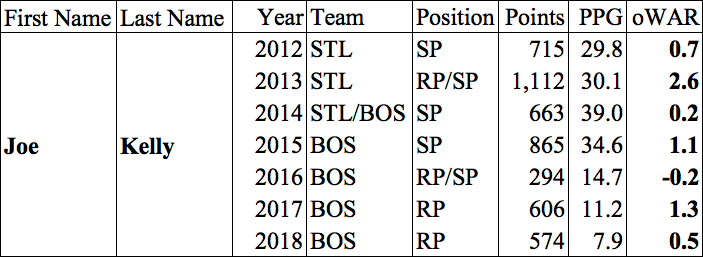
Joe Kelly has had a roundabout career as far as his role is concerned. In his first two seasons with the Cardinals, he bounced between the rotation and the bullpen, performing better as a reliever in his rookie year, but then flipping the script in his sophomore campaign. No sooner was he moved to the rotation full time, then he was shipped off to Boston in the John Lackey deal, where he continued as a starter for the next 1.5 seasons, with varying results. After spending the next year transitioning to the bullpen full time, Kelly peaked as a reliever in 2017, but his 100+ mph fastball still plays just fine in the postseason.


Yup, Heath Hembree is on Boston's World Series roster. He's even racked up three appearances so far this postseason, although none since Game 1 of the ALCS. Did you know that he came up with the Giants in 2013, then had two more non-qualifying seasons with the Red Sox after being involved in the Jake Peavy trade? Also it's fun that his ERA was exactly 4.20 in 2018. Yeah, blaze it, Heath!


Drew Pomeranz was added to the roster for the World Series, replacing embattled reliever Brandon Workman (he of the 45.00 ERA over the first two rounds), although his 2018 season as a swingman type pitcher was entirely forgettable. Once a big time prospect for the Indians with two stops on Baseball America's top 100 prospect list, Pomeranz didn't get his start in the majors until a trade to Colorado (for Ubaldo Jimenez) for a cup of coffee in 2011. But Big Smooth didn't truly break out until two more trades - first to the A's (for Brett Anderson) and then to the Padres (for Yonder Alonso) - where his 2.47 first half ERA earned him a trip to a contender in 2016 in a transaction that was steeped in controversy (due to his medical issues that were not properly disclosed by Padres GM A.J. Preller). After one and a half solid seasons in the rotation, the wheels fell off in 2018, but you could do worse when it comes to a second lefty specialist on a World Series roster.


To round things out, journeyman reliever Ryan Brasier didn't pitch enough to make his way onto my database (just shy of 34 innings), although he did put up a 1.60 ERA that translates to 462 points and 13.6 points per game. It's not uncommon for players to blossom into postseason heroes after just a brief showing in the majors (just ask David Price), but so far I wouldn't say that "solid relief work" has elevated him to "hero" status quite yet.

Wednesday, October 24, 2018

World Series 2018 Rosters - Dodgers Offense

Welcome back to the second installment of this sneak peak into my Fantasy Point By Player Database, featuring the visiting team in the World Series, the Los Angeles Dodgers. While this is scheduled to go up prior to Game 2 of the Fall Classic, in which LA will be looking to even the series, most of the commentary was written prior to Game 1, so some of these storylines will have been advanced or altered a bit. The order of the players is based on the most common Dodgers lineups throughout the 2018 postseason so far.


Did you know that out of all the offensive stars on the 2017 Dodgers, Joc Pederson was the team's top fantasy scorer during last year's World Series? You would have known that if you saw the first and only part of my Fantasy Astrology World Series Recap from last offseason. Yung Joc's star has fallen a bit since his All-Star rookie season and his even stronger sophomore campaign, as he's been shifted from center field to left (he was worth more than one defensive win BELOW replacement level in an abbreviated 2017), and basically relegated to a platoon role (he's got a career .842 OPS against right-handed pitchers, but only .583 against lefties). However, you can't discount a return of the #Joctober excitement that came from three home runs in last year's Fall Classic.


Rather than continue with the Dodgers' projected starting lineup - because with all manager Dave Roberts's roster machinations, any projections are futile - I'd like to jump to Pederson's leadoff/left field platoon mate Chris Taylor. Taylor had three years in the big leagues before his first qualifying season (at least 200 plate appearances) where he mostly served as a little-used utility piece with the Mariners. But last year's breakout performance saw him qualify at three different positions (center field, left field, and second base), hit 21 homers with an .850 OPS, and take home NLCS co-MVP honors against the Cubs. CT3 spent the majority of his 2018 season at shortstop, filling in for the injured Corey Seager (until reinforcements arrived on the trade market), but in the playoffs he's shuttled between LF and 2B, mostly against left handed pitchers.


We've heard so much about Justin Turner's historic level of excellence when it comes to clutch hitting in the playoffs, that it's easy to forget his unremarkable start as a utility infielder for the Mets. Well, actually he had a cup of coffee with the Orioles before the season where he was picked off waivers by New York NL, but he spent most of his minor league development in the Reds farm system. It wasn't until he signed with Los Angeles as a free agent that he really took off with the bat and the glove and turned himself into a legit postseason hero. A series of injuries has kept RedTurn2 from putting up the full season fantasy point totals that he truly deserves, but he does have an All-Star appearance (in 2017) and two top-10 MVP voting finishes (2016 and '17) to his credit, in addition to sharing NLCS co-MVP honors with Taylor last year.


What doesn't appear on this database is the two years Max Muncy spent with the Oakland Athletics (2014-15), where he hit .195 across an average of 120 plate appearances per year. After being released and spending 2017 in the Dodgers' minor league system, he inexplicably broke out with 35 home runs and a .973 OPS this year. The left handed hitting Muncy has been aggressively platooned over the course of the postseason, despite putting up an .891 OPS in 119 PA against lefties this year... but who can fathom the strategic mind of Dave Roberts?


Starting at first base against left handed pitchers is celebrated postseason veteran David Freese, although he spent most of 2018 acting as a platoon partner at third base for Colin Moran in Pittsburgh. Freese took home both NLCS and World Series MVP honors during the Cardinals' championship season in 2011, and he returned to the playoffs in the three subsequent years - two with St. Louis and one following his trade to the Angels. His usage in the 2018 NLCS has been brief and curious (i.e. being substituted out after hitting a home run and a double and driving in two runs), but his veteran leadership is a plus, whether on the field or in the dugout.


Another midseason acquisition, Manny Machado to the Dodgers was a widely anticipated transaction, given both the early season-ending elbow injury to starting shortstop Corey Seager and Machado's insistence (and the Orioles' acquiescence) on moving from third base this season. In fact, very few people were surprised when news broke during the All-Star break (where Manny was enjoying his fourth trip to the Midsummer Classic) that he would be on his way to Los Angeles to finish the season. While El Ministro's defense at shortstop is questionable at best, he improved since coming to LA (1.2 defense-only-WAR with LAD, compared to -1.2 dWAR with BAL), along with continuing his career-best pace, in both fantasy points and offense-only-WAR. A lot has been made of Machado's quirky (some would say "dirty") style of play, and how that might impact his impending trip to free agency, but for the next week, his focus will (should) be solely on securing a championship in his third trip to the postseason.


Cody Bellinger followed up his Rookie of the Year showing in 2017 with an NLCS MVP award this year, thanks mostly to two key hits (a game-winner in the 13th inning of Game 4 and a go-ahead two-run shot in Game 7). While Codylove is primarily a first baseman, he can also play a pretty decent center field due to his athleticism, which in turn allowed the Dodgers to get Max Muncy's bat into the lineup with more regularity... at least against right handed pitchers. On a fun sidenote, Cody's father Clay Bellinger had a brief career as a utility player for the Yankees (from 1999 thru 2001) and the Angels (in 2002), which means that every MLB team on which a Bellinger played has reached the World Series (h/t to the official MLB Instagram account for that factoid).


Like him or not, it's hard to argue that Yasiel Puig is not one of the most eminently watchable players in MLB right now. Whether it's bat flips, bat licks, or bat breaking-over-his-knees, the high-octane Cuban always plays with his emotions on full display. This has not always worked in the Wild Horse's favor, as his MLB performance has been about as uneven as his temperament, with flashes of brilliance mixed in with prolonged slumps and even a brief demotion to the minor leagues in 2016, which put his future with the Dodgers in doubt. But with two more years left on his contract and some big numbers in the 2018 postseason so far, it appears as though the Dodgers still view Puig as their friend for the foreseeable future.


Versatility has been the calling card of Enrique "Kiké" Hernandez since he first made it to the big leagues in 2014, a year he split between the Astros and the Marlins before his first qualifying season with the Dodgers in '15. In fact, Hernandez has appeared at every position except catcher in his career, including a third of an inning on the mound... in which he gave up two walks and a three-run homer, but it's the thought that counts. In 2018, the fan-favorite Kiké added power hitting to his resumé, with 21 homers, solidifying him as one of the few players to be immune from Dave Roberts' frantic platooning, as he's started all but two of LA's playoff games this year.


For the last two years (and for two cups of coffee before that), Austin Barnes has served the Dodgers strictly in the role of backup catcher... until the playoffs start. I don't know what happens to Yasmani Grandal when the calendar flips to October, but despite very solid regular season numbers (see below), he just can't seem to put things together on the game's biggest stage. Not that Barnes lights the world on fire with his own production, but he's been anointed the catcher of choice for roughly 1 and 2/3's postseasons now.


A prodigal longtime Dodger stalwart, Matt Kemp returned to his former team almost by accident this offseason. The homegrown Oklahoman left after nine seasons (eight qualifying) with the Dodgers, which included two All-Star berths (2011 and 2012), two Gold Glove/Silver Slugger combo years (2009 and 2011), and a near MVP award (that great 2011 season). Matt then spent three years split almost 60/40 with the Padres and the Braves, before returning to Los Angeles in a contract-restructuring trade (a very different type of roster machination than the ones Dave Roberts is responsible for). After having to win a spot in Spring Training, all Kemp did was make his third All-Star team and slug 21 homers, before suffering a second-half dropoff that has kept him out of the starting lineup for most of the postseason.


The second, and less impactful, half of the Los Angeles's middle infield makeover came in the form of Brian Dozier from the Twins, formerly one of the game's top power hitting second baseman. The timing wasn't great, as he put up his worst oWAR total since becoming a regular in 2013 and has been relegated mostly to a bench role against lefties, he has seen his fair share of pinch hitting appearances, and his veteran leadership is surely much appreciated, especially with Chase Utley off the roster.


Yasmani Grandal had a strange path to the majors, as reflected in his "Developed" status line: CIN*/sdp. The capitals in Cincinnati's abbreviation means that he got the majority of his minor league development in the Reds organization, but the "*" means that he never saw the majors with them. San Diego has no asterisk (i.e. he made his debut with that team), but the Padres are in lowercase, indicating that Grandal didn't need as much seasoning with his acquired team. Who knows if this has anything to do with the reasons why the Yazmanian Devil seems to struggle so much in the playoffs, but it's food for thought nonetheless.

Tuesday, October 23, 2018

World Series 2018 Rosters - Red Sox Offense

Those of you who follow this blog will notice that I haven't been posting at all throughout the MLB playoffs. That's not just because I'm trying to be more emotionally detached this postseason (at least on social media), but also because I've been busy plugging the end-of-season stats into my various baseball databases. (I've also been cutting away at my Batman: Return to Arkham City Let's Play, which I might start releasing after the World Series, but that's a different story.)

I Tweeted out excerpts from two of these documents before the wild card games/first round (a snapshot of each team's current active roster) and before the championship serieses (a summary of each team over the course of the season). But for the World Series, I'm breaking out some info from my most ambitious baseball list yet: a database consisting year-by-year fantasy points for every player from the year 2000 to the present (minimum 200 PA or 40 IP in a season). So starting with the lineup of the home team Red Sox, here's the performance history of every player who might appear in the 2018 World Series:


Mookie Betts burst onto the scene as a 21-year-old center fielder, having been blocked at his natural position of second base by a certain franchise cornerstone named Dustin Pedroia. He barely cracked the 200 plate appearance cutoff that year (he actually had fewer than 200 at-bats), yet he contributed nearly two wins with his bat alone in just 52 games as a rookie (as shown in the oWAR column on the right, which stands for "offensive Wins Above Replacement," a subset of Baseball Reference's proprietary stat for measuring a player's effectiveness, taking into account everything but fielding). Betts's star has only risen from there, to the point where he's the presumptive AL MVP favorite in his fifth MLB season, a 30-30 campaign in which he won a batting title, led the league in overall WAR (10.9), and appeared in his third consecutive All-Star Game.


Andrew Benintendi played significantly more than Betts in his rookie-qualifying year, finishing second in Rookie of the Year voting to the hated rival Yankees' right fielder Aaron Judge in 2017. But it's also important to note that Benny had a 34 game (extended) cup of coffee the prior year, where he put up an .835 OPS over 118 PA. He improved his contact game year over year, raising his batting average nearly 20 points while maintaining almost the exact same walk and strikeout totals, while also showing enough defensive ability to qualify in center field this year.


J.D. Martinez is one of the most compelling rags to riches story of our baseball generation. After playing at net below replacement level with his original team, the Astros unceremoniously cut him loose before what would have been his fourth season. But Houston didn't take into account the fact that Martinez had spent the offseason overhauling his swing with a pair of hitting gurus, which immediately paid dividends for the Tigers when they picked him up off the scrap heap during Spring Training in 2014. JDM ended up helping his new team reach the playoffs in his first year with Detroit (they were swept by the Orioles in the first round) and making the All-Star team the next year - along with winning a Silver Slugger award. In 2017, in a typical last-year-before-free-agency scenario, Martinez found himself dealt to a contender for the stretch run, where he hit an amazing 29 home runs in 62 games with the Diamondbacks, helping them get past the Rockies in the NL Wild Card game, before falling victim to another division series sweep, this time at the hands of the Dodges. His free agent deal with the Red Sox was one of the most widely anticipated transactions of the offseason, and so far it's worked out for both team and player. While "Flaco" has settled in as Boston's primary DH, he hasn't exactly hung up his glove, qualifying at both corner outfield spots, providing versatility to fantasy owners everywhere.


Xander Bogaerts had his first qualifying season in the same year (and at the same age) as Mookie Betts, solidifying the Red Sox's offensive core for years to come. Signed out of the noted baseball hotbed of Aruba, Bogaerts actually already has a World Series ring, by virtue of his 18 game cup of coffee during Boston's championship 2013 season. After winning a silver slugger award in 2015, thanks to a .320 average, but with only seven home runs, "X" unlocked his power potential the next year, smacking 21 homers en route to another silver slugger and his first (and so far, only) All-Star appearance. After a down 2017, "Bogey" returned to his 20-homer pop in his role of cleanup hitter for baseball's winningest team in 2018.


Although his first qualifying season came in 2014, at the age of 31, Steve Pearce had been bouncing around the league since 2007, when he broke in with the Pirates. Pearce's breakout 21-homer season helped the Orioles win a division title, where he then helped eliminate his current teammate J.D. Martinez's Tigers, before losing to the eventual World Champion Royals in the ALCS. His next three seasons were fairly similar in terms of fantasy points, but wildly varying in terms of wins above replacement, which shows that I don't fully understand the inner workings of the WAR system. Maybe his bump in 2016 had to do with his trade between Baltimore and Toronto for some reason? Pearce was actually the most impactful first baseman moved during this season, although only finds himself in the Sox's playoff starting lineup due to a hamstring injury to Mitch Moreland.


Speaking of injuries, Rafael Devers only took over as the starter at the hot corner after utility player Eduardo Nunez aggravated his ankle, but he was a hot hitter in the ALCS... just like he was in last year's ALDS loss against Houston. The Dominican Republic native still has some issues in his game to work out (especially defensively and strikeout percentagely), but given that he's only 21 years old, some more development time is to be expected.


I mentioned Dustin Pedroia before as the catalyst for Mookie Betts's shift to the outfield, and his injured status this year was directly responsible for the acquisition of Ian Kinsler from the Angels - just half a season after he was acquired from the Tigers. The veteran has a long history of solid play at the keystone, with just one game at a position other than second base in his 13-year career, and a much more solid defensive reputation than his one Gold Glove (in 2016) would suggest. He's made four All-Star teams in alternating years from 2008 thru 2014, the first three with Texas, and the last after being traded to Detroit, and he's been to the World Series twice before (with the Rangers in 2010 and 2011). Incidentally he also played in that Detroit/Baltimore ALDS along with J.D. Martinez and Steve Pearce.


It's well documented that the Red Sox got some of the worst production league wide from their catchers, which is one half the fault of the recently-extended Christian Vazquez. While his offensive production is unremarkable at best, his line from the database gives me an excuse to talk about some of my notation. The # signal means that the player missed the entire season (whether due to injury or otherwise), while the ^ means that the player did not have enough plate appearances to qualify. For obvious reasons, these symbols only appear if a player has had qualifying seasons before and after.


A well-deserved ALCS MVP award followed a solid season for the Red Sox number nine hitter Jackie Bradley Jr., who along with Betts, Bogaerts, and Benintendi makes up a New England version of the Killer B's. After a breakout campaign in 2016, complete with 26 home runs and an All-Star appearance, JBJ has settled into a two-win player with his bat, which is pretty impressive considering his stellar defensive reputation (although the metrics appear to be somewhat mixed on his work in 2018).


Moving on to the bench (or in this case, a starter with an ill-timed injury), Mitch Moreland has had a mostly unremarkable career as a not-quite-slugging first baseman. The Red Sox liked his left-handed bat enough to sign him to successive short-term free agent contracts, and his presence on the roster made veteran Hanley Ramirez expendable at the start of the year. In terms of postseason experience, Mitchy Two Bags went to the same World Serieses as Ian Kinsler with the Rangers, but he was also around for the Texas's successive ALDS losses to Toronto in 2015 and '16. We'll see how much his balky hamstring allows him to play in this year's Fall Classic.


Eduardo Nunez got his start backing up Derek Jeter in the Bronx, and then briefly took over for the captain before heading to Minnesota as a bench piece. The Twins sold high on Nunez, trading him to the Giants partway through his only All-Star season in 2016, where he couldn't keep San Francisco from falling to the eventual World Champion Cubs in the division series. Following a 2017 trade to Boston, "Nuni" served as the Red Sox's primary second baseman (with some time at third) given the injury troubles of Dustin Pedroia.


The second half of Boston's Pedroia-less second base picture this year, Brock Holt has mostly made his bones as a super-utility player, with proficiency all over the diamond - he's played at every position but pitcher and catcher in his seven year career (including two cups of coffee before his first qualifying season). Both his fantasy point production and his oWAR totals have trended in the wrong direction since his All-Star 2015 season, but he's still a valuable and versatile bench piece.


It took four non-qualifying seasons (the first three with the Nationals) before Sandy Leon broke onto the scene with an .845 OPS in 78 games for the 2016 Red Sox. That number then dropped to .644 the following year, then .511 the year after that (this year), and his point totals and oWAR dropped accordingly. He's been on the bench more often than not after taking the brunt of the timeshare during the regular season.


UPDATE: I didn't initially include an entry on backup catcher/outfielder Blake Swihart, because it seems as though the Red Sox made it to the postseason almost in spite of Swihart's presence on the roster than because of it, based on how little playing time he got over the course of the year. In fact, Swi only has one postseason plate appearance to his credit - a strikeout in the ALDS - but since he's on the active roster, I wanted to say a word about him, but it's still unclear whether he'll survive the offseason roster crunch.

Sunday, September 23, 2018

Magic Cards vs Dungeons and Dragons Spells


Abstract: Exploring the link between the five (5) colors of mana in Magic: The Gathering and the eight (8) schools of magic in Dungeons and Dragons, through specific names shared by both spells and cards.

Methodology: Using a proprietary database I made of D&D spells from various Player's Handbooks, and a lot of copy-pasting into Scryfall, I determined that nearly 200 spells had names that were the same as, or extremely similar to, Magic cards. By adding the colors of those cards into my database, I was able to sort by both color identity (which all cards have) and school of magic (to which all spells belong) to determine any correlations between the two.

I am also aware that in the flavor of Magic, cards are also technically "spells," but I'm using CARD to refer only to the strategy game side of the equation, while reserving the term SPELL only for the role-playing game side. For reference, the players handbookses I used for my database are from Advanced D&D (printed in 1980, hereafter referred to as 2nd edition), Third Edition (printed 2000, 3rd), and Fifth Edition (printed 2014, 5th).

Findings (listed alphabetically):


Abjuration (protection, disruption) is the least well represented school among Magic cards, with just three spells sharing exact names, and three more sharing partial names (or similar ideas). Only one of the top three spells appear in multiple editions: Death Ward was in 3rd and 5th, but was only in the Abjuration school in its latest version - it started out in Necromancy (see below). Meanwhile, the card Death Ward is a White instant from Magic's very first set (Limited Edition Alpha and Beta), that basically mirrors the effects of the 5e spell. If that doesn't cover the "protection" aspect of abjuration enough, consider that White also has a cycle of cards all titled Circle of Protection, and the majority of the cards in the game that refer to the static ability Protection (cf. rule 702.16) are White.

As for the disruption side of ABJ, let's look at the phenomena of countermagic and bounce. Counterspell, also from Limited Edition, is an exact match for the spell in 5th of the same name (countering spells was a much more complicated process in 2nd and 3rd). Then there's the spell from all three D&D editions Dispel Magic, the effect of which is actually more similar to the White Magic card Disenchant than it is to the Blue Dispel, which is just a conditional counterspell. In another strange yet appropriate disconnect, the 3rd edition spell Dismissal is basically as close as you can get to a D&D phrasing of "return target creature to its owner's hand," which is an effect commonly found in Blue mana (e.g. Unsummon). Incidentally, there are four cards with dismissal in the name, three of which are Blue and contain either counter of bounce effects. In terms of utility spells, the card Intruder Alarm shares some important similarities with the 3rd and 5th edition spell Alarm.

Conclusion: White and Blue pretty accurately sum up Abjuration, full stop. This one was like the tutorial level of a video game.


Conjuration (creation, summoning) has one of the clearest connections to Magic of the schools, but somewhat of a disconnect between specific card names. On the one hand, Summoning is a subtype of Conjuration in 2nd and 3rd editions (not just a descriptor, like the two words next to Abjuration), and Magic's oldest Creature cards all have "Summon" printed on them. So technically, the relative majority of all Magic cards correspond to the Conjuration school. While all colors of mana obviously have access to Creature cards, the one that immediately comes to mind is Green, since the relative majority of all creature spells are Green. Although it's worth noting that five 2nd edition spells outline the type of creature being summoned, which line up with Creature cards that are either Red (Conjure Fire Elemental and Conjure Earth Elemental), Blue (Aerial [Air] Servant and Invisible Stalker), or Black ([Dread] Cacodemon).

On the other hand, there are ten other Conjuration spells with Magic card names, out of which all five colors of mana are represented. But the most puzzling part of this school is that nine of these spells appear in all three D&D editions, but NONE of them are part of the Conjuration school more than twice. Fog Cloud (originally Alteration) and Web (originally Evocation) are the only two-fer's, as they are CONJ spells in both 3rd and 5th, but the former of these is a bit of a stretch, since Fog is an effect in Magic that's most associated with Green, but the summoning (i.e. creature focused) element also points to a Blue element. The only one-for-three I think really belongs here is Teleport, which was originally in the Alteration/Transmutation school in 2nd/3rd (see below for details on the name change), and then made the switch to Conjuration in the latest edition. I guess they thought that when one teleports, they effectively summon themselves to a different location, rather than altering their position in space/time? Makes sense to me. I'll be sure to cover the other eight of these spells in the ensuing schools where they're more appropriate.

Conclusion: While all colors use Conjuration for casting Creature cards, Green is clearly at the top, not just because of the abundance of Green creatures, but also for effects that focus on finding creatures and bringing them into play (e.g. Summoner's Pact, Savage Summoning, Lurking Predators).


Divination (information, prediction) is not only the name of a spell in the Divination school in all three D&D editions (I know, very meta), it's ALSO the name of a Magic card... I mean, what more do you need? And that card lets you draw cards, which IS exactly Magic's version of information. Well, it's technically information AND resources; scrying (rule 701.18) is closest to Magic's approximation of pure information, and most of the cards that involve scrying are Blue. Another Blue card that has to do with information is Clairvoyance - the DIV spell version was paired with Clairaudience in 3rd, but in 2nd the aural version was its own spell.

Looking at the other aspect of this school, we see that Foresight is about as perfect a Magic synonym for "predication" as possible, even though the spell only showed up in 3rd and 5th. As a notable exception, we should look at another so called three-for-three spell, Commune with Nature, which is, predictably, a Green Magic card. Green has a lot of "look at the top X cards of your library" type cards (not as many as Blue), but they generally only allow you to pick a creature or a land from them, showcasing a form of selective, nature-based Divination.

Conclusion: Divination is Blue -- it works for the card and the school. Also maybe with a small Green splash.


Enchantment (mind-affecting, compulsion) has by far the largest disconnect between D&D and Magic, since Enchantment is also the name of a card type, which encompasses many various strategies, only some of which are covered in the Enchantment school. In fact, some of the top Enchantment spells correspond to cards that aren't even Enchantments, such as [Ray of] Command. I stretched a little bit with the name because the effects are so similar - gaining control of a creature's actions for a limited time. While Ray of Command is of course a Blue spell, it's notable that this effect shows up a lot more in Red (e.g. Threaten, Act of Treason, Enthralling Victor - Enthrall is also an Enchantment spell in 3rd and 5th). However the more permanent control effects (e.g. Control Magic, Mind Control, which are actually more akin to charm spells in D&D) are mostly Blue.

That takes care of the mind-affecting subtype, but the compulsion aspect also has roots in Blue mana (beyond it being the name of both a card and a 5th edition spell). The only true exact-name card/spell combo to appear as an ENCH spell in all three editions is Sleep, the Magic version of which taps creatures, effectively removing them from usefulness in the most Blue way possible. Going back to Red, the most on-color way to compel creatures out of the way is to make them confused, such as the 2nd edition spell Chaos and the Apocalypse split card with half of the same name. Adding a new color into the mix, Black has an even nastier way to get into the minds of creatures with a spell like [Tasha's] Hideous Laughter, the Magic card version of which is significantly more deadly than the 3rd/5th edition spell.

Hey, remember all those Conjuration spells that became associated with different schools? The first one that's coming back is Bless[ing] (moved to ENCH for 3rd and 5th), which increases the blessed (i.e. enchanted) creature's ability to fight, and thus I don't see how it ever really made sense in CONJ to begin with.

Conclusion: Enchantment is mostly Blue (even though most Enchantment cards are White, but by a slim margin), with a sprinkling of Red and Black in there. In Magic, this combination is also the color identity of the story mode's main antagonist, Nicol Bolas.


Evocation (energy - both damaging and healing) has perhaps the strongest connection between spells and cards, since the strategy of energy manipulation is ubiquitous and effective in both competitive-strategy and role-playing environments. One need only look at the iconic spells/cards Fireball and Lightning Bolt to see both that Evocation is primarily Red, and the immediate link between color and school. But the similarities don't stop there: Fire Storm (i.e. Firestorm) is the only other Red card that's 3-for-3 in terms of editions, but Shatter and Earthquake are classified as Evocation in both 3rd and 5th (they were Alteration in 2nd - see below), and Chain Lightning is 2-for-2 in the same editions, having not been added to the PHB spell list until 3rd.


But while Red has the most cards that are also EVOC spells, the school is actually represented by spells in all five colors of mana. White is easy to explain because all healing spells as a group moved from Conjuration to Evocation in 5th edition, such as Heal - which actually started as Necromancy in 2nd (see below), then later moved to Conjuration in 3rd (see above). There's also the more general mostly-White-aligned practice of life gain (such as in the card Hallow) and some damage buffs that are also associated with the Enchantment school (i.e. Divine Favor), both of which appear as spells in 3rd and 5th. But White also has some holy-themed damage dealing of its own, such as the 3rd edition spell Searing Light (and also generally any D&D spell that deals radiant damage). Across the color wheel, the only Black Evocation spell is Darkness, but just in 3rd and 5th, as it too was listed under Alteration in 2nd.


A particular disconnect between some Red and Green EVOC spells and cards can be chalked up to a quirk in the Magic rules. Three different spells refer to walls - Wall of Fire, Wall of Ice, and Wall of Stone (the latter of which was actually originally in Evocation in 2nd, then jumped to Conjuration in 3rd, then back to Evocation in 5th). Wall is of course a unique Creature types in Magic, and thus subject to the Conjuration school. However, when you put Red and Green together, as in the card Meteor Storm (which I've linked to the spell Meteor Swarm, for obvious reasons), the distinct Evocation feel is on point. The same is true for the Green card Ice Storm, although it's strange to me that both the above cards involving ice aren't identified with Blue mana. Speaking of Blue, the only Evocation cards in that color are Telepathy and Contingency [Plan], although for me both of those spells seem like they should surely be in the Divination school.

Conclusion: Due to its damage dealing element, Evocation is Red first and foremost, then White for healing... and I honestly don't see a great thematic reason to branch too much into Green or Black. Blue is right out.


Illusion (deception, perception) as a school is all about tricking creatures into seeing/believing things that aren't there. On the contrary, the term Illusion in Magic describes a Creature type, one that is generally either hard to block or easy to remove. There are a couple of card/spell combinations that combines these two aspects: the first core set's Phantasmal Force[s] (which appears as a spell in 2nd and then again in 5th, after skipping 3rd for some reason) and the most recent core set's Mirror Image (from all three editions). But if we're looking for cards that more closely mirror Illusion spells, look no further than Invisibility, Misdirection, and Simulacrum, which are Blue, Blue, and Black, respectively. Speaking of Black mana, one card that is sort of an inverse of the spell of the same name is Fear: the spell makes its target afraid, whereas the card makes its target fearsome to creatures trying to block it. Incidentally, the spell Fear is only in the Illusion school in 2nd and 5th, as it took a brief trip to Necromancy (see immediately below) in 3rd. The only White ILLUS spell is Silence, at least two-thirds of the time, as it began its tenure in the Alteration school (see farther below).

Conclusion: Even not taking into account the fact that most Creature cards of the Illusion subtype are Blue, it's pretty clear that messing with perception and reality is a Blue mechanic. Black is a strong secondary color here.


Necromancy (death, rebirth), as with Divination, has a Magic card with exactly the same name, which pretty clearly sums up what color the school is associated with. Furthermore, there are eleven Magic cards with Necromancer in the name, and all but one of them are mono-Black. What's more, is we have one of the most iconic spells AND cards in Animate Dead, from Limited in Magic and in all three D&D editions. Other Black cards that are Necromancy spells in two of the three editions are the more straightforward Raise Dead (this spell is a 3-for-3 overall, but for some reason found itself in the Conjuration school in 3rd), [Ray of] Enfeeblement (which started out in Enchantment in 2nd, but quickly migrated to Necromancy), Contagion, and Vampiric Touch (both of which appeared only in 3rd and 5th).


The one Necromancer-titled card that wasn't mono-Black has White as its second color, which makes sense when we consider the flip side of Necromancy's focus on death. In Magic, this is only seen in the card Resurrection, which represents another one of those Conjuration-in-3rd-edition-only spells. But believe it or not, there's also a Blue and Green element to NECRO. In Blue we have Clone, which is more battlefield-focused than graveyard-focused in Magic. Green actually has two cards that share names with Necromancy spells, but both are only in that school in 2nd edition: Reincarnate (i.e. Reincarnation), which moved to Transmutation in 3rd and 5th, and Regenerate, which has been all over the map, starting in Necromancy (or Necromantic as it was known in 2nd), then moving to Conjuration (the final one of those eight spells I mentioned earlier), and finally settling in Transmutation in 5th. However I'm listing them here, because I feel like they both have a distinct Necromantic feel.

Conclusion: Given all the graveyard/reanimation shenanigans going on in Black, it's clearly the primary color of Necromancy. White is a strong secondary, though, with Green's involvement a little questionable due to the above-mentioned changes in schools.


Transmutation (Alteration, transformation) might not have the widest representation in the color wheel (it's lacking a compelling Black option), but it is for sure the most prolific school in terms of D&D spells. Considering that this school was formerly known as Alteration in 2nd edition, there are 302 combined TRANS and ALT spells, compared to 196 spells on the Conjuration list, the second-most common. (Necromancy is in last place with just 81 spells across all three editions.) The best example of spell(s) to epitomize the top colors of Transmutation is (are) Enlarge/Reduce, which were encompassed by the same spell in 2nd and 5th, but broken up in 3rd. In Magic terms, Enlarge is a Green spell that gives a creature a huge bonus to power and toughness, while the Blue Reduce is actually a class of counterspell (which as we've seen is clearly in Abjuration territory), but as one half of a split card, wordplay was perhaps more important than content. These colors largely make sense: buff cards like Enlarge have been ubiquitous in Green mana since Magic's very beginning - starting with one of the "boon" cycle Giant Growth - and the converse "de-buff" style cards are a staple of Blue - one that comes to mind is the Core Set 2019 card Dwindle.


The only other Green card that corresponds to a Transmutation spell from all three editions is Spider Climb, which is a pretty specific example of changing the properties of something in a beneficial way that's not just "better at fighting." But there are five Blue spells that link up sickeningly well to iconic 3-for-3 Transmutation spells. The first is not a perfect match, at least name-wise, but the effects are exactly the same: the spell Fly and the card Flight. The card Jump is basically a short-term Flight, while it's a bit more literal in D&D. Telekinesis is strictly defensive in Magic, but it has a wider application in D&D. Time Stop is a game-breaking spell in D&D, while the Magic version combos nicely with the upcoming Guilds of Ravnica card Chance for Glory. And perhaps the biggest stretch is from Animate Object(s) to Animate Artifact, but it's basically the same in spirit, right? To further Blue's case, we have two spells from 3rd and 5th only, Gaseous Form and Fabricate. To round things out, Polymorph and the various spells with Polymorph in the name are some of the most powerful spells in all of D&D, while it's considerably more chaotic in Magic.


The Red element of Transmutation is a bit muddied, since while you definitely change the properties of something if you Disintegrate it, and while Pyrotechnics requires a fire to transmute in D&D, those cards in Magic each deal direct damage, which is the foray of Evocation. There's only one White card with a name that corresponds directly to a Transmutation spell: Erase from 2nd and 3rd, which is spot on flavor-wise. But the 3-for-3 spell Blink recalls the mostly White-aligned mechanic known as Flicker, and which appears on the similarly named card Momentary Blink. The only mono-Black Transmutation spell is the 2nd edition version of Darkness (see Illusion, above), which also specified that it covered a 15-foot radius in its full name. But the upcoming set Guilds of Ravnica has a multicolored Black/Green half of a split card called Statue, which is fairly similar to the 2nd and 3rd edition spells of the same name. (The other half of that card, Status, actually corresponds to a 3rd edition Divination spell, but they have wildly different effects, so I'm just going to ignore it for now.)

Conclusion: Green and Blue cards dominate the effects generally seen on Transmutation spells, but there is a good case to be made that all colors make use of some Transmutation magic, with White, Red, and Black bringing up the rear, probably in that order.


Final Tally:

It's no surprise that Blue shows up in the most schools of any color (five by my count) since Blue is the color of most Wizards (in Magic) and Wizards are the class that's most concerned with the schools of magic (in D&D... confusing terminology, I know). White is next, with three schools as either the clear primary or secondary color - Green and Black feature prominently in three schools total, but one school for each of those colors could be described as a splash. And Red only really features prominently in one school (with one more as a splash), but it's such a powerhouse in that one school that it almost makes up for what it lacks in diversity.

Of course, by focusing only on names shared between D&D spells and Magic cards, I'm really only scratching the surface of this subject. I'm sure there are dozens of cards that have similar effects as some spells, but with completely (or just slightly) different names. And of the ones I did cover, I didn't even get into what classes can cast those spells (and at what level) or how many times (and when) those cards were printed in Magic's history. But as far as I'm concerned, I think we've drawn some pretty solid conclusions here today, and this whole exercise will surely make me think of both casting spells and playing cards in a new light.