Yesterday (Monday 6/24/19), MLB reminded us of the results of the first round of the brand new All-Star voting system. This year, in a departure from the tried and true "the player with the most votes gets to start" system, the top three vote-getters at each position from the three-week "Primary phase" become "finalists." Then, in a 28-hour burst starting tomorrow (Wednesday 6/26/19), voters will cast a SECOND ballot to select the actual starters from amongst those finalists. (Because MLB did not learn from US presidential elections in 2000 and 2016 how disastrous things can get when we depart from the popular vote.) While this system seems like a blatant clickbait scheme to entice fans to visit the website with the ballot not once but twice, it does allow for a period of concentrated player analysis, in which I will gladly partake.
Below will follow a position-by-position breakdown of the finalists for each position, organized by fantasy points, rather than alphabetically, as they are arranged in the above-linked article, or by total number of votes, as in this post where they announced the results. MLB's Instagram account already pointed out which teams have the most "Starters Election Candidates" (i.e., which teams' fans are most prone to stuffing the ballot boxes), but I plan to do the same with astrological signs, which are displayed in the far right column.
Would you believe that Aries starting first baseman Carlos Santana has never had an All-Star appearance in his 10-year career? That's even despite averaging 4.1 WAR per year as a primary catcher from 2011-13 and garnering some MVP votes in the last season of that span. He's got a good chance to break that streak this year, despite up and coming Aquarius fan favorite Luke Voit, who has surged since his trade to the Yankees. Over in the National League, breakout Leo Josh Bell got off to such a hot start that I didn't think anyone would catch him, but three-time Virgo All-Star Freddie Freeman has surged into the conversation lately, leading the race by a mere five points (although he does trail by 0.4 points per game). Thanks to Bell's power display, fellow Leo (and also a three-time All-Star) Anthony Rizzo has been relegated to fantasy astrology DH duty, and he should be an afterthought in this election.
It seemed a bit curious when the Yankees signed Cancer second baseman DJ LeMahieu during the offseason, since they already had a full infield. But injuries to Miguel Andujar and Troy Tulowitzki opened up playing time for David John, and all the two-time All-Star has done is lead the league in batting average (like he did in 2016 for the Rockies) and provide his usual brand of sterling defense. The out-of-nowhere breakout of Aquarius former utility player Tommy La Stella has been inspiring, and Taurus mainstay Jose Altuve has made the last five AL All-Star teams (plus one two years before that in 2012), but the choice here should be clear.
Despite his lead in both points and PPG, I might have a hard time voting for the versatile Libra Ketel Marte as a second baseman, since he's spent almost half of his 2019 as a centerfielder for the Diamondbacks. However, the same could be said of three-time All-Star Virgo Mike Moustakas, as he's filled in at third base for the injured Travis Shaw in Milwaukee. In fact, Moose just moved to the keystone this year after occupying the hot corner for the entirety of his career up to this point. Capricorn Ozzie Albies made the All-Star Game in his first full big league season in 2018, despite having lost his rookie eligibility due to a 57-game pot of coffee in 2017.
Burgeoning video producer Alex Bregman has held down both left side of the infield positions for the Astros in the past, due to multiple injuries to Houston shortstop Carlos Correa, and his shortstop eligibility comes in handy for the Aries fantasy astrology team (see below). Hunter Dozier's 2019 breakout has done a great deal to stabilize Leo's infield situation, as they were slated to rely on the oft-injured Zack Cozart at the hot corner according MLB.com's preseason fantasy rankings. It's clear that Yankees nation came out in force to vote for fill-in third baseman Gio Urshela (who didn't even make Libra's season opening fantasy roster); much more than fans of their rivals in Boston, despite the Red Sox having a clearly superior third base candidate in Scorpio Rafael Devers.
Nolan Arenado is the reason why it's so important for the above-mentioned Bregman to have shortstop eligibility, which opens up the Aries DH slot for a player with less versatility. Nado is the leading candidate for the starting job, which would make it five straight All-Star teams for the Newport Beach native - heading into the season he's also got four straight Silver Sluggers and SEVEN straight Gold Gloves. Meanwhile, the most accomplished Capricorn batter Kris Bryant has two All-Star appearances on his resume, in addition to an MVP and Rookie of the Year award, so he's also got a good track record to build on. Two Sagittariuses (Sagittarii?) round out the NL third base contenders, with Josh Donaldson narrowly beating out Justin Turner, although the former has had a clearly superior season in his first year with the Braves.
Red Sox fans clearly have been lackadaisical this All-Star voting season, as Libra infield captain Xander Bogaerts has had the best season amongst AL shortstop contenders, yet he didn't earn enough clicks to appear as a finalist. As it stands, Cancer Jorge Polanco (playing for the first place Twins) and Sagittarius Gleyber Torres (who shifted from second base to fill in for Troy Tulowitzki's newest injury) are fairly close in the race for point leader amongst the AL finalists. Meanwhile, Scorpio Trevor Story has had by far the best season of the NL finalists, yet he has received the fewest votes of the three. Not that Sagittarius Javier Baez hasn't had a great, if injury-shortened, year and it's nice to see former number one overall pick Dansby Swanson (an Aquarius) finally start breaking out, but the NL starting infield really should have two Rockies in the mix.
It's fitting that the consensus best player in baseball, Leo centerfielder Mike Trout, is also the American League's leading vote-getter. He should be on track to make his eighth straight All-Star team. Libra should also be well-represented, as defending AL MVP Mookie Betts and Minnesota slugger Eddie Rosario are the next two in terms of total fantasy points on the season. Speaking of the Twins, their fans couldn't get Aquarius Max Kepler into the next phase of voting, despite the German-born outfielder having scored more fantasy points than all but three of the AL finalists. Meanwhile, all three Astros outfielders are in the mix, despite the fact that Virgo George Springer has been out of action since May 24.
Two spots in the NL starting outfield should go to Sagittarius (and defending NL MVP) Christian Yelich and Dodgers star Cody Bellinger (who has taken his game to another level since moving to right field full time). Fellow Cancer Charlie Blackmon also patrols right field for the Rockies this year, moving from center for the first time in his career due to defensive limitations. Yelich's Sagittarius "teammate" Ronald Acuna Jr. has also had a great follow-up to his Rookie of the Year campaign, and it would make a certain amount of sense for him to earn the starting nod, as he is the only one of the top four point scorers who currently plays center field. Speaking of center field, the fact that Albert Almora Jr. is a finalist with over a million votes shows how egregiously Cubs fans stuffed the ballot box in this primary phase. I know he's a good defender, but if he makes this team after not even earning a spot on the Aries fantasy astrology roster, I might boycott the All-Star Game on principle.
It's pretty clear in both leagues who should be the All-Star catcher, as Gary Sanchez and Yasmani Grandal (a Sagittarius and a Scorpio, respectively) have handy leads on their competition. However, you should never underestimate Cubs fans, who have voted in a finalists at every position except second base, so there's a shot that Taurus Willson Contreras will "earn" the nod here. Up in the AL, it's amazing how deep the Gemini catching corps is, and that's not even counting Angels starter Jonathan Lucroy and former fifth overall pick Matt Wieters.
Perhaps the game's best pure hitter, Leo slugger J.D. Martinez has a nice point lead in the AL-only DH race, but this year he does have some statistical as well as intangible competition. Based on his last few seasons with the Giants, it seemed like Hunter Pence's career was over, but a retooled swing for the Aries outfielder earned him an opportunity with the Rangers, and he has more than taken advantage of it. Those two are followed by two Cancers, Nelson Cruz and Shohei Ohtani, a full-time DH while his right elbow recovers from Tommy John surgery. Notably absent from this list is prodigious Sagittarius slugger Khris Davis, whose .248 batting average so far in 2019 has raised his career AVG to the same amount, despite it sitting it .247 for the last four years.
My two most ardent passions brought together under the roof of one blog!
Showing posts with label All-Star Game. Show all posts
Tuesday, June 25, 2019
Thursday, July 19, 2018
All-Star Rosters 20 Year Anniversary
During the 2018 All-Star Game, I tweeted out the following analysis of how the 12 astrological signs were represented across the All-Star rosters:
As you can see, Cancer (my own sign) is at the top, while Aquarius (my wife's sign, who hates baseball) is bringing up the rear. It's worth noting that the All-Star Game itself occurs during Cancer time - or rather, while the sun is in Cancer? Is that how to say it? - while Aquarius happens deep in the offseason. I put together this list using my patented MLB Roster Database, excerpts from which I also tweeted prior to the game. Here's the victorious AL Roster, with fantasy points up to date as of the 2018 All-Star Break:
As you can see, it's organized with the fan-elected starting lineup at the top, then the reserves in the next chunk, followed by pitchers. On the right, you can see how each player made his way onto the roster (with the exception of Justin Verlander, whose status wasn't listed, but since he was unavailable for the game, it's a moot point). And now check out the NL Roster:
I didn't bother to arrange the starters in the order that they appeared on the lineup card, which was an admitted oversight on my part, since the lineups had been posted for days. However, I DID do that on the following charts, which are part of a larger project I've embarked on in the last few weeks: a 20th anniversary retrospective of the 1998 season! This was inspired partly by Grant Brisbee's weekly recaps of the thrilling McGwire-Sosa home run record chase, and partly because the first baseball video game I was truly obsessed with was All-Star Baseball 2000 for the N64 (which, counterintuitively, was released prior to the 1999 season, and thus had player stats from 1998). Here are the AL All-Stars, who also came out on top 20 years ago, by the score of 13-8:
The above stats comprise the entire 1998 season (as opposed to the mid-season snapshot from this year's charts), and on the right I have each player's home city/state/country rather than a breakdown of how they made the roster, because I didn't bother to search the interwebs for that information. Also notice that Bartolo Colon's name is in bold, because he's one of just two players who qualified for my 1998 database (200 PA for hitters, 40 IP for pitchers) to still be active 20 years later. Care to guess who the second player is? Here's a hint: he's a teammate of Colon on the Rangers...
So what the "o" in Fernando Vina's name is cut off a little bit? I changed all the other column widths to fit Mike Piazza's ridiculous three team odyssey, and also such long-winded city names like Washington Court House and San Pedro de Macoris. Speaking of the Dominican Republic, Hall of Famer Pedro Martinez was also on the AL roster - along with Aaron Sele, and also Rick Reed for the NL - but did not make it into the game for some reason (again, I'm not going to bother to check why). However, I did include those three players in the tally of astrological signs amongst 1998 All-Stars, which looks something like this:
Cancer, Scorpio - 9
Leo - 8
Sagittarius - 7
Taurus, Gemini - 5
Aries, Virgo, Libra - 4
Aquarius, Pisces, Capricorn - 2
There are some wholesale changes in the middle of the pack, but as you can see, the top and the bottom are just the same as this year. If there is such a thing as a cosmic constant, I think I might have just found it...
As you can see, Cancer (my own sign) is at the top, while Aquarius (my wife's sign, who hates baseball) is bringing up the rear. It's worth noting that the All-Star Game itself occurs during Cancer time - or rather, while the sun is in Cancer? Is that how to say it? - while Aquarius happens deep in the offseason. I put together this list using my patented MLB Roster Database, excerpts from which I also tweeted prior to the game. Here's the victorious AL Roster, with fantasy points up to date as of the 2018 All-Star Break:
As you can see, it's organized with the fan-elected starting lineup at the top, then the reserves in the next chunk, followed by pitchers. On the right, you can see how each player made his way onto the roster (with the exception of Justin Verlander, whose status wasn't listed, but since he was unavailable for the game, it's a moot point). And now check out the NL Roster:
I didn't bother to arrange the starters in the order that they appeared on the lineup card, which was an admitted oversight on my part, since the lineups had been posted for days. However, I DID do that on the following charts, which are part of a larger project I've embarked on in the last few weeks: a 20th anniversary retrospective of the 1998 season! This was inspired partly by Grant Brisbee's weekly recaps of the thrilling McGwire-Sosa home run record chase, and partly because the first baseball video game I was truly obsessed with was All-Star Baseball 2000 for the N64 (which, counterintuitively, was released prior to the 1999 season, and thus had player stats from 1998). Here are the AL All-Stars, who also came out on top 20 years ago, by the score of 13-8:
The above stats comprise the entire 1998 season (as opposed to the mid-season snapshot from this year's charts), and on the right I have each player's home city/state/country rather than a breakdown of how they made the roster, because I didn't bother to search the interwebs for that information. Also notice that Bartolo Colon's name is in bold, because he's one of just two players who qualified for my 1998 database (200 PA for hitters, 40 IP for pitchers) to still be active 20 years later. Care to guess who the second player is? Here's a hint: he's a teammate of Colon on the Rangers...
So what the "o" in Fernando Vina's name is cut off a little bit? I changed all the other column widths to fit Mike Piazza's ridiculous three team odyssey, and also such long-winded city names like Washington Court House and San Pedro de Macoris. Speaking of the Dominican Republic, Hall of Famer Pedro Martinez was also on the AL roster - along with Aaron Sele, and also Rick Reed for the NL - but did not make it into the game for some reason (again, I'm not going to bother to check why). However, I did include those three players in the tally of astrological signs amongst 1998 All-Stars, which looks something like this:
Cancer, Scorpio - 9
Leo - 8
Sagittarius - 7
Taurus, Gemini - 5
Aries, Virgo, Libra - 4
Aquarius, Pisces, Capricorn - 2
There are some wholesale changes in the middle of the pack, but as you can see, the top and the bottom are just the same as this year. If there is such a thing as a cosmic constant, I think I might have just found it...
Sunday, May 20, 2018
All Stars and Baseball Cards 2018
On Thursday last week, I bought some baseball cards, since the MLB season is about one-fourth over, which is too long into a season not to have enjoyed some 2018-flavored cardboard crack. One of my favorite recent pastimes has been to buy some packs and construct a roster out of the players on the cards contained therein, not unlike a Magic Sealed Deck. Packs from this year's Topps set feature arguably the best player in the game on their cover, so imagine how excited I was to see that very player's card on top of my "sealed pool," so to speak, since the pre-boxed product I purchased from Target didn't actually include any "booster packs." I actually went to that particular retailer looking for seeded packs of Dominaria, but to no avail...
The next day, unrelated to my purchase of baseball cards, but quite related to the fact that the 2018 baseball season had reached its "quarter pole," I compiled a list of players I would include on my hypothetical All-Star ballot this year. As you might expect, the above-mentioned Mike Trout was among them, tying together two of my baseball activities this weekend, when I actually got around to building my paper roster. But he wasn't the only one! Here I'll present two lineups side by side, one made of actual good players chosen by me, and one randomly generated by a large corporation's packaging algorithm.
The player I'd pick to put behind the plate for my All-Topps team is someone I would consider voting for as NL All-Star catcher if he had a full season's worth of stats, but J.T. Realmuto missed time early in the season due to injury. Incidentally, the NL leader in fantasy points at the #2 position (and thus my hypothetical ballot-topper) is the same guy who backs up Realmuto on my card-team: Dodgers backstop Yasmani Grandal. (I picked the switch hitting Cuban over former All-Star Salvador Perez - who also spent some time on the DL this year - mostly due to situational platoon implications.) The clear top catcher in the AL, and in fact the major league, is Gary Sanchez, one of the big reasons the Yankees have been off to an MLB-best start.
At first base, my card team has Sports Illustrated-featured launch-angle specialist Joey Gallo. At least he was projected to play first for the Rangers in the offseason, but the slugger has actually spent the majority of his time in 2018 in left field, due to the emergence of rookie Ronald Guzman. Neither of these two would even sniff either of my first base All-Star ballots, with good old "First Place" Freddie Freeman leading the way for the NL. The AL actually has a decent positional battle going, at least in terms of fantasy points: C.J. Cron, an afterthought acquisition by the Rays after they traded away all their old power hitters, actually leads the league, but he's just a handful of points away from three-time All Star Hanley Ramirez, who has been splitting time at first base for the Red Sox with Mitch Moreland. This one is too close to call, but I'd say the more decorated player deserves the consideration here.
Another Brave tops the charts in terms of fantasy points at second base, with Ozzie Albies taking the league by storm in what is technically his sophomore season. He's just 21 years old, and he's already fast approaching that number of home runs on the year, leading the team, and the league, with 13 of them through Sunday's action. In the AL, going by the numbers at the keystone, it's Rush fan Jed Lowrie, who has been absolutely on fire for the first 1.5 months of the season, although I wouldn't be surprised if Jose Altuve gets some MVP/World Series hangover effect votes. My Topps second baseman Brian Dozier came into this year a top ranked number 32 overall, but has scuffled out of the gates big time in Minnesota.
My Topps fantasy third baseman came in at exactly 100 ranks worse than Dozier, and is also off to a slow start in 2018, although for him it's been due to injury. Lamb plays for Arizona in the NL, whose starting All Star third baseman should be Kris Bryant, who if he's not technically the face of the Cubs, he's at least the one you'd most want on your side in a basebrawl. For the AL, I don't think anyone deserves an All Star nod at the hot corner more than Jose Ramirez, a position the Indians have let him settle into on a full time basis... despite the fact that he will be at second for his fantasy astrology Virgo team.
Shortstop is the third position where one of my All Star choices lines up with my Topps representative: Trevor Story of the Rockies. Based purely on the numbers, there is also a case to be made for Washington's Trea Turner, depending on whether you prefer power or speed. Actually, the top fantasy ELIGIBLE shortstop in the NL is Javier Baez, although I'm not counting him because he's taken over second base in Chicago. In the AL, it's fairly close between Manny Machado, a former third baseman who just moved back to his former-former position of shortstop this year, and Francisco Lindor, who's been a major league shortstop for much longer.
We've already talked about Mike Trout in the outfield, but he's actually not even the top choice for the AL. That honor goes to Mookie Betts, who has been showing why he trounced the Red Sox in an arbitration hearing over last offseason. An MLB-leading 15 home runs and an OPS above 1.200 on a team that could challenge for a World Series title is quite a way to start an MVP conversation. Flanking him in my All Star outfield would be Yankees juggernaut Aaron Judge, just to keep the rivalry going on the brightest stage. Incidentally, these were the two corner outfielders on the Divisional All-Stars runner-up AL East squad.
In the NL, the player who is almost solely responsible for the "arguably" from way up in the first paragraph, Bryce Harper, gets the top spot among NL outfielders. While Harper is definitely center field CAPABLE, I like to have a center field ELIGIBLE player on each of my ballots, and while the numbers would point to A.J. Pollock at this point in time, the fact that he's down with a significant injury should sap some of his votes. Even if he were to get elected somehow, it just so happens that his replacement in the top three - Colorado leadoff hitter Charlie Blackmon - also patrols center field. For the third spot, you have to take a long hard look at Nick Markakis, whose league leading 60 hits and very respectable .935 OPS are making a lot of people question whether they were wrong when they said his best years were behind him.
The rest of my Topps outfield/DH mix consists of two more quality center field options in George Springer and Brett Gardner, leaving a Kyle Schwarber/Matt Kemp platoon to fill in for an injured Yoenis Cespedes at the DH slot. Speaking of the DH slot, J.D. Martinez is the obvious choice here for the AL, and not just because of his prolonged search for a contract last offseason. And since I don't yet get to select a DH candidate for the NL (even though the All Star Game itself has evolved into using the universal DH) or pitchers, that concludes my All Star ballot.
It does NOT conclude my Topps team, since I DO get to select pitchers for that. My top two options both pitched today (Sunday 5/20): both Stephen Strasburg and Carlos Carrasco took losses, against the Dodgers and Astros, respectively. Jon Gray is the budding ace of a young and promising Rockies team, as he leads the starting staff in both strikeouts and FIP, which is better than his actual ERA by more than 2 runs. Steven Matz is still considered one of the Mets' most promising young hurlers, despite injury troubles and middling performance this year. And Nick Pivetta has gotten off to a much better start than currently-injured Zach Davies, despite a preseason ranking that was more than 250 spots worse.
My Topps bullpen has perhaps the most celebrated righty and lefty options in the game right now, Boston closer Craig Kimbrel and Cleveland high leverage long relief type Andrew Miller -- it's almost too perfect that they're both Geminis. The pitcher with the second most closing experience has to be Greg Holland, who has had nothing short of a nightmarish start with the Cardinals, after turning down TWO different superior contract offers from his 2017 team, the Rockies. Delving into setup territory, Dellin Betances is apparently not at all suited to pitch in the ninth inning of any game, according to Yankees ownership's stance in their arbitration case against him last year. Going deep, we have a second lefty in Danny Coulombe (whose card still has the out-of-style "Daniel" printed on it), and fight-starter Amir Garrett to round out the relief corps.
The next day, unrelated to my purchase of baseball cards, but quite related to the fact that the 2018 baseball season had reached its "quarter pole," I compiled a list of players I would include on my hypothetical All-Star ballot this year. As you might expect, the above-mentioned Mike Trout was among them, tying together two of my baseball activities this weekend, when I actually got around to building my paper roster. But he wasn't the only one! Here I'll present two lineups side by side, one made of actual good players chosen by me, and one randomly generated by a large corporation's packaging algorithm.
The player I'd pick to put behind the plate for my All-Topps team is someone I would consider voting for as NL All-Star catcher if he had a full season's worth of stats, but J.T. Realmuto missed time early in the season due to injury. Incidentally, the NL leader in fantasy points at the #2 position (and thus my hypothetical ballot-topper) is the same guy who backs up Realmuto on my card-team: Dodgers backstop Yasmani Grandal. (I picked the switch hitting Cuban over former All-Star Salvador Perez - who also spent some time on the DL this year - mostly due to situational platoon implications.) The clear top catcher in the AL, and in fact the major league, is Gary Sanchez, one of the big reasons the Yankees have been off to an MLB-best start.
At first base, my card team has Sports Illustrated-featured launch-angle specialist Joey Gallo. At least he was projected to play first for the Rangers in the offseason, but the slugger has actually spent the majority of his time in 2018 in left field, due to the emergence of rookie Ronald Guzman. Neither of these two would even sniff either of my first base All-Star ballots, with good old "First Place" Freddie Freeman leading the way for the NL. The AL actually has a decent positional battle going, at least in terms of fantasy points: C.J. Cron, an afterthought acquisition by the Rays after they traded away all their old power hitters, actually leads the league, but he's just a handful of points away from three-time All Star Hanley Ramirez, who has been splitting time at first base for the Red Sox with Mitch Moreland. This one is too close to call, but I'd say the more decorated player deserves the consideration here.
Another Brave tops the charts in terms of fantasy points at second base, with Ozzie Albies taking the league by storm in what is technically his sophomore season. He's just 21 years old, and he's already fast approaching that number of home runs on the year, leading the team, and the league, with 13 of them through Sunday's action. In the AL, going by the numbers at the keystone, it's Rush fan Jed Lowrie, who has been absolutely on fire for the first 1.5 months of the season, although I wouldn't be surprised if Jose Altuve gets some MVP/World Series hangover effect votes. My Topps second baseman Brian Dozier came into this year a top ranked number 32 overall, but has scuffled out of the gates big time in Minnesota.
My Topps fantasy third baseman came in at exactly 100 ranks worse than Dozier, and is also off to a slow start in 2018, although for him it's been due to injury. Lamb plays for Arizona in the NL, whose starting All Star third baseman should be Kris Bryant, who if he's not technically the face of the Cubs, he's at least the one you'd most want on your side in a basebrawl. For the AL, I don't think anyone deserves an All Star nod at the hot corner more than Jose Ramirez, a position the Indians have let him settle into on a full time basis... despite the fact that he will be at second for his fantasy astrology Virgo team.
Shortstop is the third position where one of my All Star choices lines up with my Topps representative: Trevor Story of the Rockies. Based purely on the numbers, there is also a case to be made for Washington's Trea Turner, depending on whether you prefer power or speed. Actually, the top fantasy ELIGIBLE shortstop in the NL is Javier Baez, although I'm not counting him because he's taken over second base in Chicago. In the AL, it's fairly close between Manny Machado, a former third baseman who just moved back to his former-former position of shortstop this year, and Francisco Lindor, who's been a major league shortstop for much longer.
We've already talked about Mike Trout in the outfield, but he's actually not even the top choice for the AL. That honor goes to Mookie Betts, who has been showing why he trounced the Red Sox in an arbitration hearing over last offseason. An MLB-leading 15 home runs and an OPS above 1.200 on a team that could challenge for a World Series title is quite a way to start an MVP conversation. Flanking him in my All Star outfield would be Yankees juggernaut Aaron Judge, just to keep the rivalry going on the brightest stage. Incidentally, these were the two corner outfielders on the Divisional All-Stars runner-up AL East squad.
In the NL, the player who is almost solely responsible for the "arguably" from way up in the first paragraph, Bryce Harper, gets the top spot among NL outfielders. While Harper is definitely center field CAPABLE, I like to have a center field ELIGIBLE player on each of my ballots, and while the numbers would point to A.J. Pollock at this point in time, the fact that he's down with a significant injury should sap some of his votes. Even if he were to get elected somehow, it just so happens that his replacement in the top three - Colorado leadoff hitter Charlie Blackmon - also patrols center field. For the third spot, you have to take a long hard look at Nick Markakis, whose league leading 60 hits and very respectable .935 OPS are making a lot of people question whether they were wrong when they said his best years were behind him.
The rest of my Topps outfield/DH mix consists of two more quality center field options in George Springer and Brett Gardner, leaving a Kyle Schwarber/Matt Kemp platoon to fill in for an injured Yoenis Cespedes at the DH slot. Speaking of the DH slot, J.D. Martinez is the obvious choice here for the AL, and not just because of his prolonged search for a contract last offseason. And since I don't yet get to select a DH candidate for the NL (even though the All Star Game itself has evolved into using the universal DH) or pitchers, that concludes my All Star ballot.
It does NOT conclude my Topps team, since I DO get to select pitchers for that. My top two options both pitched today (Sunday 5/20): both Stephen Strasburg and Carlos Carrasco took losses, against the Dodgers and Astros, respectively. Jon Gray is the budding ace of a young and promising Rockies team, as he leads the starting staff in both strikeouts and FIP, which is better than his actual ERA by more than 2 runs. Steven Matz is still considered one of the Mets' most promising young hurlers, despite injury troubles and middling performance this year. And Nick Pivetta has gotten off to a much better start than currently-injured Zach Davies, despite a preseason ranking that was more than 250 spots worse.
My Topps bullpen has perhaps the most celebrated righty and lefty options in the game right now, Boston closer Craig Kimbrel and Cleveland high leverage long relief type Andrew Miller -- it's almost too perfect that they're both Geminis. The pitcher with the second most closing experience has to be Greg Holland, who has had nothing short of a nightmarish start with the Cardinals, after turning down TWO different superior contract offers from his 2017 team, the Rockies. Delving into setup territory, Dellin Betances is apparently not at all suited to pitch in the ninth inning of any game, according to Yankees ownership's stance in their arbitration case against him last year. Going deep, we have a second lefty in Danny Coulombe (whose card still has the out-of-style "Daniel" printed on it), and fight-starter Amir Garrett to round out the relief corps.
Tuesday, May 2, 2017
Preliminary All-Star Ballot 2017
While watching MLB.tv's free game yesterday - a Florida Fight between the Marlins and the Rays - I saw Miami's closer AJ Ramos do several promos reminding fans to fill out their 2017 All-Star Ballots. If you're like me and think that one month into a six-month season is a bit too soon to determine who should represent their leagues in the midsummer display of baseball excellence, then you'll refrain from casting too many votes at this juncture (each individual is allowed 35 total votes, but the new rules state that you can vote no more than five times in a 24-hour period). However, I had just taken a statistical snapshot of the most fantasy relevant players for the monthly lineup rebalancing of my Fantasy Astrology project, so I thought I'd fill out a preliminary ballot with the top performers thru the month of April. Here's the NL team first:
Going in order of fantasy points scored, we find three members of the red-hot Washington Nationals, led by MLB's overall offensive point leader Bryce Harper, who should have no problem reprising his role from last year as the NL's starting right fielder. (The only higher scoring player in 2017 so far is Astros ace Dallas Keuchel, who has put up 688 points with a whopping 114.7 points per game, but we all know that fans have no say in All-Star pitchers.) To see Ryan Zimmerman as the next name on this list is a complete surprise, given how his struggles last year (a career-low .642 OPS) prompted the Nats to bring in a potential left-handed-hitting platoon partner for him this offseason in Adam Lind. Zimm's 1.345 OPS in 2017 is bound to fall back to earth, but his 11 home runs, 29 RBI, and .420 average (all four of which are league-leading figures) put him on top of a very talented crop of NL first basemen. I would argue that two 2016 All-Star reserves deserve to start this time around: Daniel Murphy, who continues the hot-hitting ways that saw him fall one percentage point shy of a batting title last year, despite spending most of Spring Training on Team USA's bench in the WBC, and Matt Wieters, the only player on either of my ballots who changed teams during the last offseason.
Another National who arguably deserves a starting spot is shortstop Trea Turner (306 points / 20.4 PPG), who very well might have eclipsed 2016 Rookie of the Year Corey Seager's point total had he not missed some time already this year with a hamstring strain. But interestingly enough, it's multi-positional threat Chris Owings (391 / 15.6) who is right on Seager's heels in terms of fantasy points, although the humidor they recently installed in Phoenix's Chase Field shows that we may have to apply the same offensive caveat to Diamondbacks as we do to those who play their home games at Coors Field in Denver. Speaking of which, Rockies Charlie Blackmon and Nolan Arenado have earned spots on my ballot, but while Blackmon looks fully deserving, the difference between 2017 Team USA member Arenado and 2016 NL MVP / All-Star starter Kris Bryant (399 / 16.6) looks fairly negligible when we account for the Coors effect. Ryan Braun rounds out my outfield picks, with his (extremely) closest competition being Diamondbacks center fielder A.J. Pollock (413 / 16.5), who hasn't lost a step after his mostly-lost 2016 season.
It's no surprise to see Mike Trout leading all AL batters in fantasy points, as it was no surprise to see him start in center field for the AL in last year's All-Star Game. The only other repeat starter I have on my AL ballot is catcher Salvador Perez, which is ironic because there's probably no player in the majors who would better deserve a prolonged rest in the middle of the season, due to his high volume of games caught and the injury he sustained while playing for his native Venezuela in the WBC. Sticking with WBC participants, Puerto Rican shortstop Francisco Lindor has been on fire for the Indians, outpacing his nearest competition (Elvis Andrus, 283 / 11.8) by more than 150 points already this year. The Dominican Republic's Nelson Cruz is far and away the top DH candidate, as he's seemingly ready to take up the mantle of his retired countryman David Ortiz. And Cruz's WBC teammate Carlos Santana has distinguished himself as the top first baseman in the AL so far, despite spending most of his 2016 as Cleveland's DH.
I'd like to take this opportunity to say a little bit about the discrepancy in first base talent across the two leagues. Santana's 306 points are tops among AL first basemen, with Mitch Moreland and Logan Morrison coming in second, both with 271 points (with 11.3 and 10.8 points per game, respectively). Meanwhile, over in the NL, you have to go nine (9!) deep before you get to someone with the same point total as the AL leader: after the aforementioned Ryan Zimmerman, we have Korean re-import Eric Thames (546 / 22.8), Canadian-American Freddie Freeman (525 / 22.8), Team USA benchwarmer Paul Goldschmidt (494 / 18.3), last year's NL All-Star DH Wil Myers (429 / 15.9), write-in candidate Mark Reynolds (411 / 15.8), Canadian-Canadian Joey Votto (398 / 16.6), Italian-American Anthony Rizzo (394 / 16.4), and burgeoning left fielder Brandon Belt (306 / 12.2). I can't account for this talent gap, especially since the NL is supposed to be a pitcher's league, what with the absence of the DH and all, but it's something to look into as the season progresses. Now back to my AL ballot.
The only rookie on either of my ballots, towering Yankees right fielder Aaron Judge, is coincidentally the AL's #2 point scorer behind Trout. After him is long-vaunted third base prospect Miguel Sano (he topped out at #4 overall prior to the 2014 season, according to MLB.com), who finally looks to be breaking out now that the Twins have abandoned the experiment of using him in the outfield. If I were voting today, I would check the box for Yankees second baseman Starlin Castro, because he's the top performer among the available choices (although I could see last year's starter Jose Altuve (330 /13.8) eclipsing him statistically by the time most of the votes come in). However, if we were going by actual 2017 playing time, rather than where players appear on the ballot, I would definitely vote for Jose Ramirez (404 / 16.8), who has spent the majority of this season so far at the keystone filling in for the injured Jason Kipnis. And even though I'm normally totally biased towards the Oakland Athletics, my decision to round out my AL outfield with A's left fielder Khris Davis is completely justified by the numbers, as he currently leads the AL with 10 homers. Although if breakout Seattle outfielder Mitch Haniger (402 / 19.1) hadn't recently gone down with an oblique strain, I would have had to deal with a big-time crisis of conscience...
So while I'm not casting any of my 35 All-Star votes this early in the season, the above players are who I would have voted for if I wanted to be hasty. Nevertheless, I think it's a worthwhile exercise to note the top performers at the start of the voting season in order to keep track of whether the same players can maintain the same level of excellence as we approach a more reasonable All-Star voting time. Until then, I'll continue to watch as many of MLB's free games as I can, where I will hopefully see All-Star voting promos from more teams.
Going in order of fantasy points scored, we find three members of the red-hot Washington Nationals, led by MLB's overall offensive point leader Bryce Harper, who should have no problem reprising his role from last year as the NL's starting right fielder. (The only higher scoring player in 2017 so far is Astros ace Dallas Keuchel, who has put up 688 points with a whopping 114.7 points per game, but we all know that fans have no say in All-Star pitchers.) To see Ryan Zimmerman as the next name on this list is a complete surprise, given how his struggles last year (a career-low .642 OPS) prompted the Nats to bring in a potential left-handed-hitting platoon partner for him this offseason in Adam Lind. Zimm's 1.345 OPS in 2017 is bound to fall back to earth, but his 11 home runs, 29 RBI, and .420 average (all four of which are league-leading figures) put him on top of a very talented crop of NL first basemen. I would argue that two 2016 All-Star reserves deserve to start this time around: Daniel Murphy, who continues the hot-hitting ways that saw him fall one percentage point shy of a batting title last year, despite spending most of Spring Training on Team USA's bench in the WBC, and Matt Wieters, the only player on either of my ballots who changed teams during the last offseason.
Another National who arguably deserves a starting spot is shortstop Trea Turner (306 points / 20.4 PPG), who very well might have eclipsed 2016 Rookie of the Year Corey Seager's point total had he not missed some time already this year with a hamstring strain. But interestingly enough, it's multi-positional threat Chris Owings (391 / 15.6) who is right on Seager's heels in terms of fantasy points, although the humidor they recently installed in Phoenix's Chase Field shows that we may have to apply the same offensive caveat to Diamondbacks as we do to those who play their home games at Coors Field in Denver. Speaking of which, Rockies Charlie Blackmon and Nolan Arenado have earned spots on my ballot, but while Blackmon looks fully deserving, the difference between 2017 Team USA member Arenado and 2016 NL MVP / All-Star starter Kris Bryant (399 / 16.6) looks fairly negligible when we account for the Coors effect. Ryan Braun rounds out my outfield picks, with his (extremely) closest competition being Diamondbacks center fielder A.J. Pollock (413 / 16.5), who hasn't lost a step after his mostly-lost 2016 season.
It's no surprise to see Mike Trout leading all AL batters in fantasy points, as it was no surprise to see him start in center field for the AL in last year's All-Star Game. The only other repeat starter I have on my AL ballot is catcher Salvador Perez, which is ironic because there's probably no player in the majors who would better deserve a prolonged rest in the middle of the season, due to his high volume of games caught and the injury he sustained while playing for his native Venezuela in the WBC. Sticking with WBC participants, Puerto Rican shortstop Francisco Lindor has been on fire for the Indians, outpacing his nearest competition (Elvis Andrus, 283 / 11.8) by more than 150 points already this year. The Dominican Republic's Nelson Cruz is far and away the top DH candidate, as he's seemingly ready to take up the mantle of his retired countryman David Ortiz. And Cruz's WBC teammate Carlos Santana has distinguished himself as the top first baseman in the AL so far, despite spending most of his 2016 as Cleveland's DH.
I'd like to take this opportunity to say a little bit about the discrepancy in first base talent across the two leagues. Santana's 306 points are tops among AL first basemen, with Mitch Moreland and Logan Morrison coming in second, both with 271 points (with 11.3 and 10.8 points per game, respectively). Meanwhile, over in the NL, you have to go nine (9!) deep before you get to someone with the same point total as the AL leader: after the aforementioned Ryan Zimmerman, we have Korean re-import Eric Thames (546 / 22.8), Canadian-American Freddie Freeman (525 / 22.8), Team USA benchwarmer Paul Goldschmidt (494 / 18.3), last year's NL All-Star DH Wil Myers (429 / 15.9), write-in candidate Mark Reynolds (411 / 15.8), Canadian-Canadian Joey Votto (398 / 16.6), Italian-American Anthony Rizzo (394 / 16.4), and burgeoning left fielder Brandon Belt (306 / 12.2). I can't account for this talent gap, especially since the NL is supposed to be a pitcher's league, what with the absence of the DH and all, but it's something to look into as the season progresses. Now back to my AL ballot.
The only rookie on either of my ballots, towering Yankees right fielder Aaron Judge, is coincidentally the AL's #2 point scorer behind Trout. After him is long-vaunted third base prospect Miguel Sano (he topped out at #4 overall prior to the 2014 season, according to MLB.com), who finally looks to be breaking out now that the Twins have abandoned the experiment of using him in the outfield. If I were voting today, I would check the box for Yankees second baseman Starlin Castro, because he's the top performer among the available choices (although I could see last year's starter Jose Altuve (330 /13.8) eclipsing him statistically by the time most of the votes come in). However, if we were going by actual 2017 playing time, rather than where players appear on the ballot, I would definitely vote for Jose Ramirez (404 / 16.8), who has spent the majority of this season so far at the keystone filling in for the injured Jason Kipnis. And even though I'm normally totally biased towards the Oakland Athletics, my decision to round out my AL outfield with A's left fielder Khris Davis is completely justified by the numbers, as he currently leads the AL with 10 homers. Although if breakout Seattle outfielder Mitch Haniger (402 / 19.1) hadn't recently gone down with an oblique strain, I would have had to deal with a big-time crisis of conscience...
So while I'm not casting any of my 35 All-Star votes this early in the season, the above players are who I would have voted for if I wanted to be hasty. Nevertheless, I think it's a worthwhile exercise to note the top performers at the start of the voting season in order to keep track of whether the same players can maintain the same level of excellence as we approach a more reasonable All-Star voting time. Until then, I'll continue to watch as many of MLB's free games as I can, where I will hopefully see All-Star voting promos from more teams.
Wednesday, July 13, 2016
Fantasy Astrology All-Star Game 2016
As you may know, we are in the midst of Baseball's annual All-Star Break, which is a perfect opportunity to analyze the players on this year's All-Star rosters. I know I haven't finished writing blog recaps for all 15 episodes of my Batman: Arkham Knight Let's Play, but I'm taking a break from that because a) it's a momentous occasion in the baseball season, and b) I just can't bear to see this Batman project come to end... So without further ado, here are the starting lineups for each league's All-Star team, complete with fantasy point totals as of the All-Star Break:
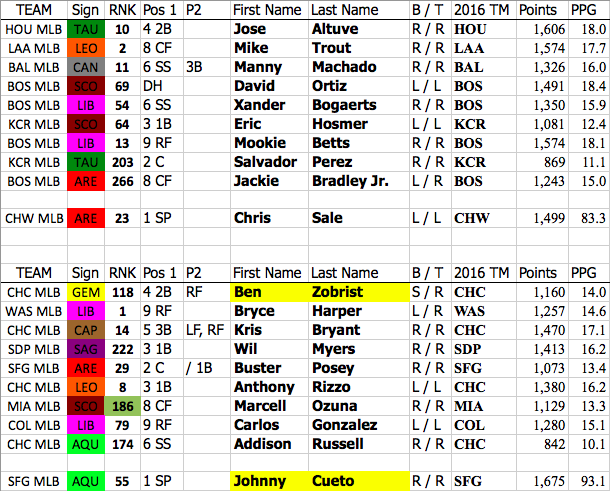
As you can see from the points column, the American League All-Stars had a much more potent offense than their National League counterparts: four (4) AL players had higher fantasy point totals than the NL's highest scorer (Kris Bryant, who was surpassed by Jose Altuve, Mike Trout, Mookie Betts, and David Ortiz). However, you can also see that the NL starting pitcher Johnny Cueto is averaging about 10 points per game higher than the best the AL could offer (Chris Sale, who was the highest scoring pitcher on the AL roster - see below for more details). This is all the more impressive from the pitching side when you consider Cueto wouldn't have come close to starting the game, were it not for injury/timing concerns surrounding Clayton Kershaw, Noah Syndergaard, Steven Strasburg, and Madison Bumgarner.
But in addition to tracking fantasy points and positional eligibility (note that this column does not necessarily follow where each player took the field in the All-Star Game itself), this chart also tracks which Fantasy Astrology team each player belongs to - which is nicely color-coded next to each player's preseason rank from MLB.com's fantasy player rater. As you can see, Libra has the lead among All-Star starters with four representatives, with Aries and Scorpio hot on its heels with three each. I'll keep a running tally of this piece of trivia as we continue into each team's reserves:
Starting with the bottom of the list, I'd like to note something to note right off the bat: Dexter Fowler and Yoenis Cespedes were voted to start by the fans, but did not play due to their injury status. (Just the latter part of that statement is true of Cardinals infielder Matt Carpenter.) In Astrology terms, this would have tied Aries and Libra with four reps apiece, as CarGo and Cespedes cancel each other out, but for the running tally, I'll keep track of everyone, including injury replacements. And after all non-starting position players are accounted for, Aries sneaks into the lead with eight (to Libra's seven, and Scorpio's six). One thing to note is the absence of a Pisces All-Star, despite the fact that the fish-related sign's team won the fantasy astrology championship last year, the first title to not go to Libra since the project's inception four years ago.
One more note about the formatting: you might notice how Matt Wieters is the only non-injured player whose name is not in bold typeface, which indicates that he would not be a current starter at his position on his astrology team (Gemini) - that honor goes to fellow All-Star reserve Jonathan Lucroy. Going back to the top, these players are arranged by their positions in the batting order in which they came into the game, so it's not a representation of numbers. If it were, Josh Donaldson would be at the top, as his point total so far has surpassed all other position players in the sport. In fact, the only players to surpass him are the aforementioned teammates Cueto and Bumgarner, and the hands down best pitcher in the game...
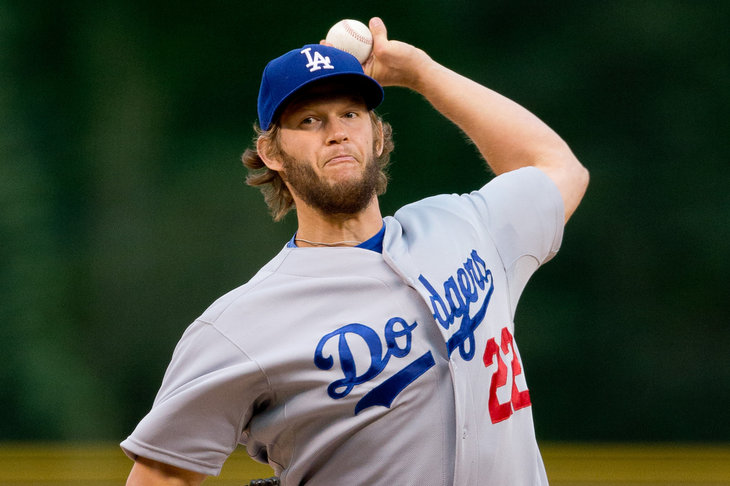
Clayton Kershaw, the only NL All-Star pitcher who is actually on the disabled list during the All-Star Break. As you can see, no one comes close to his 116.9 points per game tally, the only player to surpass 100 PPG so far this year, regardless of sample size. The top group of pitchers for each team are listed in the order in which they entered the All-Star Game, while the second group has a color-coded B/T column to show that they either rode the bench last night (blue) or were injured (red). You can see how the NL had a large advantage in terms of ace-caliber starters, while the AL had a larger component of shut-down relievers - very similar to the breakdown of the actual teams of the two All-Star managers Terry Collins (who leads the Mets and their enviable glut of young arms) and Ned Yost (whose Royals had a historically good bullpen run during their championship season last year).
And the final astrology tally: Aries takes the crown with a whopping 12 players represented in the 2016 All-Star festivities. Capricorn had a surprise surge to second place with 10, while Libra was stuck at nine, just one ahead of its cusp-mate Virgo. I don't know what practical purpose this fantasy astrology analysis could serve, unless it blossoms into some sort of betting community, like Draft Kings for the spiritual community. But until then I'll continue to track it because it's just one column of many on my patented 40-man roster spreadsheet project. Anything to put off writing those last few posts about Batman and putting Arkham Knight behind me forever, right?
As you can see from the points column, the American League All-Stars had a much more potent offense than their National League counterparts: four (4) AL players had higher fantasy point totals than the NL's highest scorer (Kris Bryant, who was surpassed by Jose Altuve, Mike Trout, Mookie Betts, and David Ortiz). However, you can also see that the NL starting pitcher Johnny Cueto is averaging about 10 points per game higher than the best the AL could offer (Chris Sale, who was the highest scoring pitcher on the AL roster - see below for more details). This is all the more impressive from the pitching side when you consider Cueto wouldn't have come close to starting the game, were it not for injury/timing concerns surrounding Clayton Kershaw, Noah Syndergaard, Steven Strasburg, and Madison Bumgarner.
But in addition to tracking fantasy points and positional eligibility (note that this column does not necessarily follow where each player took the field in the All-Star Game itself), this chart also tracks which Fantasy Astrology team each player belongs to - which is nicely color-coded next to each player's preseason rank from MLB.com's fantasy player rater. As you can see, Libra has the lead among All-Star starters with four representatives, with Aries and Scorpio hot on its heels with three each. I'll keep a running tally of this piece of trivia as we continue into each team's reserves:
Starting with the bottom of the list, I'd like to note something to note right off the bat: Dexter Fowler and Yoenis Cespedes were voted to start by the fans, but did not play due to their injury status. (Just the latter part of that statement is true of Cardinals infielder Matt Carpenter.) In Astrology terms, this would have tied Aries and Libra with four reps apiece, as CarGo and Cespedes cancel each other out, but for the running tally, I'll keep track of everyone, including injury replacements. And after all non-starting position players are accounted for, Aries sneaks into the lead with eight (to Libra's seven, and Scorpio's six). One thing to note is the absence of a Pisces All-Star, despite the fact that the fish-related sign's team won the fantasy astrology championship last year, the first title to not go to Libra since the project's inception four years ago.
One more note about the formatting: you might notice how Matt Wieters is the only non-injured player whose name is not in bold typeface, which indicates that he would not be a current starter at his position on his astrology team (Gemini) - that honor goes to fellow All-Star reserve Jonathan Lucroy. Going back to the top, these players are arranged by their positions in the batting order in which they came into the game, so it's not a representation of numbers. If it were, Josh Donaldson would be at the top, as his point total so far has surpassed all other position players in the sport. In fact, the only players to surpass him are the aforementioned teammates Cueto and Bumgarner, and the hands down best pitcher in the game...
Clayton Kershaw, the only NL All-Star pitcher who is actually on the disabled list during the All-Star Break. As you can see, no one comes close to his 116.9 points per game tally, the only player to surpass 100 PPG so far this year, regardless of sample size. The top group of pitchers for each team are listed in the order in which they entered the All-Star Game, while the second group has a color-coded B/T column to show that they either rode the bench last night (blue) or were injured (red). You can see how the NL had a large advantage in terms of ace-caliber starters, while the AL had a larger component of shut-down relievers - very similar to the breakdown of the actual teams of the two All-Star managers Terry Collins (who leads the Mets and their enviable glut of young arms) and Ned Yost (whose Royals had a historically good bullpen run during their championship season last year).
And the final astrology tally: Aries takes the crown with a whopping 12 players represented in the 2016 All-Star festivities. Capricorn had a surprise surge to second place with 10, while Libra was stuck at nine, just one ahead of its cusp-mate Virgo. I don't know what practical purpose this fantasy astrology analysis could serve, unless it blossoms into some sort of betting community, like Draft Kings for the spiritual community. But until then I'll continue to track it because it's just one column of many on my patented 40-man roster spreadsheet project. Anything to put off writing those last few posts about Batman and putting Arkham Knight behind me forever, right?
Monday, May 18, 2015
My All-Star Ballot 2015
MLB.com has been promoting its online All-Star balloting since what seems like the first week of the season, but I've held out on voting until today because it just seems wrong to judge midseason All-Stars with less than 1.5 months of the season gone by. So today I weighed all the pros and cons and fantasy point totals of each candidate and voted the maximum of 35 times (with my primary email address, I may or may not have several more rounds of voting in the tank) for the players I found the most deserving. Here are the graphics provided my MLB upon submitting my ballot:
Tuesday, July 8, 2014
All-Star Game 2014: Depth Chart
I always like having a Cancer birth sign, because I feel like every midsummer I get a special birthday present from MLB in the form of the All-Star Game! Half a season is not a very accurate sample size for judging success, but it's such a darn good MILESTONE for checking in on some of the ever-changing statistics that measure performance. These are the counting stats that - in my estimation - should form the basis for fantasy evaluation. Taking a sounding at the season's traditional halfway point (the All-Star break actually occurs a handful of weeks beyond the season's mathematical halfway point) should give us an idea about which players in the league are excelling or falling below expectations.
The All-Star Game is just one week away, and rosters have been selected by the powers that be, i.e. the fans, the managers of last year's World Series teams, Bud Selig's secret network of spies, etc. I know that contests like the All-Star Game tend to turn into popularity contests, but more often than not, the voters will identify some of the most talented and deserving players in the game. Let's check out a projected depth chart and projected pitching staffs for each league, complete with fantasy stats thru Sunday 7/6, the date the All-Star Rosters were announced.
As you can see, there is a lot of information in these little graphics. Let me point you towards a couple of key areas to make it easier to digest. First of all, looking at pure point totals, the AL comes in first for both categories of player: Mike Trout of the Angels paces all All-Star starting batters pretty comfortably in both PTS and PPG, while Seattle's Felix Hernandez has racked up the most pitching points. The highest points per game honors, however, goes to the NL's likely starter (schedule permitting) Clayton Kershaw, already the author of a no-hitter and the recipient of some pretty high praise from FanGraphs this year. King Felix's ppg average, while impressive, is about on par with both the NL and the AL's second-best pitchers: ERA leader Adam Wainwright and Japanese win-machine Masahiro Tanaka, respectively. Johnny Cueto's new delivery helped him become the NL's highest scoring pitcher, while blast from the past Francisco Rodriguez has the highest point total among relievers.
Comparing the two leagues, we see that the shortstop position has the largest point deficit between position players (at 752, about the value of an All-Star catcher): Troy Tulowitzki might just be the most valuable player in fantasy, given positional scarcity and all, while Derek Jeter was clearly given the nod out of respect for this being his last season rather than any kind of on-field ability. Nothing wrong with that (cf. Cal Ripken Jr. in 2001) as a part of this exhibition game SHOULD be a popularity contest, even if it does count for something. The next biggest deficit comes at 3B (443 between Josh Donaldson and Aramis Ramirez), where both representatives come from the best teams in their respective leagues.
Ramirez will have three teammates joining him in Minnesota from the NL-leading (and neighboring) Milwaukee Brewers: outfielder Carlos Gomez also in the starting lineup, catcher Jonathan Lucroy on the bench (although if we were going by offensive prowess alone, while ignoring defense and notoriety, Lucroy would be the clear starter), and the above-mentioned K-Rod in the bullpen. Donaldson, by contrast, will be playing alongside a whopping FIVE more members of the AL-best Oakland Athletics, which of course, for A's fans, is gonna be a bit cringeworthy, since we'll be watching some of their most important pieces taking the field an extra time. There's plenty that can happen in the next week to change this arrangement, however: 1B/OF Brandon Moss recently injured his ankle and Donaldson was hit by a pitch on the hand last night (although he stayed in the game and drove in a run) and we've already seen two AL players replaced due to injury. But the fact that part-time catcher Derek Norris, reclamation project Scott Kazmir, and first-year closer Sean Doolittle all got honors is a true testament that Boston manager John Farrell really appreciates the team effort that's necessary for the Athletics having such a special season so far. It's a little less surprising that last year's Home Run Derby champion and impressive outfield assist machine Yoenis Cespedes will take part in the festivities, so it also bears less mentioning.
The World Cup will likely still be going on come next Tuesday, July 15th, when these two teams square off at Target Field, the pride of Minneapolis. I will be watching somehow, and I hope that anyone who reads this and also plans to watch will be somewhat enlightened by the information presented herein. And while it might be too much to hope that someone who wasn't planning to watch will change his or her mind based on what I've written here, the dream is always marginally alive. Happy All-Star Week Everyone!
The All-Star Game is just one week away, and rosters have been selected by the powers that be, i.e. the fans, the managers of last year's World Series teams, Bud Selig's secret network of spies, etc. I know that contests like the All-Star Game tend to turn into popularity contests, but more often than not, the voters will identify some of the most talented and deserving players in the game. Let's check out a projected depth chart and projected pitching staffs for each league, complete with fantasy stats thru Sunday 7/6, the date the All-Star Rosters were announced.
Comparing the two leagues, we see that the shortstop position has the largest point deficit between position players (at 752, about the value of an All-Star catcher): Troy Tulowitzki might just be the most valuable player in fantasy, given positional scarcity and all, while Derek Jeter was clearly given the nod out of respect for this being his last season rather than any kind of on-field ability. Nothing wrong with that (cf. Cal Ripken Jr. in 2001) as a part of this exhibition game SHOULD be a popularity contest, even if it does count for something. The next biggest deficit comes at 3B (443 between Josh Donaldson and Aramis Ramirez), where both representatives come from the best teams in their respective leagues.
Ramirez will have three teammates joining him in Minnesota from the NL-leading (and neighboring) Milwaukee Brewers: outfielder Carlos Gomez also in the starting lineup, catcher Jonathan Lucroy on the bench (although if we were going by offensive prowess alone, while ignoring defense and notoriety, Lucroy would be the clear starter), and the above-mentioned K-Rod in the bullpen. Donaldson, by contrast, will be playing alongside a whopping FIVE more members of the AL-best Oakland Athletics, which of course, for A's fans, is gonna be a bit cringeworthy, since we'll be watching some of their most important pieces taking the field an extra time. There's plenty that can happen in the next week to change this arrangement, however: 1B/OF Brandon Moss recently injured his ankle and Donaldson was hit by a pitch on the hand last night (although he stayed in the game and drove in a run) and we've already seen two AL players replaced due to injury. But the fact that part-time catcher Derek Norris, reclamation project Scott Kazmir, and first-year closer Sean Doolittle all got honors is a true testament that Boston manager John Farrell really appreciates the team effort that's necessary for the Athletics having such a special season so far. It's a little less surprising that last year's Home Run Derby champion and impressive outfield assist machine Yoenis Cespedes will take part in the festivities, so it also bears less mentioning.
The World Cup will likely still be going on come next Tuesday, July 15th, when these two teams square off at Target Field, the pride of Minneapolis. I will be watching somehow, and I hope that anyone who reads this and also plans to watch will be somewhat enlightened by the information presented herein. And while it might be too much to hope that someone who wasn't planning to watch will change his or her mind based on what I've written here, the dream is always marginally alive. Happy All-Star Week Everyone!
Sunday, July 14, 2013
Liveblogging: All-Star Futures Game, 7/14/13
I'll only be able to get through the first four innings of this game, because then it will be time to see Guillermo del Toro's sci-fi action epic Pacific Rim! Here are the starting lineups for the two Ryder Cup-esque competing clubs: Team USA and Team World, then I'll say a little bit about some of the notable players on the rosters.
The top story should be the two starting pitchers, Noah Syndergaard from Texas and Rafael Montero from the Dominican Republic. The two of them might someday pitch in the same rotation with Matt Harvey and Zack Wheele, which projects to be an absolute powerhouse in the NL East. But since each pitcher is only scheduled to pitch one inning, the story quickly developed into Red Sox SS prospect Xander Bogaerts, making his second Futures Game appearance, who already has 2 hits and a run, which put Team World on top 2-1. His run chased scheduled 4th inning pitcher Anthony Ranaudo out of the game after just 2 outs (he also gave up a home run to Arismendy Alcantara (another Dominican, but with a seemingly Cuban name). The Red Sox prospect gave way to Phillies prospect Jesse Biddle, who finished the inning just fine.
The next guy coming in to pitch for Team World is one of two Oakland representatives, frequently injured Class A hurler Michael Ynoa. The other representative - USA Class A SS Addison Russell, who struck out in his first at-bat. Meanwhile, Ynoa just gave up a 2-run HR to D-Backs 3B prospect Matt Davidson to put Team USA back in the lead and put them in a better position to go for their 5th straight win in this contest. Not the way you want to see your team contribute to your country's prospect in this exhibition game. Check out MLB.com's Gameday coverage of the rest of the XM All-Stars Futures game from Citi Field in New York!
The top story should be the two starting pitchers, Noah Syndergaard from Texas and Rafael Montero from the Dominican Republic. The two of them might someday pitch in the same rotation with Matt Harvey and Zack Wheele, which projects to be an absolute powerhouse in the NL East. But since each pitcher is only scheduled to pitch one inning, the story quickly developed into Red Sox SS prospect Xander Bogaerts, making his second Futures Game appearance, who already has 2 hits and a run, which put Team World on top 2-1. His run chased scheduled 4th inning pitcher Anthony Ranaudo out of the game after just 2 outs (he also gave up a home run to Arismendy Alcantara (another Dominican, but with a seemingly Cuban name). The Red Sox prospect gave way to Phillies prospect Jesse Biddle, who finished the inning just fine.
The next guy coming in to pitch for Team World is one of two Oakland representatives, frequently injured Class A hurler Michael Ynoa. The other representative - USA Class A SS Addison Russell, who struck out in his first at-bat. Meanwhile, Ynoa just gave up a 2-run HR to D-Backs 3B prospect Matt Davidson to put Team USA back in the lead and put them in a better position to go for their 5th straight win in this contest. Not the way you want to see your team contribute to your country's prospect in this exhibition game. Check out MLB.com's Gameday coverage of the rest of the XM All-Stars Futures game from Citi Field in New York!
Thursday, April 25, 2013
All-Star 2013 Voting
So I signed on with my MLB.com account (which gave me an extra 10 votes, pushing my grand allotted total to 35) and checked out which players grace this year's ballot. To make my decision, I strictly adhered to the fantasy point system I use for all my lists, the player evaluation method that I trust above all others. Looking at just fantasy points is slightly closed minded, but keep in mind, I still have at least three more email addresses to utilize, so my All-Star voting is far from over in 2013. In later passes I will start looking at traditional stats and sabermetrics such as WAR (from Baseball Reference of course, even though most of the baseball blogosphere seems to prefer the Fan Graphs version). But for now, here are the players who got my first 35 votes (points are current as of yesterday, the first day of All-Star voting):
Starting with the player with the highest point total, Justin Upton should be the top vote getter in 2013 just based on his April alone. He leads his league in HR (with a Braves April record 11), SLG, OPS, and total bases, he's a virtual lock for player of the month, and if he maintains even half this pace for the rest of the year (and if the Braves continue to steamroll their opponents) he could have a good case for MVP. Sticking with Upton's position brings us to the next highest-scoring player in all of baseball: Oakland's own Coco Crisp. One of the reasons I like the point system so much is because of its complete objectivity, allowing me to extoll the virtues of a player on my favorite team without the fear of displaying a discernible bias. It's safe to say that Covelli won't hit home runs at his current clip for the whole season (he's on pace to pass 30, just less than double his career high from 2005 with the Indians) but he will continue to get on base and steal bases with great regularity.
Moving onto the rest of the outfield crop (since the All-Star Game does not differentiate between the three positions), the NL looks a lot more impressive than the AL here. Carlos Gonzalez (one of only four players with 20+ points per game as of this writing) is a big part of Colorado's unexpected early success and Bryce Harper was recently nominated as a poster boy for how to play major league baseball. At the time I cast my ballot, Harper and Shin-Soo Choo were tied for total points, but I picked Harper because of his hustle and his higher PPG. But if the NL had a DH slot (like the AL), I would have picked Choo for it, which would be an ideal place for him given his well-documented defensive struggles in center field. A pair of center fielders join Crisp on my AL ballot: Jacoby Ellsbury racked up most of his points with pure speed (10 for 10 in stolen base attempts) and Adam Jones earned his spot with batting average (he co-leads the league with 30 hits), and while it might make more logical sense for the team to have more of a power hitter in one of these spots, the points don't lie. Since All-Star votes are sometimes awarded based on the previous season rather than the current one, I wouldn't be surprised if we saw Mike Trout fill one of these spots.
Speaking of power, Jones's Orioles teammate Chris Davis has had a start for the ages, leading the AL in SLG, OPS, and total bases (sound familiar?), but I'm worried his lack of star power will cause him to be overlooked in favor of a big recognizable name like Prince Fielder. The same is true of Paul Goldschmidt in the NL, except for the part where he leads his league in all those offensive categories. If Goldy were to give way to more of a household name like Joey Votto, I'd be okay with that. Robinson Cano (AL 2B) and David Wright (NL 3B) are tied for points, and they're both tops in their respective leagues at their positions, so there were no issues here. Their interleague counterparts (Brandon Phillips and Miguel Cabrera) also clearly deserve spots on their teams, so this was a no-brainer.
In another instance of the numbers clearly supporting a player on my favorite team, Jed Lowrie's amazing start for the A's (he's the AL's co-leader in hits along with Adam Jones) has clearly earned him a spot on this team. There's no other shortstop in his league that has even approached Lowrie's production, and I really hope he's recognized for his efforts. His NL counterpart Troy Tulowitzki, along with his Rockies teammate CarGo, shows how a couple of megastars firing on all cylinders can propel even a consensus projected last place team to a first place April. John Buck's power surge behind the plate has been nothing short of amazing, especially given that he was considered little more than a placeholder in the R.A. Dickey for Travis d'Arnaud trade between the Mets and the Blue Jays. But if I were a betting man, I'd put my money on Buster Posey for reasons outlined above. Carlos Santana is the second Indian I have on my ballot (I tabbed Mark Reynolds as the DH) if he can stay healthy enough to play - already in this young season, the Dominican star has missed time with a bruised hand and flu-like symptoms.
I encourage everyone to take a look at the players and the stats and throw some votes towards the most deserving players in the MLB. Because not only is home field advantage in the World Series on the line, these votes directly determine who will play in a very fun and exciting exhibition matchup this summer!
Tuesday, July 3, 2012
No, I Don't Want No Snubs
A Snub is a guy who can't get no love from.... the All-Star voting community.
It happens every year, and will continue to happen so long as fans continue to vote for their favorite players to represent their leagues in the midsummer classic. Ever since Connie Mack and John McGraw squared off against each other in the very first All-Star game way back in 1933, I'm sure there were a fair amount of deserving players left off the team and some contributors not quite fit to be called All-Star - although there were probably a lot less of these back then when the roster comprised only 18 players (compared to the modern era's 34) and because the managers selected the entire lineup until 1946 when fan voting was introduced.
Fan voting was actually banned in 1957 following an incident of fans from Cincinnati stuffing the ballot boxes and electing 7 reds to the starting lineup. The fans were once again allowed to decide the starters in 1970, and in the early part of the last decade - in the same rules-change that made the game decide which team got home field advantage in the World Series - the players and coaches were introduced to the process. Their ballots decide the reserves (a mirror of the starting lineup with one player at each position) and the pitching staff (five starters, three relievers). The managers then select their own players (in conjunction with the Commissioner's Office), insuring that at least one player from each team in the league is represented, further diluting the talent pool.
Everybody has their own opinions about who should play in the All-Star game; and apparently Giants, Rangers, and Yankees fans have more opinions than most, as evidenced by three members of each team on the starting squads, the majority of them (roughly 6 of the 9) elected over more qualified candidates. I'm somewhat of a purist, so I try to cast my votes for the most deserving players in the league rather than my favorites. I've given you all a rundown of my decision-making process, but now, thanks to real-time fantasy point calculation courtesy of ESPN.com, I have hard and fast evidence of the true (fantasy) value of the players selected to this year's All-Star teams - evidence which I present to you here:
Starter snubs are the easiest to judge because their picks are the only ones that are a direct result of fan voting. The reserves don't always reflect the players/coaches ballot because if they happen to elect the same player as the fan ballot, the second-place vote-getter is chosen. In my estimation, the most blatant fan snub is NL 3B David Wright - not because he scored the most points of anyone left off the team (OF snubs Carlos Gonzalez and Ryan Braun [who will incidentally start for the injured Matt Kemp] had more) but because the player for whom he was passed over has the least points of any All-Star starter (only Chipper Jones, a last-minute replacement for Kemp, has fewer).
Wright currently is tied for the NL lead in WAR (along with well-deserved All-Star Joey Votto), in addition to serving as a team leader on the surprise-contender Mets. You'd think that such a high-profile player who plays in the country's largest media market would be able to drum up some more support. I can understand a player on a losing team like Carlos Ruiz (who currently leads the NL in batting) not getting too much attention from the fans, but to also be left off the player ballot? I shouldn't complain too much about that, though, because at the time I cast my votes I favored Yadier Molina, if only ever so slightly.
In the AL, Miguel Cabrera is a much more minor snub because Adrian Beltre has actually played a full season and played it quite well. I don't think I can object to Derek Jeter's election, even though Cabrera and Andrus have both played better, because Cap'n Jetes positively oozes star power. The catcher situation mirrors the NL, with the lowest scoring catcher elected by the fans, the middle scorer elected by the players, and the highest scorer selected by the manager.
As far as snubs left off the roster completely, the list has to start with Edwin Encarnacion, whose breakout season as a DH-who-can-field has to be worth more than Adam Dunn's K-filled bounceback season. Hunter Pence has had a better season than Jay Bruce, and Tony La Russa didn't even need to pick him to fill the Reds' quota since Aroldis Chapman was already elected by the players. And in the classic ignorance of defense, Brett Lawrie will not be making an appearance, because 3.4 of his AL-leading 4.8 WAR came with the glove.
For pitcher snubs, the NL is 100% culpable, with such heavy hitters as Madison Bumgarner (seemingly the only Giant left off the All-Star team), Johnny Cueto, Zack Greinke notably absent. Of the unexpected breakout talents, Lance Lynn and Chris Sale (AL) made it, but there's no sign of James McDonald or Chris Capuano, both of whom deserve some recognition for the expectations they've defied. Many of the AL's best pitchers were denied as well, but as one out of five of them have a chance to join the team via the Final Vote stunt, I'll leave them for now.
So when you watch the All-Star game next Tuesday, while you're marveling at the players on the field, remember to keep a spot in your hearts open for those who were deserving but were not so lucky to have their names up in lights this year. Your plight will probably not be remembered... but then again it's all just a big popularity contest.
It happens every year, and will continue to happen so long as fans continue to vote for their favorite players to represent their leagues in the midsummer classic. Ever since Connie Mack and John McGraw squared off against each other in the very first All-Star game way back in 1933, I'm sure there were a fair amount of deserving players left off the team and some contributors not quite fit to be called All-Star - although there were probably a lot less of these back then when the roster comprised only 18 players (compared to the modern era's 34) and because the managers selected the entire lineup until 1946 when fan voting was introduced.
Fan voting was actually banned in 1957 following an incident of fans from Cincinnati stuffing the ballot boxes and electing 7 reds to the starting lineup. The fans were once again allowed to decide the starters in 1970, and in the early part of the last decade - in the same rules-change that made the game decide which team got home field advantage in the World Series - the players and coaches were introduced to the process. Their ballots decide the reserves (a mirror of the starting lineup with one player at each position) and the pitching staff (five starters, three relievers). The managers then select their own players (in conjunction with the Commissioner's Office), insuring that at least one player from each team in the league is represented, further diluting the talent pool.
Everybody has their own opinions about who should play in the All-Star game; and apparently Giants, Rangers, and Yankees fans have more opinions than most, as evidenced by three members of each team on the starting squads, the majority of them (roughly 6 of the 9) elected over more qualified candidates. I'm somewhat of a purist, so I try to cast my votes for the most deserving players in the league rather than my favorites. I've given you all a rundown of my decision-making process, but now, thanks to real-time fantasy point calculation courtesy of ESPN.com, I have hard and fast evidence of the true (fantasy) value of the players selected to this year's All-Star teams - evidence which I present to you here:
Starter snubs are the easiest to judge because their picks are the only ones that are a direct result of fan voting. The reserves don't always reflect the players/coaches ballot because if they happen to elect the same player as the fan ballot, the second-place vote-getter is chosen. In my estimation, the most blatant fan snub is NL 3B David Wright - not because he scored the most points of anyone left off the team (OF snubs Carlos Gonzalez and Ryan Braun [who will incidentally start for the injured Matt Kemp] had more) but because the player for whom he was passed over has the least points of any All-Star starter (only Chipper Jones, a last-minute replacement for Kemp, has fewer).
Wright currently is tied for the NL lead in WAR (along with well-deserved All-Star Joey Votto), in addition to serving as a team leader on the surprise-contender Mets. You'd think that such a high-profile player who plays in the country's largest media market would be able to drum up some more support. I can understand a player on a losing team like Carlos Ruiz (who currently leads the NL in batting) not getting too much attention from the fans, but to also be left off the player ballot? I shouldn't complain too much about that, though, because at the time I cast my votes I favored Yadier Molina, if only ever so slightly.
In the AL, Miguel Cabrera is a much more minor snub because Adrian Beltre has actually played a full season and played it quite well. I don't think I can object to Derek Jeter's election, even though Cabrera and Andrus have both played better, because Cap'n Jetes positively oozes star power. The catcher situation mirrors the NL, with the lowest scoring catcher elected by the fans, the middle scorer elected by the players, and the highest scorer selected by the manager.
As far as snubs left off the roster completely, the list has to start with Edwin Encarnacion, whose breakout season as a DH-who-can-field has to be worth more than Adam Dunn's K-filled bounceback season. Hunter Pence has had a better season than Jay Bruce, and Tony La Russa didn't even need to pick him to fill the Reds' quota since Aroldis Chapman was already elected by the players. And in the classic ignorance of defense, Brett Lawrie will not be making an appearance, because 3.4 of his AL-leading 4.8 WAR came with the glove.
For pitcher snubs, the NL is 100% culpable, with such heavy hitters as Madison Bumgarner (seemingly the only Giant left off the All-Star team), Johnny Cueto, Zack Greinke notably absent. Of the unexpected breakout talents, Lance Lynn and Chris Sale (AL) made it, but there's no sign of James McDonald or Chris Capuano, both of whom deserve some recognition for the expectations they've defied. Many of the AL's best pitchers were denied as well, but as one out of five of them have a chance to join the team via the Final Vote stunt, I'll leave them for now.
So when you watch the All-Star game next Tuesday, while you're marveling at the players on the field, remember to keep a spot in your hearts open for those who were deserving but were not so lucky to have their names up in lights this year. Your plight will probably not be remembered... but then again it's all just a big popularity contest.
Wednesday, June 27, 2012
Thoughts about My All-Star Ballot
FIRST BASE
At the time I took my statistical snapshots (Monday), Prince Fielder had a slight lead in points over Paul Konerko (944 to 938) but trailed his AL Central rival by almost 3/4 of a WAR (1.8 to 1.1). Considering they both have negative defensive WAR, I went with Konerko since he's a more complete hitter. Joey Votto is his league's clear pick for this position as the only first baseman in the NL with more than 2.0 WAR. If Brett Lawrie wasn't so spectacular with his glove, Votto's 4.3 WAR as of this week would lead the majors, but more on that later.
SECOND BASE
I went with Robinson Cano as he leads all AL 2B in both points and WAR (1,058 / 3.1). Jason Kipnis (1,026) and Ian Kinsler (1,022) are both close behind in points, but while Kipnis is keeping pace with 2.7 WAR, Kinsler has racked up only a puzzling 0.7 WAR. The NL was a little harder to crack: Darwin Barney surprisingly leads all NL 2B with 3.3 WAR, but most of those come from defense, and I'm of the opinion that an All-Star starter should be able to hit. Brandon Phillips, Dan Uggla, and Jose Altuve all have that ability, but I went with the diminutive Astros sophomore (who leads the pack with 887 points, but trails with 1.7 WAR) because I like the idea of someone marginally shorter and stockier than me becoming a star in the big leagues.
SHORTSTOP
Defensive shortstops lead the pack in WAR - Brendan Ryan, Mike Aviles, and Yunel Escobar all have racked up over 2.0 largely with their gloves - along with Asdrubal Cabrera (sharing the lead with 2.4) who alone shows above average talent with the bat. Elvis Andrus leads the pack in points (920 to Cabrera's 830), but I valued Cabrera's power over Andrus's speed - plus there are too many Rangers on the leaderboard already. In the NL Starlin Castro seems the obvious choice - his 897 points and 2.8 WAR both lead the league. Rafael Furcal may have deserved my vote in late May, but he's contributed just a little over half the wins of the Cubs sophomore.
THIRD BASE
If I asked you who was leading the majors as of the start of this week with 4.5 WAR, I'll bet precious few could've named Brett Lawrie without looking it up. Granted, most of those are due to his superb defense (he already has 31 defensive runs saved above average!) and I think Miguel Cabrera's 1,011 points, plus the successful move from 1B constitute more All-Star-worthy accomplishments. David Wright is dominating the competition in the NL with 1,131 points and 4.0 WAR and I will say no more on the matter.
CATCHER
I don't care that Mike Napoli is on my fantasy team, Matt Wieters has been the superior catcher this year. Despite the fact that the Oriole leads the Ranger by about 50 points, Naps has played more than a quarter of his games at 1B this year - and while the added positional eligibility is a plus, I think it takes away from his standing as a pure backstop. Carlos Ruiz (829 / 3.3) and Yadier Molina (892 / 2.7) were neck and neck in my estimation, so I flipped a coin and gave my vote to the incumbent... although on closer inspection, Chooch probably was the more worthy candidate... but a quick look at the leaderboard shows that neither of them will probably start the game.
DESIGNATED HITTER
Edwin Encarnacion has been a great story this year and has somehow amassed more WAR (2.4) than his competition (and vote leader) David Ortiz (1.8). But looking at the numbers shows Big Papi has had a more impressive offensive season, and that's what the DH spot is all about.
OUTFIELD
Josh Hamilton (1,262 / 3.1) deserves a spot on the AL team, but I didn't feel like I needed to pour more votes into his pocket when he's approaching the all-time record for most All-Star votes already. Mike Trout (988 / 3.7) likely deserves a spot, but I can't bring myself to vote for an Angel. And I would have voted for Jose Bautista (1,147 / 2.4) since he was my first round pick for my fantasy team this year. But instead, I decided to vote on only 2 AL OF spots to try to raise the vote totals of a couple of my favorite underrated outfielders: Josh Reddick (who is 5th among all AL players in WAR (3.0), 3rd among AL outfielders behind Trout and Hamilton) and Adam Jones (who is 3rd among AL outfielders in points (1,110), behind Hamilton and Bautista).
Ryan Braun (1,253 / 3.4) deserves a spot on the NL team, but I can't bring myself to vote for a loophole-rider. (Take a page from Manny's book and serve your suspension like a man, even if it ruins what's left of your career.) I gave my votes to Michael Bourn, who trails Braun by 0.1 WAR (also due to fantasy team solidarity), and Carlos Gonzalez, who trails Braun by 1 point. Melky Cabrera, Andrew McCutchen, and Carlos Beltran all had legitimate claims to my 3rd vote, but I like Beltran's comeback story and the fact that he leads the other three in points.
UPDATE: Looking at the vote totals so close to the end of the polling period, it's a little depressing how unlikely it is that any of my marginal picks have any kind of shot at making the Starting 9. On the one hand, I like to gather the largest sample size possible before casting the majority of my votes, but it's also an exercise in futility to wait so long because most of the races are already decided. Not campaigning for whichever players I thought deserved spots would drum up the necessary support, no matter when I started doing my research. I guess the hope is that enough like-minded people to myself are also mobilizing concurrently. Which is also the hope in any voting process, political or otherwise.
Thursday, July 14, 2011
The All-Star Game!
Remember when the All-Star game happened two days ago? Well, I wrote something about it yesterday! Here's a link to Charge-Shot!!!, a blog that holds a very special place in my heart... specifically a place that occurs on Wednesday afternoons...
All-Star Tuesday: One Year Later
Monday, July 11, 2011
Liveblogging the 2011 State Farm Home Run Derby!
11:08pm EST
And will you look at that!? Cano has come back, not only to tie Gonzalez, but to beat him with two outs to spare! Just when I was beginning to lose interest. Just when I thought it was not about the competition. Just when I thought the rest of the broadcast would be comprised of the first-timer going through the motions and flaming out after an impressive two rounds, he comes back with a flair for the dramatic and wins it all, proving that the Derby can be exciting and unbelievable and fun for the whole family.
We've had a lot of fun here tonight, but what we should take away from all this is that it's never too late for a feat of sheer will to help you overcome nearly insurmountable odds. And that you should never give up, no matter how stacked the circumstances are against you. And that it's not over until it's over.
I hope you've all had fun reading my real-time thoughts about the amazing piece of history we just saw occur. And since I've still got an hour before my flight starts boarding, I've got nothing left to do but recount it in my head over and over....
10:51pm EST
Fielder's long road to 15 he needs to keep his league alive in this competition is off to a slow start. I think we can call this one right now for the American League, both in terms of cumulative totals (53-19) and in that the eventual winner will come from the AL. The NL may have won its first All-Star game in a long time last year, but they will have to wait until next year to seek triumph in the Derby.
So it comes down to this, a battle between AL contestants, between AL East players, between representatives from perhaps the most storied rivalry in the sport right now, the Yankees and the Red Sox. Each has exactly the same home run total coming in (not that it matters). Each has exactly the same on the line.
It's looking a little one-sided now, as Gonzalez continues his hot streak and gives Cano an equally astronomical mark to reach as he puts up a 13-spot on the board in the finals. Pretty straightforward now as Cano is finished unless he can perform exactly as he did in the second round. No flameouts allowed, or the Yankee's night is finished!
10:28pm EST
It's always around this time in the Home Run Derby that my interest starts to fade. I've seen all the contestants take their swings. This cumulative second round is really just an extension of the first round, which we've already seen happen. The competition aspect is a little muted, unless Prince Fielder can follow up his awesome swing-off performance (5 HRs in 5 swings!) with an even more impressive second round - the lone NL representative will need another 5 just to put him ahead of the leader's first round performance, and that's assuming Gonzalez goes homerless in his next 10 outs.
Meanwhile Ortiz added 4 to his total, pulling him even with Gonzalez, so that all his teammate needs to surpass the team captain is one more. Cano continues to mash, all but assuring him a spot in the final two. (Although he'd better pull back if he wants to have anything left in the tank for the non-cumulative final round.) Thus unless Fielder goes on a spree of 10+ homers in a row, he's pretty much out for the count. Is it me, or does making the first and second rounds cumulative put way too much emphasis on the first round? I guess the competition part is less important than just seeing all those power hitters up there doing their things.
Wow, Cano just blasted his 11th in the second round, to go with his 8 in the first round. I predict a flameout, just like what happened to Jason Giambi in the fated 2001 contest when he lost to Luis Gonzalez after setting a first-round record. To return to the present, Adrian Gonzalez just eliminated his teammate and captain with a single home run, but keeps on blasting more and more, tying Cano with 20 total homers. (At least now each contestant has an equal chance of flameout.) Fielder, the NL team captain now needs to belt at least 15 bombs in this second round to remain in contention. At least he's going last to maintain the drama. Although it's looking more and more like the blowout we knew it would be in the first round....
9:47pm EST
The two batters last to hit are the "Team Captains" of the AL and NL squads. I'm watching this from an airport bar, sitting too far away to read any of the closed captions of the commentary, so I'm not exactly sure how this works. In the rules, it says the top home run totals advance to the next rounds, so what should it matter what team they're on or who their captain is? But I guess leadership counts for something, as David Ortiz and Prince Fielder get last ups.
I remember when "Big Papi" went through a scare a couple of years ago, where commentators and fans pronounced him gone from the ranks of serious home run threats. But although he'll likely never again approach the 50-homer totals he's amassed in seasons past, he's still showing some pop out here in the desert.
Prince Fielder is an appropriate contestant to be up right now, especially considering all the hype surrounding the new Moneyball movie coming out. (No, I haven't seen the trailers, and no, I don't plan to, despite my fascination with both the Oakland A's and the entertainment industry; Spoiler Free is the Way to Be.) Some of you might recall that back in 2002, the A's draft team was terrified that the Brewers, who picked before the A's, would deprive them of their prize, outfielder Nick Swisher. How happy they were when supposedly sentimental reasons (Fielder's father, Cecil, played for the Brewers in the past) led to Prince's selection, leaving Swisher for the A's. And it's a good thing Beane didn't pick Fielder when he had the chance - when your team is second-to-last in the league with a .337 Slugging Percentage, who needs an offensive force with 50-homer potential?
Well, it's settled! Or is it? A-Gon and Robbie Cano are definitely advancing, but then we have three guys tied with five home runs apiece all vying for the last two spots. It looks like we're going into a 5-swing tie-breaking swing-off for each three. Since the totals from the first two rounds are cumulative, these tie-breaker round homers don't count towards that total. It's nice that there's still a chance for equal participation from AL and NL... although the advantage clearly goes to the two AL-guys with high totals.
The final tally (swing-off totals in parenthesis, advancing players highlighted):
9:19pm EST
Jose Bautista: where did this guy come from, am I right? Someone without any real history of smacking a lot of home runs last year suddenly discovers some amazing power and leads the league getting a chance to start in Toronto. Now he's on pace to do something that has been done only eight (8) times in Major League history: finish the year with more than 60 home runs. He's not going to set any Derby records with just four homers, but I'd rather have someone who can hit them in games than hit them in exhibitions any day.
I've got to say, I'm not too excited by Matt Kemp's chances to put up a lot of dingers here in Arizona. He is famous for smacking hitting his homers to straightaway center field, and this park has a gigantic wall up there, plus it is extra deep. I hope he doesn't try to change his approach to pull or push too much, because it's that straight-out power that helps him succeed in the 395-foot-to-CF Dodger Stadium. And sure enough, he didn't get one out of there until his final outs, with most of his hardest hits landing for flyouts to straightaway center. I've got to say, I'm not very optimistic about the National League's chances so far...
AL: 21
Gonzalez: 9
Cano: 8
Bautista: 4
NL: 10
Holliday: 5
Weeks: 3
Kemp: 2
8:59pm EST
Wow, Cano's off to a hot start. Three bombs in his first four swings. If only he hit enough dingers during the season to crack the top ten in homers in the AL, it might justify his presence a little more? Maybe it has something to do with his position - he and Rickie Weeks are both second basemen, not a position historically noted for home run power. And yet there's his teammate, Curtis Granderson (second in the league in HR) providing Cano with a rosin bag and pumping up the crowd rather than taking cuts at the plate. Puzzling...
Cano does have some kind of sweet swing, though, doesn't he? Which brings me to another concern that potential #HRDerby contestants seemingly should have: the effect that taking so many "fake" swings has on one's regular-season swing. Maybe it's some weird confirmation bias, but it seems to me that in the past, players who have performed well in the Home Run Derby suddenly experience a drop in power production immediately following the exhibition. Perhaps Rickie Weeks is aware of that possibility and is using his bright-blue neon shoes as a superstitious way to combat this real or imagined trend.
I don't know if anyone has conducted any kind of study on this, but Weeks seems to be most likely to suffer a post-derby power outage than the rest of these contestants. He only last year developed his power stroke, and who knows how all this emphasis on his big flies will affect his approach at the plate in the future. Perhaps his poor showing in this year's Derby (only 3 home runs) will cause him to second-guess his swing and start making adjustments. I wish him continued success - if only for the sake of his younger brother, who has just taken the first steps on what promises to be a long and fruitful career with the Oakland A's - but don't care too much about the rest of 2011, seeing as he's not on my fantasy team.
AL: 17
Gonzalez: 9
Cano: 8
NL: 8
Holliday: 5
Weeks: 3
8:41pm, EST
Looking at the list of players appearing in the 2011 State Farm Home Run Derby in Phoenix tonight, I can't help but cock my head to the side in slight confusion at how they select the participants. I get that there are four representatives from the AL and four from the NL, but shouldn't it be the top Home Run hitters from each league? You'd think so, but then why is Adrian Gonzalez (tied for 10th in the AL) stepping in to lead off for this squad?
And I know Matt Holliday did a good job of picking up his team when Phat Albert was down with that wrist injury, but when his another one of his teammates (Lance Berkman) is surprisingly leading the National League in Home Runs, don't you think he deserves to be up there swinging the bat, rather than commenting from the sidelines? As much fun as it is to see the hulking, bald-headed, cornfed Sooner swing the bat, dude's not even in the top ten in the league.
I have to plead ignorance here; do the powers that be on the Home Run Derby committee go down the line of the players with the highest HR totals in each league until they get four that say yes? Or is there some algorithm they make use of to determine the best contestants - one that takes into account home run totals from the current year, the previous year, while also weighing in some special "showmanship quotient" to make sure the broadcast is entertaining?
Maybe Berkman was approached for this honor and declined. His amazing first-half comeback makes for a great story, but maybe he doesn't want to jinx it by putting himself in this kind of spotlight. Maybe at age 35 and with a troubling injury history he's worried he might tweak something over the course of several dozen exhibition swings. Or maybe he wasn't even asked, for some undisclosed reason. Even after thinking about all these questions during the first commercial break, I haven't been able to figure it out. Respond with thoughts in the comments section, or Tweet them at me why not at @Hunter_S_Batman
AL - Adrian Gonzalez: 9
NL - Matt Holliday: 5
And will you look at that!? Cano has come back, not only to tie Gonzalez, but to beat him with two outs to spare! Just when I was beginning to lose interest. Just when I thought it was not about the competition. Just when I thought the rest of the broadcast would be comprised of the first-timer going through the motions and flaming out after an impressive two rounds, he comes back with a flair for the dramatic and wins it all, proving that the Derby can be exciting and unbelievable and fun for the whole family.
We've had a lot of fun here tonight, but what we should take away from all this is that it's never too late for a feat of sheer will to help you overcome nearly insurmountable odds. And that you should never give up, no matter how stacked the circumstances are against you. And that it's not over until it's over.
I hope you've all had fun reading my real-time thoughts about the amazing piece of history we just saw occur. And since I've still got an hour before my flight starts boarding, I've got nothing left to do but recount it in my head over and over....
10:51pm EST
Fielder's long road to 15 he needs to keep his league alive in this competition is off to a slow start. I think we can call this one right now for the American League, both in terms of cumulative totals (53-19) and in that the eventual winner will come from the AL. The NL may have won its first All-Star game in a long time last year, but they will have to wait until next year to seek triumph in the Derby.
So it comes down to this, a battle between AL contestants, between AL East players, between representatives from perhaps the most storied rivalry in the sport right now, the Yankees and the Red Sox. Each has exactly the same home run total coming in (not that it matters). Each has exactly the same on the line.
It's looking a little one-sided now, as Gonzalez continues his hot streak and gives Cano an equally astronomical mark to reach as he puts up a 13-spot on the board in the finals. Pretty straightforward now as Cano is finished unless he can perform exactly as he did in the second round. No flameouts allowed, or the Yankee's night is finished!
10:28pm EST
It's always around this time in the Home Run Derby that my interest starts to fade. I've seen all the contestants take their swings. This cumulative second round is really just an extension of the first round, which we've already seen happen. The competition aspect is a little muted, unless Prince Fielder can follow up his awesome swing-off performance (5 HRs in 5 swings!) with an even more impressive second round - the lone NL representative will need another 5 just to put him ahead of the leader's first round performance, and that's assuming Gonzalez goes homerless in his next 10 outs.
Meanwhile Ortiz added 4 to his total, pulling him even with Gonzalez, so that all his teammate needs to surpass the team captain is one more. Cano continues to mash, all but assuring him a spot in the final two. (Although he'd better pull back if he wants to have anything left in the tank for the non-cumulative final round.) Thus unless Fielder goes on a spree of 10+ homers in a row, he's pretty much out for the count. Is it me, or does making the first and second rounds cumulative put way too much emphasis on the first round? I guess the competition part is less important than just seeing all those power hitters up there doing their things.
Wow, Cano just blasted his 11th in the second round, to go with his 8 in the first round. I predict a flameout, just like what happened to Jason Giambi in the fated 2001 contest when he lost to Luis Gonzalez after setting a first-round record. To return to the present, Adrian Gonzalez just eliminated his teammate and captain with a single home run, but keeps on blasting more and more, tying Cano with 20 total homers. (At least now each contestant has an equal chance of flameout.) Fielder, the NL team captain now needs to belt at least 15 bombs in this second round to remain in contention. At least he's going last to maintain the drama. Although it's looking more and more like the blowout we knew it would be in the first round....
9:47pm EST
The two batters last to hit are the "Team Captains" of the AL and NL squads. I'm watching this from an airport bar, sitting too far away to read any of the closed captions of the commentary, so I'm not exactly sure how this works. In the rules, it says the top home run totals advance to the next rounds, so what should it matter what team they're on or who their captain is? But I guess leadership counts for something, as David Ortiz and Prince Fielder get last ups.
I remember when "Big Papi" went through a scare a couple of years ago, where commentators and fans pronounced him gone from the ranks of serious home run threats. But although he'll likely never again approach the 50-homer totals he's amassed in seasons past, he's still showing some pop out here in the desert.
Prince Fielder is an appropriate contestant to be up right now, especially considering all the hype surrounding the new Moneyball movie coming out. (No, I haven't seen the trailers, and no, I don't plan to, despite my fascination with both the Oakland A's and the entertainment industry; Spoiler Free is the Way to Be.) Some of you might recall that back in 2002, the A's draft team was terrified that the Brewers, who picked before the A's, would deprive them of their prize, outfielder Nick Swisher. How happy they were when supposedly sentimental reasons (Fielder's father, Cecil, played for the Brewers in the past) led to Prince's selection, leaving Swisher for the A's. And it's a good thing Beane didn't pick Fielder when he had the chance - when your team is second-to-last in the league with a .337 Slugging Percentage, who needs an offensive force with 50-homer potential?
Well, it's settled! Or is it? A-Gon and Robbie Cano are definitely advancing, but then we have three guys tied with five home runs apiece all vying for the last two spots. It looks like we're going into a 5-swing tie-breaking swing-off for each three. Since the totals from the first two rounds are cumulative, these tie-breaker round homers don't count towards that total. It's nice that there's still a chance for equal participation from AL and NL... although the advantage clearly goes to the two AL-guys with high totals.
The final tally (swing-off totals in parenthesis, advancing players highlighted):
AL: 26
Gonzalez: 9
Cano: 8
Bautista: 4
Ortiz: 5 (+4)
NL: 15
Holliday: 5 (+2)
Weeks: 3
Kemp: 2
Fielder: 5 (+5!)
9:19pm EST
Jose Bautista: where did this guy come from, am I right? Someone without any real history of smacking a lot of home runs last year suddenly discovers some amazing power and leads the league getting a chance to start in Toronto. Now he's on pace to do something that has been done only eight (8) times in Major League history: finish the year with more than 60 home runs. He's not going to set any Derby records with just four homers, but I'd rather have someone who can hit them in games than hit them in exhibitions any day.
I've got to say, I'm not too excited by Matt Kemp's chances to put up a lot of dingers here in Arizona. He is famous for smacking hitting his homers to straightaway center field, and this park has a gigantic wall up there, plus it is extra deep. I hope he doesn't try to change his approach to pull or push too much, because it's that straight-out power that helps him succeed in the 395-foot-to-CF Dodger Stadium. And sure enough, he didn't get one out of there until his final outs, with most of his hardest hits landing for flyouts to straightaway center. I've got to say, I'm not very optimistic about the National League's chances so far...
AL: 21
Gonzalez: 9
Cano: 8
Bautista: 4
NL: 10
Holliday: 5
Weeks: 3
Kemp: 2
8:59pm EST
Wow, Cano's off to a hot start. Three bombs in his first four swings. If only he hit enough dingers during the season to crack the top ten in homers in the AL, it might justify his presence a little more? Maybe it has something to do with his position - he and Rickie Weeks are both second basemen, not a position historically noted for home run power. And yet there's his teammate, Curtis Granderson (second in the league in HR) providing Cano with a rosin bag and pumping up the crowd rather than taking cuts at the plate. Puzzling...
Cano does have some kind of sweet swing, though, doesn't he? Which brings me to another concern that potential #HRDerby contestants seemingly should have: the effect that taking so many "fake" swings has on one's regular-season swing. Maybe it's some weird confirmation bias, but it seems to me that in the past, players who have performed well in the Home Run Derby suddenly experience a drop in power production immediately following the exhibition. Perhaps Rickie Weeks is aware of that possibility and is using his bright-blue neon shoes as a superstitious way to combat this real or imagined trend.
I don't know if anyone has conducted any kind of study on this, but Weeks seems to be most likely to suffer a post-derby power outage than the rest of these contestants. He only last year developed his power stroke, and who knows how all this emphasis on his big flies will affect his approach at the plate in the future. Perhaps his poor showing in this year's Derby (only 3 home runs) will cause him to second-guess his swing and start making adjustments. I wish him continued success - if only for the sake of his younger brother, who has just taken the first steps on what promises to be a long and fruitful career with the Oakland A's - but don't care too much about the rest of 2011, seeing as he's not on my fantasy team.
AL: 17
Gonzalez: 9
Cano: 8
NL: 8
Holliday: 5
Weeks: 3
8:41pm, EST
Looking at the list of players appearing in the 2011 State Farm Home Run Derby in Phoenix tonight, I can't help but cock my head to the side in slight confusion at how they select the participants. I get that there are four representatives from the AL and four from the NL, but shouldn't it be the top Home Run hitters from each league? You'd think so, but then why is Adrian Gonzalez (tied for 10th in the AL) stepping in to lead off for this squad?
And I know Matt Holliday did a good job of picking up his team when Phat Albert was down with that wrist injury, but when his another one of his teammates (Lance Berkman) is surprisingly leading the National League in Home Runs, don't you think he deserves to be up there swinging the bat, rather than commenting from the sidelines? As much fun as it is to see the hulking, bald-headed, cornfed Sooner swing the bat, dude's not even in the top ten in the league.
I have to plead ignorance here; do the powers that be on the Home Run Derby committee go down the line of the players with the highest HR totals in each league until they get four that say yes? Or is there some algorithm they make use of to determine the best contestants - one that takes into account home run totals from the current year, the previous year, while also weighing in some special "showmanship quotient" to make sure the broadcast is entertaining?
Maybe Berkman was approached for this honor and declined. His amazing first-half comeback makes for a great story, but maybe he doesn't want to jinx it by putting himself in this kind of spotlight. Maybe at age 35 and with a troubling injury history he's worried he might tweak something over the course of several dozen exhibition swings. Or maybe he wasn't even asked, for some undisclosed reason. Even after thinking about all these questions during the first commercial break, I haven't been able to figure it out. Respond with thoughts in the comments section, or Tweet them at me why not at @Hunter_S_Batman
AL - Adrian Gonzalez: 9
NL - Matt Holliday: 5
Subscribe to:
Posts (Atom)