Showing posts with label MLB 2012. Show all posts

Thursday, December 6, 2012

NL Central Divisional All-Stars 2012

Now for the final division before we get into the Wild Cards. This is the division that brought you the MLB's two worst teams in 2012, but also the NL's highest overall point scorer. Let's see if this team displays the same level of disconnect. I bring you:

NL CENTRAL DIVISIONAL ALL-STARS


The aforementioned NL high-scorer is the only player to appear on all four of my Divisional All-Star lists is the steroid-popping, guilt-sidestepping, former MVP and 2012 league leader in runs scored, HR, and OPS, Brewers slugging LF Ryan Braun. Now, Aramis Ramirez is no slouch - he led the league with 50 doubles and had an OPS over .900 while hitting behind Braun in the regular season, plus he earned the NL Central starting 3B job last year too while with the Cubs - it's just that he doesn't strike the same kind of fear into opposing pitchers that Prince Fielder did when he hit clean-up for Milwaukee in the recent past. It's interesting though that with Fielder and Albert Pujols signing huge contracts to move to the AL and with Joey Votto injured, a Brewer still ended up as the starting 1B on this team: Corey Hart turned in a fine season after shifting from RF (where he repped Milwaukee on the 2010 AL Central team). Andrew McCutchen continued his steady rise to superstardom with a trifecta of accolades: a Gold Glove, a Silver Slugger, and his second consecutive All-Star berth - he even came in third in MVP voting, despite his Pirates' inability to log their first winning season in a decade. Starlin Castro, like McCutchen, has appeared on this team for the past three years, was named to his second All-Star team in 2012, and played for a losing team.

Two pairs of teammates from one of the league's biggest rivalries (and with 11 Divisional All-Star appearances between them) round out this squad: Yadier Molina had by far his best season ever, earning his fifth consecutive Gold Glove, his fourth consecutive All-Star appearance, and surpassing his previous career-high in OPS by 60 points. Matt Holliday obviously played second-fiddle to Braun, but makes it in as the DH. It's interesting to note that Holliday's first appearance in this feature in 2009 was for the AL West, as he spent the majority of his season in Oakland. Brandon Phillips reprises his leadoff role for this squad from last year despite nearly 200 fewer points. Jay Bruce is the only one from this paragraph with less than three appearances, and last year's was as the Wild Card's DH - hey, can you blame him for playing a deep position in a tough division?

Top free agent starter Zack Greinke's inclusion in this division (he had a 123 to 89 IP split between the Brewers and the Angels after a mid-season trade) makes this team one of only two clubs to feature four 2,000+ point-scorers in the rotation. (The other, as you'd know if you were paying attention last week, was the AL East.) But at the top of the rotation, we once again see the Reds/Cardinals rivalry manifesting itself. Leading the pack is my fantasy team's ace Johnny Cueto - whose pick in the 14th round ALMOST made up for Cliff Lee's no-win-itis. Another free agent (and, in my opinion, a huge candidate to see a drop-off in production) Kyle Lohse (of the ridiculous 18-3, .847 winning percentage) was not far behind. A couple newcomers to the division round out the rotation: Mat Latos overcame a slow start after coming from the Padres in a big trade to contribute to Cincinnati's dominant pitching attack, and A.J. Burnett returned to form upon leaving the Yankees and became the Pirates' unlikely ace.

The three Reds in this group proves that Cincinnati's pitching attack came at both ends of the game. Aroldis Chapman had one of the most dominant seasons out of the bullpen ever - his last for the foreseeable future, since he is likely to move to the rotation next year. Lefty Sean Marshall is the only reliever to have appeared on a previous Divisional All-Star team, and he's appeared on all of them - the last two years as a setup man and the year before that as a swingman for the Cubs. Mitchell Boggs will likely continue setting up closer runner-up Jason Motte in St. Louis and Jose Arredondo used to pitch for the Angels, but as for the other two, I couldn't have named them prior to (heck, even halfway through) this season. Brad Lincoln still qualifies for the NL Central despite having been shipped to Toronto for a former #6 ranked prospect by Baseball America - which seems kind of unbalanced (even if the ranking was from three years ago), but I guess when you need bullpen help, you need it bad and quick.


This concludes the six Divisional All-Star squads corresponding to MLB's six divisions. Before coming back with the Wild Card teams, I've got a little project that I've been waiting to unveil, which will likely take precedence over the weekend. Until then, keep watching that Hot Stove to make sure your pots and pans full of rumors don't boil over!

Tuesday, December 4, 2012

AL East Divisional All-Stars 2012

The polar opposite of yesterday's team in terms of division and league (but not talent level), I now bring you the:

AL EAST DIVISIONAL ALL-STARS


This lineup consists of three Yankee infielders who each have appeared on three out of the last four Divisional All-Star teams. Two of them will likely not return next year. Let's see if you can guess who. 38-year-old Derek Jeter showed no signs of slowing down last year, leading the league in plate appearances and hits, and winning his fifth Silver Slugger award... until he broke his ankle during the post-season, putting his opening day status in doubt. 29-year-old Robinson Cano is not so arguably the top 2B in the game, he reached the 30 HR plateau for the first time this year en route to his fourth Silver Slugger and second Gold Glove. 36-year-old Alex Rodriguez hasn't played 140 games in five years, he's only on this list because his injury-riddled 2012 season was less catastrophic than Evan Longoria's injury-riddled 2012 season, and he's about to miss the first half of 2013 with hip surgery. There might have been a fourth Yankee on this list: IF I had chosen to use only the points players scored in their respective division, THEN Mark Teixeira's 1,576 points would have ruled the day. But I chose to include the full season of now four-time Divisional All-Star Adrian Gonzalez - he moved back to his old division mid-2012 in the most epic waiver-wire blockbuster trade in history.


Blue Jays DH Edwin Encarnacion edged Cano by a mere 12 points to be the team's highest offensive scorer. Think of what Toronto's offense could have looked like if Jose Bautista's injuries hadn't made a mockery of my #1 pick in this year's fantasy draft. Taking his place in RF is the ever-versatile Ben Zobrist who this year added his original position (SS) back to his usual 2B-RF repertoire. His teammate Desmond Jennings becomes perhaps the least-qualified Divisional All-Star, but I just couldn't bring myself to move Curtis Granderson over to a position where he didn't play a single inning in 2012. He missed out in CF to the Orioles' $85 million dollar man Adam Jones who, along with Matt Wieters, looks to lead a competitive birds team for the rest of the decade.

Any starting rotation led by the Cy Young award winner is sure to be exciting, even though Justin Verlander had a slightly more impressive fantasy season. The fact that all five of these pitchers come from only two teams makes it somewhat less exciting, although David Price's fellow Ray James Shields could very well find himself changing uniforms before the off-season is over. The combination of Sabathia, Kuroda, and Hughes (who each tallied at least 15 wins for the Yankees last year) will be back together next year, although the star of New York's 2013 rotation just might be 41-year-old Andy Pettitte, whose 2.87 ERA in 12 games after his 17th comeback from retirement prompted him to re-up with the club that made him a star.

Where the rotation was comprised solely of Rays and Yankees, the bullpen has only Rays and Orioles. Comeback player of the year Fernando Rodney turned in the best year out of any reliever in 2012 - an ERA under 1.00 will best even a 105 mph fastball from a tumbling Cuban superstar. Relief stalwart Darren O'Day makes his third appearance after showing up two years in a row with Texas, but no other pitcher in this group has made a Divisional All-Star team before. The Rays have such a glut at starting pitching that they were able to let Wade Davis try his hand at relieving, which worked out quite well. Jake McGee fills that ever-important lefty role in the first season he's spent entirely in the majors. Carlos Villanueva reprises his role as swingman - a role I clearly don't count as part of the bullpen proper, since he pitched for the Blue Jays and showed up on this team last year.

Monday, December 3, 2012

NL West Divisional All-Stars 2012

With the Winter Meetings in full swing, some big changes to the Free Agency landscape have already occurred, some of them affecting this very team! With that in mind, let's change leagues but stay in the same geographical location as last time, to give you the division that brought you this year's World Series Champions:

NL WEST DIVISIONAL ALL-STARS


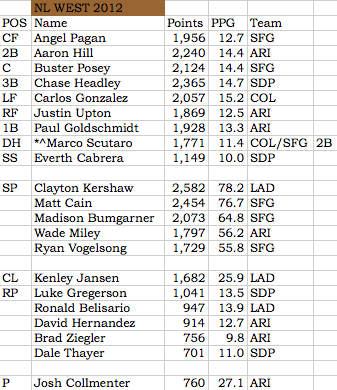
The World Champion San Francisco Giants are well-represented in all parts of the lineup: Angel Pagan, the erstwhile free agent who just re-upped with his former team in one of the above-mentioned transactions, leads off as he did for the 2010 NL Wild Card team while representing the Mets. Buster Posey bats third after winning the NL MVP, Silver Slugger, and batting title in a crucial year following a brutal leg injury. And Marco Scutaro serves as the team's DH after being both traded and acquired by teams in the NL West. (Usually when a good player changes team's midseason, I have to choose one division, based on where he played more or scored more fantasy points, whichever is more advantageous. It's a slightly questionable practice, but luckily in this situation there was no choice to be made.) The team's highest offensive scorer, breakout 3B Chase Headley, earned some hardware of his own (a Silver Slugger and Gold Glove) while becoming the first Padre to start on the NL West team since Adrian Gonzalez left the division after the 2010 season. Also from San Diego is surprise SS Everth Cabrera, whose league-leading 44 SB allowed him to fill in for injured Troy Tulowitzki, who had been the NL Wests's starting SS for all three years of this feature.

Colorado has another NL West stalwart in Carlos Gonzalez, who has reached the 20-20 plateau in each of the last three seasons, although he hasn't come close to his ridiculous unreal 2009 in which he hit 37 HR and won the batting title, Silver Slugger, and Gold Glove awards. He actually picked up another GG this season... despite the fact that he cost his team nearly two whole wins with his defensive ineptitude (-1.9 dWAR, 9 Zone Fielding Runs BELOW Average in 2012). The remaining three spots are filled by Diamondbacks (no Dodgers in this lineup - that should change next year with (hopefully) full seasons from Matt Kemp, Adrian Gonzalez, and Hanley Ramirez). Aaron Hill showed that he can once again have a flukily-amazing season at 2B as he did for Toronto in 2009. Justin Upton maintains his spot in RF despite a drop of nearly 500 points from his output last year. And Paul Goldschmidt had his moment in the sun as the second-highest-scoring 1B in the entire NL (behind the NL East's Adam LaRoche).

Moving to the defensive side, Matt Cain is the only pitcher to have appeared in the NL West's starting rotation all four years of this feature. However, he's never been more deserving than in 2012, where he reached career highs in W's and K's, and career (full season) lows in ERA and BB's, not to mention his historic perfect game. His lefty compliment Clayton Kershaw didn't equal his astounding 3,000-point Cy Young-award winning performance from last year, but he was still the top fantasy LHP in the game, leading the league in ERA and WHIP. Madison Bumgarner and Ryan Vogelsong are two Giants starters who jumped to the divisional rotation from the Wild Card rotation last year, while Rookie of the Year runner-up Wade Miley of the Diamondbacks makes his first appearance in his first full season.

After sporting five different 2,000+ point closers in the last three years (Jonathan Broxton, Heath Bell (once for the division and once for the Wild Card), J.J. Putz, and Brian Wilson (WC)), the 2012 NL West suffered from inconsistency at the back end of their bullpen with Kenley Jansen leading the pack - despite the fact that he didn't take over from Javy Guerra until the end of April and gave way to Brandon League in the middle of August. Luke Gregerson once again turned in a stellar setup season, as he also did two of the previous three years. David Hernandez also has two previous appearances - one last year as an NL West setup man and one in 2010 as an AL East swingman. Brad Ziegler and Ronald Belisario make their first appearances since 2009, with Ziegler making his first divisional appearance (he last represented Oakland on the AL Wild Card team). One weakness in this bullpen is the lack of a lefty reliever - Dale Thayer unfortunately earned the last spot due to his inflated stats from his short time as the Padres fill-in closer (which corresponded to the time he spent on my fantasy team). If I was really building this lineup, I'd switch him with COL LHP Rex Brothers. Josh Collmenter became a part-time starter after finishing 5th in ROY voting last year, and looks to remain there with top prospects Patrick Corbin and Tyler Skaggs waiting in the wings.

Friday, November 30, 2012

AL West Divisional All-Stars 2012

It's Friday, a new Undercover Boss airs this evening on CBS (if you liked Stephen Cloobeck from the Season 3 premiere, be sure to tune in), and I deserve to write about the division that houses my favorite team. So let's move out west but stay in the same league for today's installment of the 2012 Divisional All-Stars. Here's the lineup and analysis:

AL WEST DIVISIONAL ALL-STARS


As has been the case for the last couple of years, the offense on this squad is very Texas-heavy. We all know how well Josh Hamilton was doing before his famous caffeine overdose slowed the former MVP's production. What we DON'T know is what team will be willing to shell out for his services next year and beyond. Adrian Beltre, an All-Star with both his bat (5.5 oWAR) and his glove (1.4 dWAR), successfully defends his starting 3B crown from last year. Recent astrological research shows that Ian Kinsler, who had been incorrectly languishing on the Gemini team, actually belongs to Cancer, my own sign's team. That little gaffe on my part very well might have cost us the fantasy-astrology championship. Mike Napoli was named to his first actual All-Star team this year, the fifth in a row in which he reached 20 home runs - pretty impressive for a catcher.

The Angels are represented with two of the highest-profile players in the league. Last off-season, Albert Pujols went through the same free agent rigamarole Josh Hamilton is currently going through, although Mike Trout's Rookie of the Year presence in the Angels outfield will likely prevent his going to the same team where Phat Albert ended up. The A's also have two players on this team, but despite Josh Reddick winning a gold glove, Yoenis Cespedes finishing second in ROY voting, and each picking up some MVP votes, the players repping the Green & Gold flew much lower under the radar than their counterparts. You'll notice also that I was a little liberal with assigning positions, considering Hamilton played mostly in CF and Cespedes played in LF. However, both players spent enough time at their secondary positions to qualify in fantasy, and it wasn't worth relegating Hamilton to the Wild Card team in favor of Michael Young's 1,457 points at DH.

It took us the entire offense, but we finally have a Mariner on this list: in the year of his perfect game, King Felix Hernandez headlines this staff as he did in 2009 and '10. Last year he finished behind the trio of Jered Weaver, Dan Haren, and C.J. Wilson, of which only the first pitcher returns this year, after leading the league in wins and WHIP. First-time All-Star Matt Harrison makes the divisional team for the first time as a starter: in 2010 he made the squad as a swingman, and in 2011 he started for the Wild Card team. Yu Darvish also makes his first appearance, which is appropriate since it's his first year since coming to the majors from Japan. Jason Vargas has come into his own as a solid middle-of-the-rotation starter just in time for his last year of arbitration eligibility.

Joe Nathan hasn't been a star reliever since he dominated the AL Central with Minnesota in 2009, but a weak closer class this year gives him the crown once again at age 37. My close personal friend Jerry Blevins (he signed my book of stats during Spring Training 2011) and rookie Robbie Ross hold it down from the left side, while it's interesting that the three righty relievers in this bullpen have all spent time as starters earlier in their careers. Depending on what happens with free agents Zack Greinke and Dan Haren, Angels swingman Jerome Williams might find himself with an opportunity to start full time.

Thursday, November 29, 2012

AL Central Divisional All-Stars

In the past, I have always ordered this feature by league and geographically by division, but this year I thought I'd mix it up and jump around a bit. So without further ado, here's the 2012 version of the...

AL CENTRAL DIVISIONAL ALL-STARS


Three key positions from the AL Champion Detroit Tigers remain intact in this lineup - I guess you don't get to the World Series with schlubs in the 1, 3, and 4 spots in the order. Austin Jackson makes his first appearance in this feature in his third full season with an OPS more than 100 points above his previous career high. Miguel Cabrera and Prince Fielder on the other hand have never missed an appearance: Miggy was the AL Central's starting 1B the last 3 years running and the change back to his original position only seemed to increase his production, what with his MVP/Triple Crown performance. Fielder has bounced around a little: he started at 1B for the NL Central last year (ahead of both Joey Votto and Albert Pujols), was relegated to the Wild Card team in 2010 (behind Votto and Pujols), and earned a spot as the NL Central's DH in 2009 (behind Pujols, but ahead of Votto and the surprisingly resurgent Derrek Lee).

Sandwiched between those Tigers is one of two Twins to merit inclusion on this list (surprising based on how dismal their season was). While Joe Mauer will likely never approach his legendary 2009 that led to a record contract, but his high batting average and plate discipline still make him one of the top catchers in the game. Speaking of impossible-to-live-up-to contracts, Alex Rios has had two out of three good seasons since leaving the team that signed him and going to Chicago, even garnering some MVP votes in 2012 for the first time in his career. Back to the Twins, left fielder Josh Willingham returns from last year where he DH'd for the AL West team representing the A's. As Willingham's 2011 placement indicates, I tend to play fast and loose with the DH position even in the AL, since many teams are using it not as a full-time spot, but as a way to rest their veterans on a regular basis. But the Royals' regular DH Billy Butler happened to be the best candidate to fill that position on this team. Jason Kipnis just missed rookie eligibility (not that it would have mattered with the likes of Mike Trout in the equation), but he could develop the power/speed abilities worth building a team around.

Except for 2009 when he played second-fiddle to Zack Greinke's unbelievable season, Justin Verlander has been the ace of the AL Central staff every year since I started this feature, and deservedly so. Chris Sale graduated from Divisional All-Star setup man to Divisional All-Star SP2, and his teammate Jake Peavy makes his first appearance on this list in his first injury-free season since before he joined the White Sox in '09. Scherzer and Fister are repeats (Scherzer is in fact a three-peat), although Fister's place on the '11 list is somewhat controversial: he pitched more innings for Seattle, which would place him in the AL West, but he scored more points for Detroit. I'm usually very scientific about these things, but sometimes the heart has to triumph over the head.

Talk about the volatility of Major League relief pitchers - exactly ONE member of this bullpen showed up on any other divisional All-Star team since 2009: Vinnie Pestano of the Indians. His teammate gained the closer role with a mediocre season after Jose Valverde (famously perfect in save situations in '11) flamed out and lost his job in the playoffs. Anthony Swarzak on the Twins can't seem to hold on to a starter spot, which makes it questionable why he needs to be included here, but I'm a sucker for a swingman.

With this new system I have in place, who can tell which team will show up here tomorrow? The only way to find out is to tune in!

Wednesday, November 28, 2012

NL East Divisional All-Stars 2012

Since I'm taking a more casual, relaxed approach to my quest towards 100% completion of LEGO: The Lord of the Rings, it's going to be a while until I have anything of note to report on that front. Let's just say at this point I'm focusing my efforts on unlocking the score multipliers so I'll be able to purchase all the interesting characters at a much faster rate. The one time I strayed from this plan was to purchase the "8-bit music" upgrade, which, to my complete and utter disappointment, WASN'T an 8-bit rendition of Howard Shore's music that we love so well, but a dull, boring, generic background tune - at least for the overworld. I haven't tried it out in-level yet, so I may yet be pleasantly surprised.

My next project - a video Power Hour based on Batman: The Animated Series - is nearing completion, so expect a detailed analysis of that as soon as it's ready to hit the presses (by which I mean probably YouTube). So until then, let me return to a best-loved feature of mine, one that was not published last year due to my unhealthy yet creatively productive obsession with Batman: Arkham City - Major League Baseball Divisional All-Stars! To recap: these are lineups consisting of the best players at each position in each division (East, West, Central, and one Wild Card - screw the new two-team setup). I'll provide the lineup (arranged according to my projected batting order) and then provide some analysis, including mentioning runners-up when applicable. Hope you enjoy the first of eight painstakingly researched lineups!

NL EAST DIVISIONAL ALL-STARS


Jose Reyes may have played for a different team than in 2011, but he stayed in the same division, which allowed him to repeat as starting SS and leadoff hitter for the NL East squad. He hit 50 points lower than his league-leading .337 average last year, but not for lack of trying: his 716 plate appearances were the most of anyone in the league. The NL East is known for producing a glut of star shortstops, and 2012 was no exception: Jimmy Rollins was not only the 2nd-highest scoring SS, but he was also the team's 9th-highest scorer overall, allowing him to claim a spot on this lineup as the DH - which is ironic because J-Roll won a Gold Glove in 2012. I chose to bat him 6th (or "second leadoff") rather than 2nd despite his point advantage over Michael Bourn because, as an NL team, this squad won't have Rollins available to start every day and I didn't want to gum up the chemistry in such a crucial spot in the order. Plus, as table-setters go, Bourn is probably the better fit with a 30 point advantage in OBP.

I wanted the heart of the order to alternate handedness of the batters, so I sandwiched David Wright (who had a nice comeback after injuries kept the 2010 starting 3B off the list in 2011) between two power lefties making their first Divisional All-Star appearances: Jason Heyward (who flashed 20/20 power/speed after suffering through a sophomore slump last year) and Adam LaRoche (who took advantage of an injury to NL East 1B stalwart Ryan Howard to post Silver Slugger numbers). Carlos Ruiz's rise to prominence as an elite backstop perfectly coincides with runner-up Brian McCann's slide into mediocrity: the Braves' hometown hero missed inclusion this year for the first time since I started blogging this feature in 2009. In a similar vein, slugging 2B Dan Uggla (who had held the spot two years running, first with the Marlins, then with the Braves) fell to Danny Espinosa by the margin of one point.

Perhaps the most shocking development in this year's NL East pitching staff is the absence of 3-time ace Roy Halladay (twice for the NL East, once for the AL East). In his place is surprise Cy Young winner R.A. Dickey. The ulnar collateral ligament-less knuckleballer, ranked 303 by MLB prior to the season, ended up leading the league in innings, strikeouts, complete games, and shutouts. He's followed by a trio of lefties: Cole Hamels (who was supposed to be the Phillies' SP3, but was forced to take on the role of ace), Gio Gonzalez (who led the league in wins), and Cliff Lee (who couldn't buy a win with his $21.5mm 2012 salary, despite a league-best 7.39 K/BB ratio). I'm pleased to announce that Stephen Strasburg will make an appearance on this team, despite being shut down in the most controversial personnel decision of the year.

Craig Kimbrel was once again the closer to beat in the NL, pushing the division's newest bullpen addition (Jonathan Papelbon, 1,966 points) to the curb. Just when we had gotten used to seeing Tyler Clippard in the setup role, an injury to Drew Storen made him the de facto closer, but fortunately his replacement Craig Stammen did quite well. Despite Frank Francisco's 5.50+ ERA, the Mets never committed to making Bobby Parnell the full-time closer. This team has the luxury of having both a long lefty (Gorzelanny) and a situational lefty (O'Flaherty), which should make playing matchups that much easier. Kris Medlen was one of the best starters down the stretch after being a very effective reliever the rest of the season, so the swingman role is a perfect place to put him.

Wednesday, October 24, 2012

Fantasy Points = Real Life Wins /boggle

Hey everybody, the World Series starts today! The San Francisco Giants are coming off the momentum of having completed their postseason's second improbable three-game winning streak in the face of elimination while the Detroit Tigers have enjoyed six full days of inactivity while they waited for their Fall Classic opponent to be decided. I wonder who has the momentum going into this one? But Game 1 starter Barry Zito has his work cut out for him, since there's one very important game-changer that the Giants don't have: Justin Verlander.


But enough about what's happening in the actual world of baseball, let's talk more about the fantasy point system I've been using to evaluate players all season. It is indeed the same system I've been using for the last decade, but has now become infinitely easier to calculate thanks to ESPN's fully-customizable fantasy baseball program. I've mentioned those guys so many times that they should seriously be sponsoring this site by now... maybe my chances would be better if I used their standard scoring instead of my own system. But this is what I'm used to, and furthermore, I'm setting out to prove that the aggregate point totals of all the players on a team pretty accurately reflects that team's wins. First, here's how the point system shakes out:


I know baseball is a game of 3's, but this fantasy point system is essentially based on 5's. Batters get 5 points each for runs scored and driven in. Then we move to the basic building blocks of run production: Total Bases. Each one is worth 5 points: 5 for a single, 10 for a double, 15 for a triple, 20 for a home run. The progression makes sense - the more bases you reach per hit, not only do you put yourself in a better position to score, but the more potential runs you stand to drive in. Scoring position also plays a part in why steals are worth so many points - if you successfully steal a base, you at least put yourself in scoring position, whereas if you are caught, you erase yourself as a baserunner in a nonessential play. You lose a point every time you have a hitless at-bat, with an extra point lost for a strikeout (because in that situation you can't even advance the runner). A walk is worth three-fifths of a base hit, which is somewhat of a compromise, considering it puts you on base, but gives you very little chance of driving in a run in turn.

I'll be the first to admit that win-loss percentage is overvalued in this system, but in fantasy you want to make sure you're drafting the top pitchers on each team, which in terms of starters, are generally the ones in the position to rack up the most wins. The measure of the top relievers on each team is generally saves, hence the big point value there. Hey, I'm not saying it's a perfect system. Keeping with the motif of 5, each pitcher gains 5 points for each out pitched (which works out to 15 per inning) but loses 5 points for each baserunner allowed (via either a hit or walk). In another three-fifths compromise, a strikeout gains a pitcher an extra 3 points, which essentially makes each batter struck out worth 8 total points. Each run allowed costs a pitcher 10, because allowing runs is how a pitcher loses games after all.

Normally this point system is used to evaluate players personally, but for this experiment, I ran the combined stats of each team through the program to see how total points scored (both batting and pitching combined) corresponds with how many games that team won. However, I didn't use the exact same formula when calculating the team statistics - or, rather, I did and then I quickly realized where I went wrong and made some adjustments. The first adjustment was for batters: sure runs are important (scoring them is, after all, how you win games), but that's no reason to count them twice - i.e. for both runs scored and runs driven in. And while I don't think it's fair to exclude unearned runs as if they don't count, I removed RBI from the scoring. For pitchers, it doesn't make sense to include in the scoring system the very statistic you're trying to test for, so I removed wins and losses. There is also no reason a team should be rewarded for winning a close game, so saves had to go as well. This next chart contains the new points for each team in terms of both batting (BPts) and pitching (PPts). The most important column for our purposes are the last two: total points (TPts) and points divided by total team wins (TPts/W). Check out the results:


Lots of numbers, I know, but here's an overview of the important stuff we learned to look for in math class:

  • BPts range from 13,787 (NYY) to 9,668 (HOU) with an average of 11,692. This number speaks volumes about the Yankees' offense, as their park ranked just 17th in terms of ESPN's park factors. The median is 11,803 (the average between KCR and TOR) - just slightly higher than the mean.
  • PPts range from 12,354 (TBR) to 5,507 (COL) - a much larger spread. I guess the effects of the humidor in Denver are finally wearing off as we're starting to return to the batting/pitching discrepancies of the pre-2002 days. The average team scored 9,424 PPts, with the median at 9,657 (between PIT and CHW).
  • TPts range from 24,105 (WAS) to 17,153 (HOU). Notice, much to my delight, that the highest point total corresponds to the team with the most wins and vice versa for the team with the fewest wins. In the old system (including all the stats) the Astros were still on the bottom, but the Yankees had the top spot. These two teams also occupy the top and bottom spots respectively in terms of points per game. The average is 21,116 and the median is 21,583 (ARI and LAD).

Now for the new and exciting category: TPts/W, which shows how many points each team scores per win. The first thing we notice is that the team with the fewest wins (55) has the most TPts/W (HOU with 311.873). However, BAL has the fewest TPts/W with 229.204 and they managed 6 fewer wins than the top squad (WAS with 98). This anomaly kind of makes sense, considering this was a team that was not expected to play well. Plus, they vastly outperformed their run differential - based on their runs scored vs. runs allowed, they should have managed only 82 wins. It might be the case that fantasy points have a better correlation with a team's expected performance than their actual performance, but that's a question for a different day.

Not that there isn't a decisive pattern emerging already as it stands: teams with the six lowest TPts/W all won at least 90 games, while the teams with the six highest TPts/W all won fewer than 70 games. It seems that teams that win more games use their points more efficiently in that it takes fewer of them to get a W. However, there's a lot more work to be done: the average of all 30 teams is 263.117 TPts/W, and the 3 teams closest to that figure won 88 (STL, 261.136), 73 (TOR, 265.110), and 90 (TBR, 265.378) games, respectively. So there's clearly not a precise correlation. However, that analysis will have to wait, as we've just had a sighting of the Justin Verlander we've come to expect in the playoffs in San Francisco. Let's watch some World Series!

Friday, October 12, 2012

The Number One Seeds: Analysis

Well, the bad news is that one quarter of the teams that made it to the big final year-end tournament have been eliminated, among them my first and third priorities of teams I'd like to have seen win the World Series. The good news however, is that all four division series made it Game 5, providing fans with a full 20 out of 20 potential first-round games! If anyone knows somebody who works at the Elias Sports Bureau, go ahead and ask them when the last time was that this happened.

As it turns out, the top seeded teams in each league (the ones with the distinct pleasure of facing the winners of the first inaugural Wild Card Games) are now on the brink of elimination, just like everybody else. I won't go into detail on their respective opponents, because I've already done write-ups on the Wild Card teams, but here's an in-depth look into the playoff lineups of the teams who led their leagues in wins this year:


The Nationals won the most regular season games of any team (just edging out the freshly-eliminated Reds by one), but 15 of those wins came behind the arm of Stephen Strasburg (1,861 points / 66.5 ppg) who will not appear in Washington's playoff run due to a controversial decision by GM Mike Rizzo. No one can know if Strasburg would have gotten shelled any less than Jordan Zimmermann or Edwin Jackson (his technical replacement, Ross Detwiler, actually pitched quite well facing elimination) had he taken the hill in his playoff debut, but unless the Nats can continue their run into October, the decision to sit the organization's best pitcher for the city's first playoff berth in 79 years will surely haunt the franchise for many years to come.

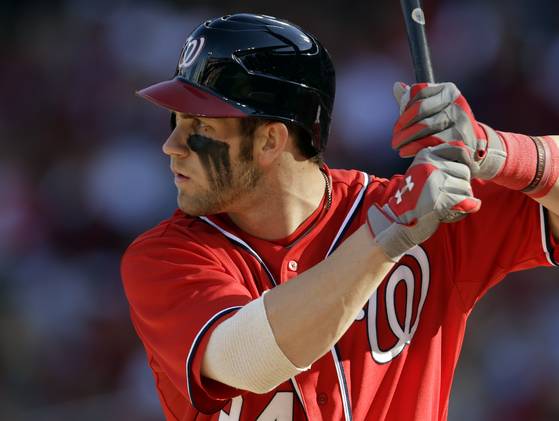
3B stalwart Ryan Zimmerman played well despite battling injuries - a theme the Nats will have to get used to for the next 7 years, since he doesn't become a free agent until 2019. But the real stories this year revolve around the impressive debut of Bryce Harper (if you don't count his performance in the playoffs) and the breakout success of Ian Desmond (my pick of him in the 20th round really solidified my fantasy team). Jayson Werth missed a lot of time with a broken wrist, but he really took ownership of that leadoff role upon his return, from which spot in the lineup he hit the key walk-off HR that forced today's Game 5.

A couple of ex-Athletics form the battery of today's game: Gio Gonzalez was sent over in the offseason trade that netted the A's both SP Tommy Milone and C Derek Norris (along with SP Brad Peacock, but we don't like to talk about his 2012 season in AAA). The remaining guaranteed year+OPT on Kurt Suzuki's 3*-yr extension he signed with the A's prior to 2011 was transferred to the Nationals in a waiver-wire deal in early August. The Nats' bullpen got a late boost with the return of closer Drew Storen from the devastating elbow injury that forced him to the 60-day DL.


The Yankees will have to play a day game following a (late, due to 13-innings) night game this afternoon to decide who advances to the ALCS. That news does not bode well for the aging squad, who were already feeling sore and banged-up to begin with. Case in point: manager Joe Girardi wasn't able to get his best offensive players on the field the last two games because he had to use the DH slot to rest first A-Rod and then Jeter. At least he found a spot for Game 3 hero Raul Ibanez in today's lineup - even if it's at the expense of quarter-of-a-million dollar man Alex Rodriguez (which means that the Yanks will start another ex-Athletic at 3B: none other than Eric "Chokey" Chavez!).

Andy Pettitte pitching for New York in 1997 (L) and 2012 (R)
As further proof that the Yankees are stuck in 1997, just look at their Game 2 starter: 40-year-old Andy Pettitte, who the Yanks lured out of "retirement" for the second time this year. I like Pettitte as a pitcher, but I can't say I approve of the Yankees' relationship with him, treating what should be his retirement years as if he's in their own personal farm system. But if the man wants to play, let him play, I guess. I think Hiroki Kuroda is a more effective pitcher at this point in his career, and we'll see what happens to both of them when they hit free agency after this season.

The Bronx Bombers also failed to get younger when they traded for Ichiro Suzuki in a deadline deal. The 38-year-old outfielder can still swing the bat (he hit .322 in 67 games since heading east) and plays a better defensive LF than Brett Gardner's last fill-in (Ibanez). Robinson Cano put up another offensive season for the ages while Curtis Granderson quietly surpassed 40 HR for the second straight year and CC Sabathia led the pitching staff as only a 6'7" 290lb giant of a lefty can. Rafael Soriano didn't miss a beat taking over the closer role after Mariano Rivera went down with a freak batting practice injury. I hope the Yankees re-sign him next year (is there really any doubt?) because he deserves a better end to his career than a torn ACL sustained while shagging fly balls.


So those are the top seeded teams in the game right now, each playing to stay alive in games today. I'm glad I was able to pull myself out of an A's-loss-related funk long enough to get these out while both these teams are still in contention. Before I sink back in, I have two grievances with the Athletics' performance in the ALDS to get off my chest.

1) Where in the name of all that is holy were Jonny Gomes and Chris Carter?
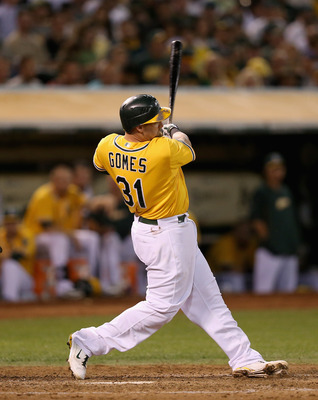
These two power righties hit 32 home runs between them and spent significant time at the No. 2, No. 4 (Gomes) and No. 5 (Carter) spots in the batting order, all high profile offensive positions, and yet only one of them got as much as a single plate appearance in the division series - during the 8th inning of the Game 5 blowout. I know their platoon splits dictate that they should play primarily against lefty pitchers, but the A's faced Phil Coke three times in close/late situations, and yet the only pinch hitter Bob Melvin could muster was... his backup catcher. Carter is under team control for at least another 5 years, but Gomes - who was a huge part of the A's' magical season, providing excellent energy and always being the first out of the dugout after a walk-off win (unless he was responsible for the win himself) - becomes a free agent after the World Series. I would love to see him return, but if it were me, I don't know if I'd want to re-sign with an organization that showed me absolutely no love when the games mattered most.

2) How come no yellow jerseys?
When the A's clinched the AL West title against the Rangers last week, they were wearing their sweet alternate throwback yellow jerseys that they unveiled last year, and yet they didn't show up for even one game in the ALDS. HOW'S A TEAM SUPPOSED TO FIND SOME LUCK IN BORING HOME WHITES!?!?

That is all. Now I can finally put this disappointing finish to the season behind me. Who's ready for Free Agent season!?!?

Monday, October 8, 2012

NLDS CIN vs. SFG Analysis

Woah there, Cincinnati, slow down! We don't want TWO out of the four division serieses to be over before they started. The Reds have taken the first two from the 2010 World Series champion Giants; and just when I was about to voice my outrage at the new format that puts the BETTER-seeded team on the road for the pivotal first two games of a best of five series - a format that put the A's at a HUGE disadvantage this weekend (in hindsight they might have been better off pulling an "Olympic Badminton" and throwing one of those last three games against Texas, taking their chances with Baltimore in the Wild Card round, knowing that they'd get to start the next series with the Yankees at home... but I digress). Playing in the Bay Area didn't bother the Reds, who are traveling home today in a great position.


C: Ryan Hanigan vs. Buster Posey
Hanigan, who profiles more as a backup than a starter, was supposed to give way to Devin Mesoraco, Baseball America's #16 ranked prospect. But the catcher of the future only managed 54 games so the Reds had to make do. Posey meanwhile could be heading for an NL MVP award to put on the mantle next to his ROY from two years ago. His amazing season, in which he won the batting title* and led the league in OPS+, is even more impressive since it came on the heels of a brutal career-threatening leg injury sustained in a home plate collision.
ADVANTAGE: GIANTS

1B: Joey Votto vs. Brandon Belt
Votto is one of the most fearsome hitters in the game right now, and he's been rewarded for his greatness with a couple of contract extensions that run through 2024. He didn't put up fearsome power totals this year, as he missed a bunch of time getting arthroscopic surgery to repair a torn meniscus in his knee (although he still managed to lead the league in BB and OBP), but he's back at full strength and ready to contribute in the playoffs. Belt can... play left field in a pinch? That's all I've got.
ADVANTAGE: REDS

2B: Brandon Phillips vs. Marco Scutaro
Phillips is another Red to get a long-term extension, so the right side of Cincinnati's infield is set for at least another six years. Scutaro actually produced similar value in terms of fantasy points in his season he split with the Rockies and Giants, but he did it with base hits and plate discipline as opposed to power and speed. "Dat Dude" has the talent set more suited to change the outcome of a game.
ADVANTAGE: REDS

3B: Scott Rolen vs. Pablo Sandoval
I haven't been following the Reds very closely this season, but one of the few stories I did catch wind of was Todd Frazier's emergence as a solid rookie 3B. Why then did he give way to oft-injured veteran Scott Rolen for the playoffs? The world may never know. In the meantime, Sandoval has had his share of injuries himself in what is becoming an unpleasant trend for the Kung Fu Panda. When healthy though, I'd rather have his bat in the lineup.
ADVANTAGE: GIANTS

SS: Zack Cozart vs. Brandon Crawford
Crawford is your stereotypical one dimensional all-field-no-hit player, while the rookie Cozart is a much rarer two dimensional all-field-some-power player. According to Baseball Reference, both players contributed 2.0 dWAR (with the glove) and 0.9 oWAR (with the bat) despite the fact that Cozart out-homered Crawford 15 to 4. Neither player excels at getting on base (.304 OBP for Crawford, .288 for Cozart) and they both strike out far too much (Cozart K'd 113 times, Crawford 95), but you all know how chicks dig the long ball.
ADVANTAGE: REDS

LF: Ryan Ludwick vs. Gregor Blanco
Remember when Ludwick had that breakout 2008 season with 37 long balls and a .966 OPS? Well this year he put up his highest totals in those categories since then (26 and .877 respectively). He's even been batting cleanup in front of All-Star Jay Bruce. Blanco was a non-roster invitee who's only playing this position because his teammate (and the guy who actually led the NL in AVG) made some poor career choices and got himself suspended.
ADVANTAGE: REDS

Jay Bruce Jay Bruce #32 of the Cincinnati Reds hits a two run double scoring Joey Votto #19 and Chris Heisey #28  in the eighth inning of Game Two of the National League Division Series against the San Francisco Giants at AT&T Park on October 7, 2012 in San Francisco, California.CF: Drew Stubbs vs. Angel Pagan
Despite 14 HR and 30 SB, Stubbs had an incredibly disappointing season, embodied by a .277 OBP. Pagan has provided an invaluable spark at the top of the order after coming over from the Mets in an offseason trade. Despite getting on base .061 points more effectively than Stubbs, Pagan actually stole one fewer base... but that's only because he finished his at-bat on third base a league-leading 15 times.
ADVANTAGE: GIANTS

RF: Jay Bruce vs. Hunter Pence
Pence was involved in his second high-profile trade deadline deal in as many years. But unlike last year when he carried the Phillies on his back to the tune of a .324 AVG, .954 OPS, and 2.2 WAR, this year he rode the Giants' coattails into the playoffs with a .219 AVG, .671 OPS, and 0.1 WAR. Bruce on the other hand has developed into the middle of the order pure power threat we expected, with his second straight season of 30+ HR, but an AVG in the .250s. He'll be a part of this Reds team almost as long as Phillips and Votto.
ADVANTAGE: REDS

SP1: Johnny Cueto vs. Matt Cain
How about Johnny Cueto finally coming into his own for a full season this year: 19 wins (3 more than Cain), 2.78 ERA (.01 lower than Cain), and a league-leading 33 starts. I certainly appreciated his performance after drafting him to my fantasy team in the 14th round. But Cueto threw only 8 pitches before being forced to exit game 1 with back spasms. His uncertainty for the rest of the series coupled with the magic of Cain's perfect game this year settles the score for this matchup.
ADVANTAGE: GIANTS

SP2: Bronson Arroyo vs. Madison Bumgarner
cain NLDS Preview: SF Giants With Advantage Over RedsThe game in which these two faced off against each other already happened, but if I were doing projections, I would never have expected 7 shutout innings from Arroyo against 4.1 innings with 4 ER for Bumgarner. Overall though Maddy is a more talented pitcher with a significantly higher upside.
ADVANTAGE: GIANTS

SP3: Homer Bailey vs. Ryan Vogelsong
The penultimate start of the best season of Bailey's career was a no-hitter, the seventh of the year. Vogelsong has done his best to prove that his comeback last season after four years out of the majors was no fluke. At 26 years old I think Bailey has more potential than the 34-year-old Vogelsong, but for one game I don't think the difference is too great.
ADVANTAGE: PUSH

SP4: Mat Latos vs. Tim Lincecum/Barry Zito
Game 4 starters haven't been announced yet, so we don't know if Latos will return on 3 days rest after coming to Cueto's rescue with 4 IP of relief in game 1. Likewise we don't know if Bruce Bochy will trot out the veteran Zito or pull two-time Cy Young winner Lincecum out of the bullpen, where he was relegated after an uncharacteristically pedestrian season. Whoever his opponent is, Latos's bounceback after a disastrous April (right after I dropped him from my fantasy roster) gives him the clear upper hand.
ADVANTAGE: REDS

RP: Aroldis Chapman vs. Sergio Romo
We've all heard the stories about the 105 mph fastballs, the somersaults off the mound, the time off in September due to shoulder fatigue, but one thing is for sure: Aroldis Chapman is one of the most dominant left-handed relievers to play the game of baseball ever. Romo might have similarly impressive facial hair, but Brian Wilson he ain't - and even if The Beard weren't injured, there's no way he'd compete with the Cuban Missile.
ADVANTAGE: REDS


As with the A's-Tigers series, this one is all but in the books. It's nearly impossible to come back from such a deficit, even heading into home-field advantage. But I wouldn't count out even these Lincecum-less Giants until the last pitch. Because as a baseball great once said, "It ain't over 'til it's over."

Sunday, October 7, 2012

ALDS OAK vs. DET Analysis

Well, the Oakland Athletics' tremendous unexpected season is now on the verge of coming to an end. Even going back home, it's nearly impossible to come back from a two-game deficit and win three in a row, especially knowing that Justin "I bribe every home plate umpire in the league" Verlander is gonna pitch in the last game. Might as well see how these two ALDS teams stack up, because I might not get another chance to...


If you compare the overall total points scored of these two teams, things look a little bleak for the A's. But then when you see that the A's won six more games in a much more competitive decision, and you see that there's more magic at work here than the numbers can express. Let's see how that magic descends position by position.

C: Derek Norris vs. Alex Avila
Avila was an All-Star last year, but his OPS is down .159 points and his HR totals have dropped by more than half. But I'd still take him over a rookie who barely cracked the Mendoza line this season.
ADVANTAGE: TIGERS

1B: Brandon Moss vs. Prince Fielder
Brandon Moss - Texas Rangers v Oakland Athletics
Moss has been one of the great feel-good stories of the year, finally making some noise in the majors after being a well-regarded prospect since 2005. Three teams and an open batting stance later, he is a big reason why the A's led the majors in home runs after the All-Star break. But it's hard to top Fielder (below) who's cleared 30 HR in six straight seasons and who just signed for $214mm over nine years, regardless of how loose-fitting his jersey is.
ADVANTAGE: TIGERS

2B: Cliff Pennington vs. Omar Infante
Infante was originally developed by the Tigers, but found his way back into the fold after spending some time with the Braves and Marlins. He doesn't have a lot of pop in his bat, but he's the kind of guy who profiles as a No. 2 hitter. What Pennington brings to the table is SS-caliber defense - that's where he played until the midseason acquisition of Stephen Drew - cuz he's certainly not turning many heads with a .215 AVG.
ADVANTAGE: TIGERS

3B: Josh Donaldson vs. Miguel Cabrera
Donaldson is a converted C who was moved to 3B in a hurry prior to the start of the season due to a freak workout injury to projected starter Scott Sizemore. He spent most of the year in AAA, but he elevated his game, and when he came back down the stretch, he came up with some big hits. As for Cabrera, two words: Triple Crown.
ADVANTAGE: TIGERS

SS: Stephen Drew vs. Jhonny Peralta
Drew played an abbreviated season after recovering from a gnarly ankle injury he sustained last year with the Diamondbacks, but his raw skills were never in doubt. Peralta is known more for the nontradition spelling of his first name than for anything outstanding on the field.
ADVANTAGE: PUSH

LF: Yoenis Cespedes vs. Quintin Berry
Two rookies here, one known for his amazing success on the basepaths (Berry was 21 for 21 in SBs this year) and one known for this YouTube video showcasing his awesome talents. Despite a rash of unfortunate injuries, Cespedes has impressed in every aspect of his game and might have gotten some serious Rookie of the Year consideration were it not for that 21-year-old who plays in Anaheim.
ADVANTAGE: ATHLETICS

CF: Coco Crisp vs. Austin Jackson
An amazing contact hitter, Jackson's fantasy numbers were certainly impressive - .300 AVG, 103 R scored, a league-leading 12 triples. But he doesn't bring to the table nearly what Crisp does in terms of defense or danger on the basepaths. And had Crisp not been bitten by the injury bug, I don't doubt his season would have been just as impressive if not more so.
ADVANTAGE: ATHLETICS

RF: Josh Reddick vs. Andy Dirks/Avisail Garcia
Reddick was acquired from the Red Sox in the offseason in a trade for closer Andrew Bailey, and it's been no question which team got the better of that deal, at least in 2012. The wiry Reddick brings 30 HR power, Gold Glove-quality defense in RF (he led the league with 14 OF assists), and great taste in which professional wrestler to cheer for. Meanwhile, Jim Leyland can't even find an outfielder solid enough to play against both lefties and righties.
ADVANTAGE: ATHLETICS

SP1: Jarrod Parker vs. Justin Verlander
Changeup artist Parker has put together an amazing rookie performance after coming over from Arizona, leading the team with 13 wins. But how can you compete with Verlander, the reigning Cy Young award winner, especially when he has every umpire in the league in his pocket, handing out called strike three's like so many flyers on a street corner. I hope he and his stupid double butt-chin never gets to hang out with Kate Upton in that damn dumb perfect game club.
ADVANTAGE: TIGERS

SP2: Tommy Milone vs. Doug Fister
Is there an echo in here? Crafty lefty Milone also put together an amazing rookie performance, and also led the team with 13 wins. Fister is 6'8" and has a name that probably got him some flak as an adolescent, as soon as his schoolmates got mature enough to understand the possibilities.
ADVANTAGE: PUSH

SP3: Brett Anderson vs. Anibal Sanchez
Anderson looked like he had recovered really well from his Tommy John surgery for his six starts this year, until he sustained an oblique injury just from throwing a pitch. If he's ready and available, he's one of the nastiest lefties in the game right now. Sanchez pitched poorly at first after coming over from the Marlins in a trade, but has righted the ship and has gotten back to the pitcher we knew he could be.
ADVANTAGE: ATHLETICS

SP4: A.J. Griffin vs. Max Scherzer
Another rookie, Griffin actually led the A's in points per game among starters A's pitchers with at least 10 games started. But it's hard to match up against the pitcher who struck out the second most batters in the league, no matter how badly he hurt his ankle in the Tigers' division-winning celebration.
ADVANTAGE: TIGERS

RP: Grant Balfour vs. Jose Valverde
Valverde is a completely different pitcher than the one who was 49 for 49 in save opportunities in 2011, but he still brings the same theatricality and flare to the mound. Balfour is one of the most fiery pitchers in the game right now, sacrificing pure rage for theatricality. He started and finished the year as Oakland's closer, giving way to Ryan Cook in the midsummer months, but his role is set in stone now after appearing in five games in a row to close out the season.
ADVANTAGE: ATHLETICS


The A's have their work cut out for them, but as we've seen seven times before, this is not an impossible hole out from which to crawl. But the A's won an improbable three games in a row to take the AL West on the last day of the season, so they can DO IT AGAIN, DAMMIT! It's been a season full of remarkable comebacks (14 walk-off wins to lead the league), so why should the trend stop now? LET'S GO A'S! WOOO!

Friday, October 5, 2012

2012 (Inaugural) AL Wild Card Preview

What a surprising collapse for the Texas Rangers, am I right? To hold first place in their division EVERY DAY of the season except for two days in April and 1 day in October... and then to have to settle for a Wild Card spot. But that's what happens when you don't take a magical team like the Oakland A's seriously enough, which is a lesson the Tigers will learn starting tomorrow. Meanwhile, to continue into the traditional playoffs, the Rangers have to face an equally surprising (but for the opposite reason) Baltimore Orioles team, who has defied all odds and earned a spot in the inaugural AL Wild Card Game. Let's take a look at this matchup:


C: Matt Wieters (3.2) vs. Mike Napoli (1.4)
Power hitting catchers are rare commodities indeed, and we've got two of the best facing off against each other in this matchup (Napoli has slugged 24 HR to Wieters's 23). But power hitting catchers that can also contribute on defense (Wieters has thrown out 39% of potential base stealers  as opposed to Napoli's 21%)? That is truly a special player.
ADVANTAGE: ORIOLES

1B: Mark Reynolds (-0.1) vs. Mitch Moreland (0.2)
Reynolds moved over to 1B after his defense at 3B was too much for the O's to stomach, so a lot of his negative defensive WAR has been negated by that position switch. And he didn't lead the league in strikeouts for the first time in five years! Meanwhile Moreland split time at 1B with Michael Young when one of Texas's bigger hitters needed some time at DH.
ADVANTAGE: ORIOLES

2B: Robert Andino (0.0) vs. Ian Kinsler (2.0)
Baltimore has nothing but replacement level folks to trot out here, whereas Kinsler is a two-time 30/30 player who came one HR short of his fourth 20/20 season.
ADVANTAGE: RANGERS

3B: Manny Machado (1.5) vs. Adrian Beltre (6.6)
Machado making his debut and helping his team reach the playoffs for the first time in 15 years is a great story... but Beltre is straight up a great player. It's unclear whether he'll play at 3B in this game, ceding the hot corner to Michael Young in the last few contests of the regular season. But he will be sure to make a difference in this game, whether it's with his bat or his glove or both.
ADVANTAGE: RANGERS

SS: J.J. Hardy (3.0) vs. Elvis Andrus (3.4)
Power hitting shortstops with soft hands in the field are almost as rare as power hitting catchers who can throw out baserunners, but Baltimore has one of each! But unfortunately for the Orioles, power does not a complete hitter make. Despite the lack of pop in his bat, Andrus has a higher OPS than Hardy by nearly .060 points, and that coupled with what he brings on the basepaths (21 steals in 31 attempts vs. 0 steals in 0 attempts) gives Andrus the edge.
ADVANTAGE: RANGERS

LF: Nate McLouth (0.8) vs. David Murphy (3.2)
Murphy spent a lot of time on the bench when Josh Hamilton's fragile body prevents him from playing in CF. But McLouth spent a lot of time languishing in Pittsburgh putting up -0.5 WAR. He's been a great table setter since coming over to the Orioles and his intangibles are through the roof, but there's no question who puts up the better production.
ADVANTAGE: RANGERS

CF: Adam Jones (3.4) vs. Josh Hamilton (3.3)

Conventional wisdom would say to pick Hamilton here because of his monster offensive numbers, but given his recent performance I'm not so sure. After a crazy start to the season, he hit only one HR over the crucial final two weeks of the season, and while neither of these players are exactly assets on defense, Jones didn't drop a routine fly ball that very opened the door to costing his team the division title. Then there's durability, which doesn't come into play much for a one-game playoff, but Jones played all 162 games, whereas Hamilton missed games because he had too much caffeine - what does he think this is Marcy Playground circa 1997?
ADVANTAGE: PUSH

RF: Chris Davis (1.3) vs. Nelson Cruz (0.1)
Ask the Rangers how they feel about that trade that sent Davis and SP Tommy Hunter to the O's for RP Koji Uehara now that Davis has erupted with 33 HR on the year and a 1.057 OPS in the season's final months, and you'll likely hear some wringing of hands and gnashing of teeth in response. Cruz still puts up good power numbers, but he's completely fallen apart defensively - not that Davis is a stud in the field, but at least he can play three different positions with moderate competency.
ADVANTAGE: ORIOLES

DH: Jim Thome (-0.1) vs. Michael Young (-2.4)
Thome is the second starting Oriole to have spent time with a Pennsylvania team before heading south to help Baltimore with its playoff push. He's a hitting legend and sure Hall of Famer, but clearly on his way out and it's questionable how much he can contribute at age 41. Young got absolutely no love in terms of baseball reference WAR, both offensively (-1.0) and defensively (-2.1, again not sure how the math works out), definitely a far cry from the guy who led the league in hits last year. But there is something to be said for a veteran who can step in and play any infield position when called upon to do so.
ADVANTAGE: RANGERS

SP: Joe Saunders (0.7) vs. Yu Darvish (4.0)
Darvish technically qualifies as a rookie, despite five dominant seasons in the Japanese league (76-21 record (.731 win pct), 1.72 ERA, 0.890 WHIP). He racked up a lot of innings overseas, but the rigors of the longer MLB season might have been getting to him towards the end there. Saunders has pitched decently for the Birds after being acquired in late August from the D-Backs (3-3, 3.63 ERA, 1.276 WHIP), but not as strongly as say Wei-Yin Chen (another import from the Japanese leagues) or Chris Tillman (who was used in the last game of the season two days ago). Maybe Showalter tabbed the lefty because he's had the most postseason experience of any starter on his staff (with the Angels in 08-09 and with the D-Backs last year) but whatever the reasoning, the talent level looks a little skewed in one direction.
ADVANTAGE: RANGERS

RP: Jim Johnson (1.3) vs. Joe Nathan (1.9)
In Johnson's first year as a closer he did not disappoint, leading the league with 51 saves, a 2.49 ERA, and a 1.019 WHIP - but only 5.4 K/9IP. Nathan returned to form in his first full season after missing all of 2010 due to Tommy John surgery (37 saves, 2.80 ERA, 1.057 WHIP, 10.9 K/9). As much as the concept of a pitch-to-contact closer worries me, I don't think there's a big difference between these two as far as who I'd rather have closing down a big game.
ADVANTAGE: PUSH

2012 (Inaugural) NL Wild Card Round Preview

What an incredible end of the 2012 regular season, especially for us A's fans! I tell you what, if you're only gonna be in first place for one day in the entire season, the last day is the right day to pick! This great comeback story featuring a roster full of rookies and castoffs is one for the ages, and I'm looking forward to seeing the boys in green and gold take on the Tigers in a rematch of the 2006 ALCS. We'll see if they can build on this improbable run to the division title and surpass the success of the famed Moneyball season.

But before we enter that chapter, we still have a whole round of playoffs to get through! I use the term "round" lightly, because a one-game playoff seems pretty scant for fans who are used to kicking off the playoffs with a best of five series. The new format is essentially adding a tiebreaker game to each league to determine the wild card spots. The funny thing is that in the AL, this one game matchup between the Rangers and the Orioles would have happened even in the old format, because they both finished the season with the same record! In the NL, however, the Cardinals have a chance to make their seven fewer wins than the Braves completely disappear in one game. Let's see how their two lineups stack up.


A quick word about my chart, as usual: The rank column represents where that player stands in relation to the other batters or pitchers on his team. I've written enough about swp that you all should be pretty familiar with it by now. Also, since the above chart includes swp, I've included each player's WAR next to their names below. And for those fantasy-relevant players (i.e. owned in more than 40% of ESPN leagues) I've included the player's astrological sign, just for kicks. We'll see if any patterns develop among playoff teams. Now let's get to the position-by-position rankings I love so well...

C: Brian McCann (0.6) vs. Yadier Molina (6.7)
I don't know if McCann is still considered an elite catcher, but he sure didn't have an elite season this year. He still has some pop in his bat (20 HR), but his 2012 OPS was more than .125 points off his career average. We'll see how the Braves approach his $12.5m option going into the offseason. The Cardinals on the other hand won't have to worry about Yadier Molina's contract option until 2018, and they couldn't be happier with how the 29-year-old defensive wiz has been progressing at the plate as well. This one is the no-brainerest decision of this whole endeavor.
ADVANTAGE: CARDINALS

1B: Freddie Freeman (2.1) vs. Allen Craig (2.2)
I can tell you right now, we're looking at a push. Freeman has delivered on the promise he showed when the Braves made him the second rookie in as many years to start the season at a key offensive position in 2011. When Craig was finally given a starting role - after recovering from knee surgery, battling back from a hamstring strain, and thanks to an injury to Lance Berkman - he picked up right where he left off from his 3 HR performance in last year's World Series. I was tempted to give the edge to Craig because he put up comparable totals in less playing time, but I think what they bring to the table is about equal.
ADVANTAGE: PUSH

2B: Dan Uggla (2.7) vs. Daniel Descalso (-0.2)
Despite Uggla's highly-publicized benching in September, he still brings infinitely more to the plate than Descalso, who's a backup utility infielder on most teams.
ADVANTAGE: BRAVES

3B: Chipper Jones (2.6) vs. David Freese (3.6)
These two players put up very similar fantasy production in two very different stages of their careers. Freese is just now entering his prime (2012 was his first season playing in more than 100 games) while Jones is famously retiring after this season. Their rate stats are almost identical, but I'm going to have to give the edge to Freese here due to his upside and his ability to stay on the field (Jones made two trips to the DL15 with a meniscus tear and a calf bruise). Plus, being a postseason hero last year is enough to push him over the edge.
ADVANTAGE: CARDINALS

SS: Andrelton Simmons (2.8) vs. Pete Kozma (1.1)
Both of these SS's are backup plans for their respective clubs: the Cardinals re-signed veteran Rafael Furcal for this season, and the Braves hoped that rookie Tyler Pastornicky could shoulder the starting SS role. Kozma appears more polished with the bat (.952 OPS in his 26 games) while Simmons is a rock star in the field (2.4 WAR with his glove alone), but they're both very much works in progress.
ADVANTAGE: PUSH

LF: Martin Prado (5.4) vs. Matt Holliday (3.8)
Let me make this clear: WAR takes defense into account, and defense is NOT Matt Holliday's strong suit. Offensively, he's got the clear advantage with 4.4 oWAR to Prado's 3.2 - it's the difference between a middle of the order power bat and a prototypical No. 2 hitter. But Prado's defensive versatility (he played every non-battery position except the other two outfield spots) give him the edge in the advanced metrics. But there's no question who I'd rather have at the plate in a key situation.
ADVANTAGE: CARDINALS

CF: Michael Bourn (6.0) vs. Jon Jay (3.2)
Talk about the prototypical leadoff hitter... and you'd be talking about Michael Bourn. Great speed (that more often than not also translates into good outfield defense at a key position - his WAR is pretty evenly split between offense and defense), pretty good plate discipline, and the willingness to attempt a steal in any situation (he was caught stealing a league leading 13 times, against 42 successful tries). Jay had the leadoff role thrust upon him with Furcal's injury, and he responded fairly well, keeping his average right around his career .300 mark. But it's clear who's more of a difference-maker at the top of the order.
ADVANTAGE: BRAVES

RF: Jason Heyward (5.5) vs. Carlos Beltran (3.6)
Like Prado, Heyward's WAR is also skewed because of defense, but here's the thing: he's got a slight edge on Beltran even considering only oWAR (3.2 to 3.0, although Beltran is also listed as having -0.0 dWAR, so it looks like baseball reference's calculations break down slightly on this one). After losing out to Buster Posey in the 2010 Rookie of the Year voting (I mean, the first-year catcher did lead his team to a World Championship), Heyward rebounded from a 2011 sophomore slump with a 20/20 season. Beltran is doing his best Lance Berkman comeback-with-the-Cardinals impression with his first 30 HR season in five years.
ADVANTAGE: BRAVES (but it's close)

SP: Kris Medlen (4.4) vs. Kyle Lohse (3.9)
Which strategy for nursing a pitcher back to health following a major surgery do you support? Trotting him out to the mound every five days to start, and then shutting him down when he reaches his prescribed innings limit? Or pitching him out of the bullpen for the first four months of the season, then moving him to the rotation when the games count, leaving him well short of any potential innings limit by the time the playoffs role around? The Nationals followed the first strategy with Stephen Strasburg, and now he's unavailable for the postseason. Meanwhile the Braves followed the second strategy with Kris Medlen, and now he's scheduled to pitch in the Wild Card Game. Not only that, but despite Strasburg's electric stuff, Medlen actually outperformed the phenom by a whole 1.7 WAR. So we'll see whose strategy wins out.

Meanwhile, Kyle Lohse has been the Cardinals' most consistent starter all season. He led the league in starts (he tallied as many as his age, 33) and win pct. (16-3, .842), and beat his career low ERA by more than half a point. He is coming into a contract year and the Cardinals have hinted that they're going to let him test the market, so any team signing him should beware of Adrian-Beltre-in-2004-itis. I thought rookie manager Mike Matheny might have gone with playoff veteran Adam Wainwright or even the newly-returned Chris Carpenter for this game, but he chose to go with the stats here. But if you want to talk about stats: in Medlen's 12 starts since joining the rotation he's gone 9-0 with 112.7 swp/g. He's on track to become a household name, and it might start with a win in the first ever Wild Card Game.
ADVANTAGE: BRAVES

RP: Craig Kimbrel (3.2) vs. Jason Motte (1.4)
Last year's Rookie of the Year might be on his way to becoming this year's Cy Young winner. Never mind that the last reliever to win the award was Eric Gagne back in 2003 (who had some choice words to say about Adrian Beltre circa 2004, and they didn't have anything to do with his dropoff in production following a big free agent deal). Never mind that Gio Gonzalez won 21 games and that R.A. Dickey turned in a magical season even while allegedly pitching with a torn right abdominal for most of the year. Kimbrel has had one of the all-time most absolutely dominant seasons out of the bullpen. Don't get me wrong, Jason Motte is nothing to sneeze at, but this is a guy who wasn't even the official "Closer" during last year's playoff run.
ADVANTAGE: BRAVES


I know from doing a bunch of these that position-by-position previews amount to a hill of beans when predicting who's going to win an actual matchup, but it's fun nevertheless to be able to say a little bit about all the pieces that make a roster work. This promises to be a great game, and I hope everyone tunes in at 5:07pm ET to see which of these great teams advances to the next round!