Sunday, September 23, 2018

Magic Cards vs Dungeons and Dragons Spells


Abstract: Exploring the link between the five (5) colors of mana in Magic: The Gathering and the eight (8) schools of magic in Dungeons and Dragons, through specific names shared by both spells and cards.

Methodology: Using a proprietary database I made of D&D spells from various Player's Handbooks, and a lot of copy-pasting into Scryfall, I determined that nearly 200 spells had names that were the same as, or extremely similar to, Magic cards. By adding the colors of those cards into my database, I was able to sort by both color identity (which all cards have) and school of magic (to which all spells belong) to determine any correlations between the two.

I am also aware that in the flavor of Magic, cards are also technically "spells," but I'm using CARD to refer only to the strategy game side of the equation, while reserving the term SPELL only for the role-playing game side. For reference, the players handbookses I used for my database are from Advanced D&D (printed in 1980, hereafter referred to as 2nd edition), Third Edition (printed 2000, 3rd), and Fifth Edition (printed 2014, 5th).

Findings (listed alphabetically):


Abjuration (protection, disruption) is the least well represented school among Magic cards, with just three spells sharing exact names, and three more sharing partial names (or similar ideas). Only one of the top three spells appear in multiple editions: Death Ward was in 3rd and 5th, but was only in the Abjuration school in its latest version - it started out in Necromancy (see below). Meanwhile, the card Death Ward is a White instant from Magic's very first set (Limited Edition Alpha and Beta), that basically mirrors the effects of the 5e spell. If that doesn't cover the "protection" aspect of abjuration enough, consider that White also has a cycle of cards all titled Circle of Protection, and the majority of the cards in the game that refer to the static ability Protection (cf. rule 702.16) are White.

As for the disruption side of ABJ, let's look at the phenomena of countermagic and bounce. Counterspell, also from Limited Edition, is an exact match for the spell in 5th of the same name (countering spells was a much more complicated process in 2nd and 3rd). Then there's the spell from all three D&D editions Dispel Magic, the effect of which is actually more similar to the White Magic card Disenchant than it is to the Blue Dispel, which is just a conditional counterspell. In another strange yet appropriate disconnect, the 3rd edition spell Dismissal is basically as close as you can get to a D&D phrasing of "return target creature to its owner's hand," which is an effect commonly found in Blue mana (e.g. Unsummon). Incidentally, there are four cards with dismissal in the name, three of which are Blue and contain either counter of bounce effects. In terms of utility spells, the card Intruder Alarm shares some important similarities with the 3rd and 5th edition spell Alarm.

Conclusion: White and Blue pretty accurately sum up Abjuration, full stop. This one was like the tutorial level of a video game.


Conjuration (creation, summoning) has one of the clearest connections to Magic of the schools, but somewhat of a disconnect between specific card names. On the one hand, Summoning is a subtype of Conjuration in 2nd and 3rd editions (not just a descriptor, like the two words next to Abjuration), and Magic's oldest Creature cards all have "Summon" printed on them. So technically, the relative majority of all Magic cards correspond to the Conjuration school. While all colors of mana obviously have access to Creature cards, the one that immediately comes to mind is Green, since the relative majority of all creature spells are Green. Although it's worth noting that five 2nd edition spells outline the type of creature being summoned, which line up with Creature cards that are either Red (Conjure Fire Elemental and Conjure Earth Elemental), Blue (Aerial [Air] Servant and Invisible Stalker), or Black ([Dread] Cacodemon).

On the other hand, there are ten other Conjuration spells with Magic card names, out of which all five colors of mana are represented. But the most puzzling part of this school is that nine of these spells appear in all three D&D editions, but NONE of them are part of the Conjuration school more than twice. Fog Cloud (originally Alteration) and Web (originally Evocation) are the only two-fer's, as they are CONJ spells in both 3rd and 5th, but the former of these is a bit of a stretch, since Fog is an effect in Magic that's most associated with Green, but the summoning (i.e. creature focused) element also points to a Blue element. The only one-for-three I think really belongs here is Teleport, which was originally in the Alteration/Transmutation school in 2nd/3rd (see below for details on the name change), and then made the switch to Conjuration in the latest edition. I guess they thought that when one teleports, they effectively summon themselves to a different location, rather than altering their position in space/time? Makes sense to me. I'll be sure to cover the other eight of these spells in the ensuing schools where they're more appropriate.

Conclusion: While all colors use Conjuration for casting Creature cards, Green is clearly at the top, not just because of the abundance of Green creatures, but also for effects that focus on finding creatures and bringing them into play (e.g. Summoner's Pact, Savage SummoningLurking Predators).


Divination (information, prediction) is not only the name of a spell in the Divination school in all three D&D editions (I know, very meta), it's ALSO the name of a Magic card... I mean, what more do you need? And that card lets you draw cards, which IS exactly Magic's version of information. Well, it's technically information AND resources; scrying (rule 701.18) is closest to Magic's approximation of pure information, and most of the cards that involve scrying are Blue. Another Blue card that has to do with information is Clairvoyance - the DIV spell version was paired with Clairaudience in 3rd, but in 2nd the aural version was its own spell.

Looking at the other aspect of this school, we see that Foresight is about as perfect a Magic synonym for "predication" as possible, even though the spell only showed up in 3rd and 5th. As a notable exception, we should look at another so called three-for-three spell, Commune with Nature, which is, predictably, a Green Magic card. Green has a lot of "look at the top X cards of your library" type cards (not as many as Blue), but they generally only allow you to pick a creature or a land from them, showcasing a form of selective, nature-based Divination.

Conclusion: Divination is Blue -- it works for the card and the school. Also maybe with a small Green splash.


Enchantment (mind-affecting, compulsion) has by far the largest disconnect between D&D and Magic, since Enchantment is also the name of a card type, which encompasses many various strategies, only some of which are covered in the Enchantment school. In fact, some of the top Enchantment spells correspond to cards that aren't even Enchantments, such as [Ray of] Command. I stretched a little bit with the name because the effects are so similar - gaining control of a creature's actions for a limited time. While Ray of Command is of course a Blue spell, it's notable that this effect shows up a lot more in Red (e.g. Threaten, Act of Treason, Enthralling Victor - Enthrall is also an Enchantment spell in 3rd and 5th). However the more permanent control effects (e.g. Control Magic, Mind Control, which are actually more akin to charm spells in D&D) are mostly Blue.

That takes care of the mind-affecting subtype, but the compulsion aspect also has roots in Blue mana (beyond it being the name of both a card and a 5th edition spell). The only true exact-name card/spell combo to appear as an ENCH spell in all three editions is Sleep, the Magic version of which taps creatures, effectively removing them from usefulness in the most Blue way possible. Going back to Red, the most on-color way to compel creatures out of the way is to make them confused, such as the 2nd edition spell Chaos and the Apocalypse split card with half of the same name. Adding a new color into the mix, Black has an even nastier way to get into the minds of creatures with a spell like [Tasha's] Hideous Laughter, the Magic card version of which is significantly more deadly than the 3rd/5th edition spell.

Hey, remember all those Conjuration spells that became associated with different schools? The first one that's coming back is Bless[ing] (moved to ENCH for 3rd and 5th), which increases the blessed (i.e. enchanted) creature's ability to fight, and thus I don't see how it ever really made sense in CONJ to begin with.

Conclusion: Enchantment is mostly Blue (even though most Enchantment cards are White, but by a slim margin), with a sprinkling of Red and Black in there. In Magic, this combination is also the color identity of the story mode's main antagonist, Nicol Bolas.


Evocation (energy - both damaging and healing) has perhaps the strongest connection between spells and cards, since the strategy of energy manipulation is ubiquitous and effective in both competitive-strategy and role-playing environments. One need only look at the iconic spells/cards Fireball and Lightning Bolt to see both that Evocation is primarily Red, and the immediate link between color and school. But the similarities don't stop there: Fire Storm (i.e. Firestorm) is the only other Red card that's 3-for-3 in terms of editions, but Shatter and Earthquake are classified as Evocation in both 3rd and 5th (they were Alteration in 2nd - see below), and Chain Lightning is 2-for-2 in the same editions, having not been added to the PHB spell list until 3rd.


But while Red has the most cards that are also EVOC spells, the school is actually represented by spells in all five colors of mana. White is easy to explain because all healing spells as a group moved from Conjuration to Evocation in 5th edition, such as Heal - which actually started as Necromancy in 2nd (see below), then later moved to Conjuration in 3rd (see above). There's also the more general mostly-White-aligned practice of life gain (such as in the card Hallow) and some damage buffs that are also associated with the Enchantment school (i.e. Divine Favor), both of which appear as spells in 3rd and 5th. But White also has some holy-themed damage dealing of its own, such as the 3rd edition spell Searing Light (and also generally any D&D spell that deals radiant damage). Across the color wheel, the only Black Evocation spell is Darkness, but just in 3rd and 5th, as it too was listed under Alteration in 2nd.


A particular disconnect between some Red and Green EVOC spells and cards can be chalked up to a quirk in the Magic rules. Three different spells refer to walls - Wall of Fire, Wall of Ice, and Wall of Stone (the latter of which was actually originally in Evocation in 2nd, then jumped to Conjuration in 3rd, then back to Evocation in 5th). Wall is of course a unique Creature types in Magic, and thus subject to the Conjuration school. However, when you put Red and Green together, as in the card Meteor Storm (which I've linked to the spell Meteor Swarm, for obvious reasons), the distinct Evocation feel is on point. The same is true for the Green card Ice Storm, although it's strange to me that both the above cards involving ice aren't identified with Blue mana. Speaking of Blue, the only Evocation cards in that color are Telepathy and Contingency [Plan], although for me both of those spells seem like they should surely be in the Divination school.

Conclusion: Due to its damage dealing element, Evocation is Red first and foremost, then White for healing... and I honestly don't see a great thematic reason to branch too much into Green or Black. Blue is right out.


Illusion (deception, perception) as a school is all about tricking creatures into seeing/believing things that aren't there. On the contrary, the term Illusion in Magic describes a Creature type, one that is generally either hard to block or easy to remove. There are a couple of card/spell combinations that combines these two aspects: the first core set's Phantasmal Force[s] (which appears as a spell in 2nd and then again in 5th, after skipping 3rd for some reason) and the most recent core set's Mirror Image (from all three editions). But if we're looking for cards that more closely mirror Illusion spells, look no further than Invisibility, Misdirection, and Simulacrum, which are Blue, Blue, and Black, respectively. Speaking of Black mana, one card that is sort of an inverse of the spell of the same name is Fear: the spell makes its target afraid, whereas the card makes its target fearsome to creatures trying to block it. Incidentally, the spell Fear is only in the Illusion school in 2nd and 5th, as it took a brief trip to Necromancy (see immediately below) in 3rd. The only White ILLUS spell is Silence, at least two-thirds of the time, as it began its tenure in the Alteration school (see farther below).

Conclusion: Even not taking into account the fact that most Creature cards of the Illusion subtype are Blue, it's pretty clear that messing with perception and reality is a Blue mechanic. Black is a strong secondary color here.


Necromancy (death, rebirth), as with Divination, has a Magic card with exactly the same name, which pretty clearly sums up what color the school is associated with. Furthermore, there are eleven Magic cards with Necromancer in the name, and all but one of them are mono-Black. What's more, is we have one of the most iconic spells AND cards in Animate Dead, from Limited in Magic and in all three D&D editions. Other Black cards that are Necromancy spells in two of the three editions are the more straightforward Raise Dead (this spell is a 3-for-3 overall, but for some reason found itself in the Conjuration school in 3rd), [Ray of] Enfeeblement (which started out in Enchantment in 2nd, but quickly migrated to Necromancy), Contagion, and Vampiric Touch (both of which appeared only in 3rd and 5th).


The one Necromancer-titled card that wasn't mono-Black has White as its second color, which makes sense when we consider the flip side of Necromancy's focus on death. In Magic, this is only seen in the card Resurrection, which represents another one of those Conjuration-in-3rd-edition-only spells. But believe it or not, there's also a Blue and Green element to NECRO. In Blue we have Clone, which is more battlefield-focused than graveyard-focused in Magic. Green actually has two cards that share names with Necromancy spells, but both are only in that school in 2nd edition: Reincarnate (i.e. Reincarnation), which moved to Transmutation in 3rd and 5th, and Regenerate, which has been all over the map, starting in Necromancy (or Necromantic as it was known in 2nd), then moving to Conjuration (the final one of those eight spells I mentioned earlier), and finally settling in Transmutation in 5th. However I'm listing them here, because I feel like they both have a distinct Necromantic feel.

Conclusion: Given all the graveyard/reanimation shenanigans going on in Black, it's clearly the primary color of Necromancy. White is a strong secondary, though, with Green's involvement a little questionable due to the above-mentioned changes in schools.


Transmutation (Alteration, transformation) might not have the widest representation in the color wheel (it's lacking a compelling Black option), but it is for sure the most prolific school in terms of D&D spells. Considering that this school was formerly known as Alteration in 2nd edition, there are 302 combined TRANS and ALT spells, compared to 196 spells on the Conjuration list, the second-most common. (Necromancy is in last place with just 81 spells across all three editions.) The best example of spell(s) to epitomize the top colors of Transmutation is (are) Enlarge/Reduce, which were encompassed by the same spell in 2nd and 5th, but broken up in 3rd. In Magic terms, Enlarge is a Green spell that gives a creature a huge bonus to power and toughness, while the Blue Reduce is actually a class of counterspell (which as we've seen is clearly in Abjuration territory), but as one half of a split card, wordplay was perhaps more important than content. These colors largely make sense: buff cards like Enlarge have been ubiquitous in Green mana since Magic's very beginning - starting with one of the "boon" cycle Giant Growth - and the converse "de-buff" style cards are a staple of Blue - one that comes to mind is the Core Set 2019 card Dwindle.


The only other Green card that corresponds to a Transmutation spell from all three editions is Spider Climb, which is a pretty specific example of changing the properties of something in a beneficial way that's not just "better at fighting." But there are five Blue spells that link up sickeningly well to iconic 3-for-3 Transmutation spells. The first is not a perfect match, at least name-wise, but the effects are exactly the same: the spell Fly and the card Flight. The card Jump is basically a short-term Flight, while it's a bit more literal in D&D. Telekinesis is strictly defensive in Magic, but it has a wider application in D&D. Time Stop is a game-breaking spell in D&D, while the Magic version combos nicely with the upcoming Guilds of Ravnica card Chance for Glory. And perhaps the biggest stretch is from Animate Object(s) to Animate Artifact, but it's basically the same in spirit, right? To further Blue's case, we have two spells from 3rd and 5th only, Gaseous Form and Fabricate. To round things out, Polymorph and the various spells with Polymorph in the name are some of the most powerful spells in all of D&D, while it's considerably more chaotic in Magic.


The Red element of Transmutation is a bit muddied, since while you definitely change the properties of something if you Disintegrate it, and while Pyrotechnics requires a fire to transmute in D&D, those cards in Magic each deal direct damage, which is the foray of Evocation. There's only one White card with a name that corresponds directly to a Transmutation spell: Erase from 2nd and 3rd, which is spot on flavor-wise. But the 3-for-3 spell Blink recalls the mostly White-aligned mechanic known as Flicker, and which appears on the similarly named card Momentary Blink. The only mono-Black Transmutation spell is the 2nd edition version of Darkness (see Illusion, above), which also specified that it covered a 15-foot radius in its full name. But the upcoming set Guilds of Ravnica has a multicolored Black/Green half of a split card called Statue, which is fairly similar to the 2nd and 3rd edition spells of the same name. (The other half of that card, Status, actually corresponds to a 3rd edition Divination spell, but they have wildly different effects, so I'm just going to ignore it for now.)

Conclusion: Green and Blue cards dominate the effects generally seen on Transmutation spells, but there is a good case to be made that all colors make use of some Transmutation magic, with White, Red, and Black bringing up the rear, probably in that order.


Final Tally:

It's no surprise that Blue shows up in the most schools of any color (five by my count) since Blue is the color of most Wizards (in Magic) and Wizards are the class that's most concerned with the schools of magic (in D&D... confusing terminology, I know). White is next, with three schools as either the clear primary or secondary color - Green and Black feature prominently in three schools total, but one school for each of those colors could be described as a splash. And Red only really features prominently in one school (with one more as a splash), but it's such a powerhouse in that one school that it almost makes up for what it lacks in diversity.

Of course, by focusing only on names shared between D&D spells and Magic cards, I'm really only scratching the surface of this subject. I'm sure there are dozens of cards that have similar effects as some spells, but with completely (or just slightly) different names. And of the ones I did cover, I didn't even get into what classes can cast those spells (and at what level) or how many times (and when) those cards were printed in Magic's history. But as far as I'm concerned, I think we've drawn some pretty solid conclusions here today, and this whole exercise will surely make me think of both casting spells and playing cards in a new light.

Tuesday, September 18, 2018

Karma and the 2018 Baseball Playoffs

The defending World Series champion Houston Astros are undoubtedly a fun team to watch. Their roster is filled with both tremendous talent and compelling personalities, with perhaps both culminating in young infielder Alex Bregman. Not only is he sitting on a 30 HR, 100 RBI campaign, but he has spearheaded a movement where he and his teammates will stare directly into the camera after an accomplishment on the field. But, as Matt Vasgersian pointed out on a recent edition of ESPN's Sunday Night Baseball, Bregman and the gang ripped off the camera stare from Cubs minor league catcher Taylor Davis, who has been a master of that stunt for over a year. Houston's appropriation of dugout hijinks - coupled, of course, with the most egregious ethically questionable transaction of the 2018 season - got me thinking about how the effects of karma might come into play in the 2018 playoff picture.

When I posed this question to a fellow baseball fan friend of mine, his response was something along the lines of, "Dude, karma has nothing to do with the playoffs - how many championships have the Yankees won?" While it's true that New York's AL team is arguably the most hated franchise in the sport, due to many of their recent wins coming as a result of throwing their financial weight around, but, as noted by SBNation's Grant Brisbee earlier this summer, there's a lot more going on behind the scenes than a fat wallet. In any case, they haven't won the World Series in nearly a decade, so it's not like they're a perennially annoying juggernaut on the level of the Patriots. With all that in mind, and given that I've already said my piece about the Astros acquiring a still-suspended Roberto Osuna at the trade deadline, let's take a look at some of the 2018 playoff contenders who might have put themselves in the karmic "penalty box" heading into the stretch run.

Oakland Athletics: In a situation that could be described as "Roberto Osuna-lite," the A's picked up dominant late inning reliever Jeurys Familia from the Mets this summer, despite the fact that he has a domestic violence suspension on his resume. Unlike Osuna's, however, Familia's case was closed and the charges dropped before he even served his 15-game ban last year (which was just one fifth the length as Houston's new closer's). It's a tricky situation, because the difference in severity surely doesn't excuse Familia's conduct, but you also don't want to suggest that past offenders are incapable of remorse and rehabilitation.

Cleveland Indians: The Tribe made a controversial trade of their own this year, but not due to anything the acquired player did, but rather his health status. Former AL MVP Josh Donaldson's injury plagued season was not enough of a deterrent to prevent the Indians from trading for him at the August 31st waiver-trade deadline, and understandably so, given his upside when healthy. The problem is that Donaldson was clearly not yet in game shape at the time of the trade, a situation that is expressly prohibited by MLB rules. Sheryl Ring of Fangraphs did a great job summing up the validity of the transaction, and the league did issue a "buyer beware" caveat regarding any potential Donaldson trades, but that apparently wasn't enough to prevent other contending teams from bellyaching about the situation.

Chicago Cubs: This is more of an instance of karma already coming back to bite this team, but I feel like it's relevant to mention. On September 13th, in the top of the 10th inning of a game in which the Cubs had just taken a one-run lead, manager Joe Maddon sent arguably his best reliever Pedro Strop to the plate. He promptly grounded into an inning-ending double play, but what's worse, he injured his hamstring running to first base, and will now be out for multiple weeks. Is this Maddon's fault for not using a pinch hitter to try and extend the lead? Is it Strop's fault for not jogging to first base and preserving his body to pitch the next inning? Is it the league's fault for not implementing the universal DH? Without diving too deep into all the separate factors at play, it's not a stretch to describe this whole incident as karmicly significant.

Boston Red Sox: For the first month-plus of the season, Hanley Ramirez was a force at the plate, maintaining a .330 batting average, an .874 OPS, and a memorable walk-off win that was immortalized in the April 5th version of MLB's Fastcast. However, when a roster crunch arose towards the end of May, Ramirez found himself surprisingly cut from the team. True his numbers had taken a tumble (he ended his season with a .254 AVG and .708 OPS overall), but many would argue that HanRam's approaching $22 million vesting option was the main factor in the release of such an important clubhouse presence. Notably, Boston president of baseball operations Dave Dombrowski recently stated that his organization "couldn't touch" Roberto Osuna in trade talks, although to be fair, that might just be posturing after the fact.

Colorado Rockies: In a rare example of good karma, the Rockies brought back franchise icon Matt Holliday on a minor league deal, and he has rewarded the team with a 1.028 OPS and two home runs in an admittedly tiny sample size of 52 plate appearances. Putting aside Holliday's personal grudge against my favorite team, it's nice to see a familiar face getting a second chance and making good during a very important stretch run. Of course, Colorado was just "rewarded" for their positivity with the news that star shortstop Trevor Story is facing a potentially serious elbow injury. Fate is a fickle mistress...

Arizona Diamondbacks: This one is admittedly based more on personal preference than any widely accepted unwritten rule of baseball, and plus the D-Backs are fading fast from postseason contention anyway. There's nothing inherently wrong with removing Brad Boxberger from the closer's role, especially given that he's suffered through a 7.71 ERA since the beginning of August. But the announcement that they plan to utilize a closer by committee approach just doesn't sit well with me. You can show me all the statistics you want that using different relievers for particular ninth inning matchups is the most effective way to utilize a bullpen, but the traditional closer is the one old school strategy that I will hold onto kicking and screaming. But more importantly, it just never seems to work! With the possible exception of this year's...

Milwaukee Brewers: The Brew Crew has divided their save opportunities fairly evenly between Corey Knebel (18), Jeremy Jeffress (17), and Josh Hader (15), with a lot of success. However, when insensitive tweets from the latter of these three pitchers were uncovered during the All-Star Game, the whole vibe of the team was called into question. Obviously no one was hurt, and the game's rules weren't violated, but the situation did bring up some deep seated issues within white baseball.

Atlanta Braves: The Braves have their own lefty pitcher with a questionable social media history in sophomore starter Sean Newcomb. But the baseball issue I want to tackle here is the organization's decision to keep star outfielder Ronald Acuna Jr. in the minors for the start of the season, despite his MLB readiness, to artificially suppress his service time, i.e. his earning power. The community seems pretty split between whether this is just a quirk of the rules that must be accepted or a travesty that must be addressed (I obviously fall closer to the second camp). But it's interesting to note that the Braves have shown a willingness to fly in the face of this custom in the past in the handling of Jason Heyward in 2010. But then again, Acuna and Ozzie Albies look like they're having so much fun playing together that it's hard to find fault with the organization.

New York Yankees: OK, just a couple thoughts about the Yankees to finish things off. While baseball's lack of a salary cap means there is nothing technically wrong with a move such as trading away pending free agent Aroldis Chapman for a massive prospect haul (including starting second baseman and Rookie of the Year hopeful Gleyber Torres), then turning around and signing him to a big money deal the next offseason, it does rub a lot of fans the wrong way. Plus there's the whole "mystique" surrounding the Yankees organization, as evidenced by the fact that Giancarlo Stanton spurned the Giants and Cardinals - two organizations that pulled out all the stops in courting him - only to approve a trade to New York, because he only wanted to be a Yankee. While these examples of players being eager to play for the Yankees actually paint the club in a positive light overall, they're also the types of instances that cause unbridled frustration for 29/30ths of baseball fans.

Thursday, September 6, 2018

Fantasy Astrology Playoffs 2018 - Round 1

The playoff race in Major League Baseball is shaping up to be pretty exciting down the stretch. Three teams separated by 2 games in the NL West. The upstart A's chasing the World Series champion Astros in the AL West. Two teams battling in the NL East, neither of which is the highly favored Nationals. Three teams in the hunt for the NL Central crown. And don't even get me started on the Wild Cards... However, in certain alternate universes, such as the one occupied by Fantasy Astrology teams, the playoff picture is already settled. This past Monday's Labor Day holiday marked the start of the first of two two-week long matchups between the top four teams in the league... mostly. Take a look at the standings as of the last day of the regular season and you'll see what I mean:


While Aries and Virgo were locks for the Fire and Earth divisions, respectively, the other two were each in a dead heat. Over in the Water division, Cancer and Scorpio were sporting identical 13-7 records, while in a completely unexpected situation, four-time champion Libra had the same .500 record as Gemini in the Air division. It didn't help matters that the former two teams both won their final matchups, while the latter two teams both lost theirs. Thus, half of this league's postseason participants were determined by ESPN.com's proprietary "Points For" and "Points Against" system, which crowned Cancer (my home sign) and Gemini (a first time playoff team) as the winners of their divisions. So with these matchups underway, let's check out the lineups of these four teams and go over what changes I made (as league commissioner) heading into the year-end tournament.


Back during Spring Training, I looked at the four Fantasy Astrology playoff teams from the previous year, starting with defending champion Aries. While the Rams managed the league's best record, their playoff lineup somewhat remarkably has only three players from their projected season opener: Lorenzo Cain, Nolan Arenado, and Alex Bregman (who has already insured shortstop eligibility for next season). Buster Posey (1,017 points on the year, 9.7 points per game, as of the start of the playoffs) was the starting catcher until he underwent a planned season ending hip surgery at the end of last month. All-Star Jed Lowrie has stayed hot all season, supplanting the recently traded (and until-recently injured) Daniel Murphy (723 / 10.6). Travis Shaw has been on a tear recently, even performing better than fellow third baseman Arenado in the last month, but I couldn't justify subbing out such a proven performer - instead Shaw takes over from Starlin Castro (1396 / 10.3), who had been occupying the DH spot.

The 10-day DL placement of Chris Sale (2,207 / 96.0) definitely hurts this pitching rotation in a big way, but the return of fellow Red Sock Eduardo Rodriguez from his injury helps make up for the loss. Likewise, when Kenta Maeda (1,047 / 37.4) was demoted to the bullpen, his Dodgers teammate Hyun-Jin Ryu was ready to step in. Also, Anthony DeSclafani has been pitching better of late than Zach Eflin (951 / 47.6) and Jake Odorizzi (927 / 33.1), despite those two putting up better numbers over the course of the season. With the trade of Keone Kela (1,253 / 23.2) to the Pirates, he saw his save chances evaporate, and thus his fantasy usefulness. I picked Brad Hand to fill his RP2 spot, despite the presence of Scorpio closer Cody Allen on the Indians, over the Yankees' closer committee comprised of two Aries relievers to fill in for the injured Aroldis Chapman : David Robertson (1,000 / 16.9) and Dellin Betances (853 / 15.0).


Virgo has not had quite as much turnover as Aries compared to their preseason projections, with just five position players from the Maidens' projected starting nine in the playoff lineup. Most importantly, they had two key Astros players back from injury: center fielder George Springer (displacing Brett Gardner - 1,374 / 11.1) and shortstop Carlos Correa (coming in for utility player Chris Taylor - 1,339 / 10.1). Two other shortstops on the roster actually had better overall production than Correa - Marcus Semien (1,479 / 10.9) and Andrelton Simmons (1,398 / 11.2), but Correa definitely has the best upside when healthy. Virgo's famed first base trio of Paul Goldschmidt, Freddie Freeman, and Joey Votto (1,380 / 11.1) is now down to two, as Votto has both missed time due to injury and also clearly lagged behind his counterparts. While Justin Upton (1,553 / 12.4) isn't technically on the disabled list, he did recently suffer a concussion, so he may be eligible to return when the matchup reaches its second week.

The biggest loss from the season opening pitching staff was David Price (1,581 / 60.8), who was day-to-day when I was putting together these lineups, after his wrist was hit by a batted ball. He's another candidate to come back if I decide to make lineup changes midway through this matchup. Cardinals ace Carlos Martinez (913 / 38.0) is in a similar situation to Kenta Maeda, re: being moved to the bullpen, but another pitcher who calls Missouri home, Jakob Junis of the Royals, has been pitching well enough of late to take his spot. And with Gio Gonzalez (753 / 27.9) slumping lately, journeyman Edwin Jackson rounds out this rotation for the playoffs.


The last step of my monthly "lineup rebalancing" process - after I put together the highest scoring lineup based on full season fantasy points, then look at how each player performed over the last 30 days and adjust for slumps or hot streaks - is to check the waiver wire to see if it's worth adding anyone who was left off the season opening roster. These factors came into play with the Cancer pitching rotation, so I will start with that part of the Decapods roster. While reinstalling Stephen Strasburg into the rotation after he came back from injury was a no brainer (replacing the now-injured Tyler Skaggs (984 / 46.9)), Lucas Giolito and Wei-Yin Chen weren't even on the team prior to the playoffs. But with Jaime Barria (923 / 44.0) struggling of late and Mike Montgomery (676 / 19.9) potentially moving back to the bullpen, I decided to go with the hot hands.

Not much has changed on the offensive side, except for DJ LeMahieu returning from injury to supplant fill-in Ian Kinsler (1,195 / 10.8). There is a bit of inefficiency what with Nelson Cruz (1,615 / 13.2) only eligible for DH - which is currently being held down by Trea Turner - although it's questionable whether Cruz would even be the best fit for an outfield spot given Cody Bellinger's newfound eligibility and Shin-Soo Choo's (1,630 / 12.6) resurgent season. The big question mark on this roster is Shohei Ohtani, whose fantasy point total has been a bit of a mystery all season. ESPN claims that he only gets credited with either batting or pitching points (not both) depending on his position in the lineup, but the interface shows the same point total whether you plug him in as a pitcher or a batter: 1,538 points and 19.0 PPG. According to my calculations, that is in fact the total of his batting and pitching points - 974 / 12.0 for the former and 564 / 56.4 for the latter - but it's hard to say how the points are actually being calculated in a game setting. Of course now that Ohtani's storyline has ended in the MOST PREDICTABLE WAY POSSIBLE (i.e. Tommy John Surgery), we won't have to figure out this issue until 2020 at the earliest.


When you look at the Gemini pitching staff, it's no mystery why the Twins have forced their way into the playoffs (albeit with a sub-.500 win percentage). Any rotation led by NL Cy Young candidates Jacob deGrom and Aaron Nola will rack up some mondo fantasy points, and that's before factoring in the streaking Mike Fiers and Zack Wheeler, plus rookie sensation Dereck Rodriguez, a group that pushes standout performers Jose Berrios (1,513 / 54.0), Andrew Heaney (1,242 / 49.7), Sean Newcomb (1,234 / 47.5), and Vince Velasquez (1,124 / 41.6) to the bench. And with a legitimate two-headed closer monster of Craig Kimbrel and Brad Boxberger (who also has the most creative Player's Weekend nickname by far), it's almost enough to make you forget that Andrew Miller (259 / 9.6) has been a shade of his former self this year and that Hector Neris (571 / 13.0) lost his hold on the Phillies ninth inning job. And that's not even counting rookies Joey Lucchesi (970 / 44.1), Freddy Peralta (713 / 50.9), and Shane Bieber (711 / 47.4), who I picked up off the waiver wire JUST IN CASE.

Speaking of the waiver wire, adding Kendrys Morales and his suddenly hot bat is the only thing that gives this lineup a semblance of respectability. When the most impactful substitution is to bring in Harrison Bader for Joey Rickard (453 / 7.2) in the center field spot, you know you're not dealing with many world beaters on the offensive side of things. Sure Yoan Moncada (1,266 / 9.8) has been quite good, despite a recent slump, and the team does have two outfielders who are either injured or not performing at present - Avisail Garcia (781 / 10.4) and Corey Dickerson (1,226 / 10.4), respectively - and they would look a lot stronger if Justin Bour (1,126 / 9.2) wasn't relegated to a bench role with his recent trade. But it's still a bit of a surprise to see them battling for the championship given the talent on hand.

Friday, August 31, 2018

Magic The Gathering Tokens - Soldiers

Rounding out the "big three" of Magic tokens, so to speak, is a key component of the evocatively-named "white weenie" strategy: the 1/1 White Soldier. Dating back to the Alliances expansion from 1996 (the same set that saw the debut of Zombie tokens, which was two years after the first Goblin token from Fallen Empires), this token has appeared in 29 different sets throughout Magic's history, with 12 different unique art printings. These little guys have represented members of the Kjeldoran army, the Mercadian security force, gladiators in the Otarian fighting pits, allies of angels in the fight for justice, Auriok nomads on the plane of Mirrodin, and Benalish standing troops, among others. And that's all before set-specific soldier tokens were included as promotional material in booster packs.


If you've been following along, you'll notice that the first four printed soldier tokens follow the same pattern as Zombies and Goblins: first in Unglued (a spiky boy illustrated by Daren Bader, top left), next as part of the Magic Player Rewards program (this one from 2002), then included in Tenth Edition boosters, and finally corresponding to specific cards in the Shards of Alara set. Interestingly enough, the middle two of these tokens both go with the card Mobilization, which originally showed up in Onslaught - the expansion symbol that shows up on the Ron Spencer Player Rewards token (top middle) - and then was reprinted in Tenth Edition - you can clearly see the artistic similarities between the figures in Carl Critchlow's card art and those in Paolo Parente's token (top right).

The first two tokens on the bottom line of the image have the distinction of both being created by an Elspeth planeswalker - Elspeth, Knight Errant and Elspeth Tirel, respectively - however, they both have different visual styles. While Alan Pollack's token from Shards of Alara has gear that clearly identifies him with the army of Bant (the Green/White/Blue faction on the plane of Alara), the Scars of Mirrodin token, illustrated by Goran Josic, is equipped like a classic medieval crusader, except with a sword that is reminiscent of Elspeth's spear. The triumphantly bloody token from Magic 2013, with art by Greg Staples (bottom right), has been reprinted the most times of any soldier in Magic's history, appearing in six sets altogether.


The soldier that goes with Precinct Captain in the Return to Ravnica expansion (top left) is the best example of diversity - in terms of both gender and ethnicity - that we've seen in these tokens so far. In a clever bit of synergy, you can see the character from the token in the art of the card that creates it (and vice versa), which are both illustrated by artist Steve Prescott. The next two soldier tokens on the list are both from the Theros expansion, making it the first set to feature multiple printings of the same type of token since zombies in Innistrad. (NOTE: I was actually incorrect when I said the Innistrad zombies were the first tokens to get the multiple printing treatment; that honor actually goes to the 0/1 colorless Eldrazi Spawn tokens from Rise of the Eldrazi.) The Greek mythology-themed set has just three cards that create soldier tokens, but it's pretty obvious that Seb McKinnon's token (top middle) goes with the Trojan Horse-inspired Akroan Horse, as you can clearly see an army of soldiers descending from a wooden structure under the cover of night. Svetlin Velinov's soldier token, on the other hand (top right), is the third such token to be paired with an Elspeth planeswalker, this one of the Sun's Champion variety.

While the bottom left token on the above image also bears the Theros expansion symbol, like the M13 Goblin before it, the magnificently bearded Zoltan Boros-illustrated token was a prize for finishing in the top 10 of the corresponding Magic League. The token in the bottom middle was printed for the Modern Masters 2017 expansion, even though such compilation sets include only reprints. In this case, Magali Villeneuve's art featuring an epic female soldier standing alone in front of a burning sky doesn't quite fit the theme of the mild-mannered squire in the art for Attended Knight (originally from M13), but this token was also reprinted in the latest core set. Sticking with the female soldier theme, the bottom right token, illustrated by Jakub Kasper, corresponds to two Benalia-themed cards in the Dominaria expansion (as well as featuring as a character in my latest Magic fan fiction).


While soldiers are a supported "tribe" in Magic, one thing that is never explicitly stated in the type line of these generic 1/1 white soldier tokens is their race. Judging by their art and some contextual clues on the cards that create them, all but one are clearly human - the only one leaving any room for ambiguity is Goran Josic's helmeted soldier from Scars of Mirrodin. However, the only soldier token that explicitly states that fact is from Shadows over Innistrad (bottom right), which has a "humans matter" subtheme. In chronological order, the other races to receive soldier tokens are Kithkin, which are basically Magic's version of Halflings, or Hobbits. The two unique art versions represent the day-night aspects of the dual plane Lorwyn-Shadowmoor. Soldiers of the birdlike Aven race fight alongside the human soldiers of Bant in Alara Reborn. The humanoid-but-not-quite-human Kor appear on at least two planes in the multiverse, but they didn't get their own token until Zendikar. The first two tokens on the bottom line of the image (one from Born of the Gods, the other given away as a Magic League prize) might look human, but given that they're also Enchantments, you can't put them in the same category. The second set in the Theros block also introduced the tokens of the Cat Soldier type, known locally as Leonin.


There are a handful of other soldiers that appear to be human, but that have some subtle differences from the generic 1/1 white version. Worldwake, the second set in the original Zendikar block, features a Soldier that is also an Ally, a creature type unique to the adventuring party-themed plane. Two cards with the Boros watermark from Gatecrash, the second set in the dual-colored guilds-themed Return to Ravnica block, create soldier tokens that are both red and white. (There was actually a second RW Soldier token printed for Magic League, but I left it out of the above image since Scryfall doesn't let you arrange cards in groups larger than four.) In addition to the two white soldier tokens from Theros, there is a red version created by Akroan Crusader. And finally, the Conspiracy Hold the Perimeter (which we've seen before) creates not only a unique Soldier token (1/2 with defender), but a unique Goblin as well.

Tuesday, August 28, 2018

Magic the Gathering Tokens - Goblins

If you're familiar with any games or stories set in the high fantasy genre, you've likely come across your fair share of goblins. These low level threats are a staple of the D&D Monster Manual, they exist in both Lord of the Rings and Harry Potter (although with vastly different physical and mental characteristics), and there's a video game series half named after them. The goblins of Magic: The Gathering delight in foolish antics as much as they do in causing violence, and they always travel in large numbers. Of the 43 total cards that make tokens of the goblin creature type, all but 10 of them create the standard 1/1 Red Goblin that we know and loathe.

Goblin tokens of the above-pictured type were printed in 29 different sets with 14 unique-art printings - both second only to Zombies - and the early history of both types of tokens mirrors each other exactly. The first one appeared as part of Magic's first parody set, there was one with the old-school card frame given out as a Magic Player Reward, and then the first expansion set to feature tokens that correspond to specific cards in that set also featured a goblin. But before going into gameplay specifics, I'd like to mention the discrepancy between these creatures' color identity and their color palette. While the leering Pete Venters goblin from Unglued is wearing a red tunic, the Darrell Riche token (which goes with Warbreak Trumpeter from Legions) is climbing up a red mountain, and there's a red haze of battle surrounding Dave Kendall's hapless-looking grunt from Tenth Edition (corresponding to a reprint of Siege-Gang Commander from Scourge), the goblins themselves all have distinctly green skin. I guess this goes to show that the Magic color wheel goes deeper than just physical properties.

Speaking of the goblin token from Tenth Edition, it features the most-reprinted art of any goblin token, appearing in eight different sets. And speaking of the one goblin-creating card from Tenth Edition, Siege-Gang Commander is one of the most powerful goblin cards ever printed, as evidenced by its headliner status in Magic's first ever Duel Decks product: Elves vs. Goblins. S-GC also highlights a classic feature of goblins in Magic: the ability to sacrifice them for value, in this case, to deal direct damage. This mechanic calls back to the very first card to ever produce goblin tokens: Goblin Warrens from way back in Fallen Empires, which allowed you to create three goblin tokens... in return for sacrificing two goblins (of any kind, not just tokens). It's fairly high starting price, but if you get the engine going, the reward could be INFINITE GOBLINS!

Moving to the bottom of the image, we see another parallel between zombies and goblins, both of which were represented in Shards of Alara, although technically the creatures created by Goblin Assault have haste, which is not printed on the tokens. The visual style is interesting to note as well, with the goblins shifting to furry rat-like creatures. Goblins and zombies also coexist in the Scars of Mirrodin block, with tokens for the former showing up in the first and third sets, and the latter only in the second. I didn't mention the Alaran/Mirran undead in my last post because there were just simply too many zombies to go over each one individually.


Based on the expansion symbols, it might seem like there were two separate goblin tokens released with the Magic 2013 core set (to go with the legendary Krenko, Mob Boss and his command), but if you look closely at the bottom of Jim Nelson's token (second from top left), you'll see that that more generic one was actually given out to the top 10 finishers in that year's Magic League. Like the character Krenko, who is from the city-plane of Ravnica, the only two cards from the Return to Ravnica block that create goblin tokens (illustrated by Christopher Moeller, second from top right) don't appear to be affiliated with any of the ten two-color guilds. We'll see if that changes at all in the upcoming Guilds of Ravnica expansion.

Dave Allsop's silver-bordered goblin token for the joke set Unstable actually should go after the next two, chronologically speaking. However, I went out of order so as not to separate the two goblin tokens from the Tarkir block, one from each of Khans (Kev Walker, bottom left) and Dragons (Mike Bierek, second from bottom left), in what is yet another parallel to zombie tokens. These two return to the Alara-style red and furry body type, although these goblins look more like monkeys than rats. With the return to Magic's "home plane" of Dominaria (which includes the third unique art printing of Siege-Gang Commander), we also return to the more traditional green-hued skin, in a different piece of art by Kev Walker (second from bottom right). In the last callback to zombie tokens, the most recent core set also gets a brand new goblin token, this alley-dweller courtesy of Filip Burburan.

OK, there's just one more comparison I'm going to draw between goblins and zombies. While one specific type of token makes up the vast majority of each (1/1 Red for the former, 2/2 Black for the latter), there are several other variations of different colors and types. The first of these is a multicolored goblin with a class level: namely a red and white soldier first created by the card Goblin Trenches from Apocalypse (top left). This card was later reprinted with new art, and a corresponding new token, for the Eternal Masters compilation set (top right). The top middle RW goblin soldier does not come from a reprint, but rather goes with the card Rise of the Hobgoblins from Eventide, in the Lorwyn/Shadowmoor block, which is also responsible for the Black goblin rogue (and its Modern Masters reprint version) and the Red/Green goblin warrior in the middle row.

On the bottom left is our first example of a legendary token - well, technically second overall, but it's the first that was included in a specific set's booster packs. This one is equal parts goblin and golem, as it's the resurrected artifact version of the equally legendary Tuktuk the Explorer from Rise of the Eldrazi. The last two goblin tokens on this list each have a combat-related line of rules text, making them the only non-vanilla goblin tokens in the game. These come from Hold the Perimeter, a card of the Conspiracy type from the second Conspiracy expansion, and Goblin Spymaster from Commander 2016, respectively.

Friday, August 24, 2018

Magic The Gathering Tokens - Zombies

In my last post, I outlined my newfound obsession with the tokens of Magic: The Gathering, and teased a database I put together that tracks all the printed tokens throughout Magic's history. The first and most obvious conclusion I drew from this exercise was to figure out that the most numerous token in Magic's history is that staple of both horror movies and graveyard-themed decks alike, the 2/2 Black Zombie token (hereafter referred to as "zombie token"). This nearly ubiquitous token appears in a whopping 42 different sets (including reprints, a baker's dozen more than the next-most common types), with 19 unique art printings. Below are some screenshots of the these printings, courtesy of the now-defunct magiccards.info:


The first zombie token on this list actually doesn't correspond to a specific card that creates zombie tokens. Instead, Christopher Rush's cartoony art in the oval-shaped frame in the top left is one of six promotional tokens from the silver-bordered parody set Unglued, released in 1998. This was more than two years after the release of the first card to create a zombie token: Feast or Famine, a "choose one" spell, whose token-creating half is the significantly less powerful mode of the two. For reference, the other five tokens in that Unglued group are the extremely common Red Goblin (29 sets, 14 unique art printings) and White Soldier (29 and 12), and the significantly less so Green Squirrel (4 and 4), White Pegasus (2 and 2), and Green Sheep (printed only the one time). Keep in mind, these numbers that I've been citing only refer to sets that include printed tokens as part of their promo materials, so they don't paint the full picture of how many Magic cards create these tokens. To paint said picture as far as zombie tokens are concerned: a whopping 69 unique cards generate them, which is actually just second-most in Magic's history, behind the 73 cards that produce 1/1 Green Saprolings.

The next wave of printed tokens weren't included in a particular Magic set, but were given out as part of the Magic Player Rewards program from 2001 through 2004. Despite this fact, these tokens - the only ones printed with the classic card frame, and the only ones with flavor text - did have expansion symbols in the "type" line. Dana Knutson's zombie token (top middle) features Odyssey expansion symbol, indicating that this particularly smelly token corresponds to the card Zombie Infestation, an enchantment that lets you convert spare cards in your hand into zombie tokens on the battlefield. Tenth Edition was the first set to include tokens in booster packs, which means that the token with Carl Critchlow's Viking-inspired illustration (top right) goes with the card Midnight Ritual, a reprint from Mercadian Masques. Magic 2010 was the first core set to feature new cards, including the combination lord and token-generator Cemetery Reaper, which got its own corresponding emaciated-looking token illustrated by Bud Cook (bottom middle).


Zombies are so integral to both the strategy and the aesthetic of the gothic horror-themed set Innistrad that three distinct zombie tokens were included in its booster packs, the first ever token type to receive multiple unique art printings in the same set. This makes sense, given that Innistrad earneda new record with five cards that make zombie tokens - plus three more in Dark Ascension and one more in Avacyn Restored, back when the three-sets-to-a-block paradigm was in effect. In fact, the art on the first of these tokens - the stringy-haired knock-kneed shrieker emerging from a bog (top left) - has the distinction of being not just the most-reprinted zombie, but the most-reprinted token in Magic's history. Lucas Graciano's iconic illustration has been printed in 14 different sets, including compilation sets (such as Modern Masters series) and re-releases (such as the Commander Anthology). The only other zombie arts to be printed more than twice overall are the above mentioned M10 Bud Cook token and Craig J Spearing's zombie from the second block to take place in Innistrad (more on that one later).

The chained-up bald dude on the Khans of Tarkir token (bottom left) was the first new art zombie to be printed on the updated card frame. However, since this new visual style was adopted for the Magic 2015 core set, the first ever zombie token to reflect this change had art by, you guessed it, Lucas Graciano. From top to bottom, some of the notable changes are: the bar with the name of the token extends across the entire width of the card, the art window is no longer rounded at the bottom, the designation "Token" has been added in front of "Creature" on the type line, and the collector's number, copyright information, and artist's name (in this case, Wayne Reynolds) are printed on a solid black background. Moving to the end of the above image, the floating hedrons in Kev Walker's art for the Oath of the Gatewatch zombie token (bottom right) distinctly set it in the plane of Zendikar.


The top half of this new image contains all the zombie tokens from Magic's second trip to Innistrad, the two-set block Shadows over Innistrad and Eldritch Moon. Although SOI actually had more zombie-creating cards than EMN (by a slim 7-to-6 margin), the second set in the block was the second such set to receive three distinct zombie tokens. This could be because the storyline of Eldritch Moon flips the usual script regarding zombies: instead of being depicted as a mindless horde seeking to devour as many brains as possible, they are allies of humanity, serving as tools for the necromantic planeswalker Liliana Vess to battle an otherworldly threat to the entire plane. It's nice to see the undead playing the part of protagonist, a tradition continued in the soon-to-be-console-bound Divinity: Original Sin II.

If you look closely at the bottom left of the picture, you'll see a fourth token with the Eldritch Moon expansion symbol. That's because I mistakenly included Daarken's token with variable power and toughness created by the artifact Soul Separator. I would go back and change it, but as I mentioned, that was a screenshot made using the website magiccards.info, which has been taken over by scryfall.com, which is superior in most ways, except I haven't figured out how to print proxies with quite as much versatility. If anybody can teach me the finer points of manipulating image_uris properties, please let me know in the comments. Finishing things off, Core Set 2019 is the third core set to boast a new art zombie token (bottom right), this one illustrated by Scott Canavan.


While the 2/2 Black Zombie token is by far the most numerous, it is not the only type of zombie token in Magic's history. Starting from the top left, there's a multicolored zombie, the blue and black zombie wizard created by Lich Lord of Unx from the Alara Reborn expansion. There's a giant zombie, created by Quest for the Gravelord from Zendikar (but reprinted twice after that). There's a zombie that's also an enchantment, courtesy of Forlorn Pseudamma from Born of the Gods. The first variable power/toughness zombie, made by Ritual of the Return from Journey into Nyx, showcases the Greek mythology-themed Theros block's take on the undead needing to forge golden masks if they wish to return to the world of the living.

The only blue zombie token also has variable power and toughness, this one created by Stitcher Geralf, one of the most popular characters on Innistrad - the plane, not the set, as this version of the character only appears in Commander 2014. As if zombies weren't scary enough on their own, there's a zombie that's also a horror, made by the evocatively-named Corpseweft from Dragons of Tarkir. It turns out Liliana is not the only member of the Vess family adept at making zombies, as her undead brother Josu creates zombie knights with menace (which are functionally equivalent to the pirates from Ixalan). And then there are the series of white-aligned zombie tokens from Amonkhet, the Egyptian mythology-themed set, whose Embalm mechanic reminds us that mummies are really just a cultural subset of zombies (except of course for the Unhinged joke card Working Stiff).


Wow, that certainly was a lot to say about zombies! And I didn't even get into George A. Romero, or debating fast vs. slow! Next time, we'll delve more into some high fantasy fare!

Tuesday, August 21, 2018

Magic the Gathering Tokens - A Brief History

A couple of months ago, I was asked to teach a group of kids how to play Magic: The Gathering. While many of them were slightly younger than the ideal age to be introduced to Magic, they all seemed to have a fun time, and they hopefully left the session with a greater understanding and appreciation of some concepts of the game. Since the 30-card mono-colored intro-style decks that I built for the occasion were made entirely from the just-released Dominaria expansion, some of these concepts were perhaps too advanced for the situation, such as +1/+1 counters and token creation. But the latter of these was a surprisingly big hit with the group, with many players paying as much attention to the tokens I brought as to the actual cards in their decks.


This makes sense when you consider that to these kids, Magic cards are first and foremost pretty pieces of cardboard and only secondarily components to a strategy tabletop game. And the full-frame artistic renditions on the tokens can be more compelling to look at, as they lack distractions such as rules text and converted mana cost. The only concern stemmed from the availability of these tokens, as I was asked multiple times what to do if you didn't have a copy of the particular token created by a card in your deck. When I explained that you could just as easily use a piece of paper or a spare six-sided die to represent the creature in question, I was met with a quizzical look and the question, "So you can't play Magic unless you carry a bunch of dice with you?" My response was something along the lines of, "Maybe not, but since you can't play Magic unless you have at least 60 very specific pieces of cardboard, what's adding a bag of dice to the mix?"

Snappy retorts aside, the affinity for tokens showed by these new Magic players got me thinking about the history of tokens in the game of Magic. It turns out that tokens have been a part of Magic since the beginning, with exactly one token-making card appearing in the very first Magic set: an artifact called The Hive. Here's the somewhat convoluted rules text that appears on the 1993 Limited Edition printing of the card:

5: Creates one Giant Wasp, a 1/1 flying creature. Represent Wasps with tokens, making sure to indicate when each Wasp is tapped. Wasps can't attack during the turn created. Treat Wasps like artifact creatures in every way, except that they are removed from the game entirely if they ever leave play. If the Hive is destroyed, the Wasps must still be killed individually.

Given that this card was the first to create tokens, it makes sense that it would include a lengthy explanation of what tokens are and how they interact with the rest of the cards in play. In today's game, many of these explicitly stated rules governing tokens are assumed, which is clear when you compare the above paragraph with the errata'd line from the card's entry in the official Gatherer database: "5, [T]: Create a 1/1 colorless Insect artifact creature token with flying named Wasp." Ironically, while they both share the use of the verb "create," Magic's rulemakers actually took quite a roundabout path to get back to the original wording.

For example, on the next two cards that make tokens - Rukh Egg and Bottle of Suleiman, both from the Arabian Nights expansion - the text says that "a [creature] comes into play on your side... Use a counter to represent [creature]." Obviously "counters" and "tokens" became very different things, although that wording does harken back to how I suggested using dice as tokens in my above-mentioned teachings session. Those two concepts get slightly muddled in the Antiquities card Tetravus, which "gets three +1/+1 counters when cast. During your upkeep, you may move each of these counters on or off Tetravus. Counters moved off of Tetravus become independent 1/1 flying artifact creatures. If such a creature dies, the counter is removed from play." This mechanic would later become a two-part process of first removing counters and then creating tokens, but I think it's more evocative to imagine these counters "animating" into creatures of their own.

The language for token creation got a little more streamlined in the 1994 Legends expansion, which has five such cards. As an example, let's take the legendary Boris Devilboon, whose rules text reads: "2BR[T]: Put a minor demon token into play. Treat this token as a 1/1 red and black creature." Notable changes from previous token makers include the shift from passive (where a creature "comes into play") to active (prompting the player to "put" a creature into play), and also the two-sentence format, where the first refers to making the token, and the second describes the token in question. The "treat this token as" format would persist for nearly five years, finally getting an update with the massive Sixth Edition rules change in 1999. And what better card to use as an example than our old friend The Hive, which now reads: "5, [T]: Put a 1/1 Wasp artifact creature token into play. That creature has flying."

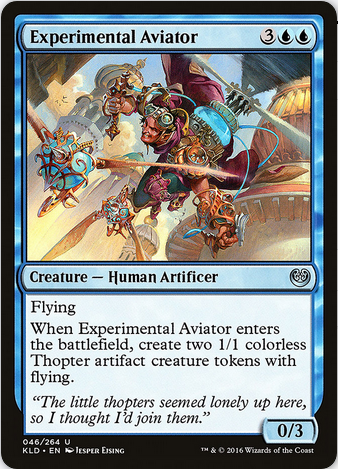
With this phrasing, Magic had basically found its rhythm when it came to cards that make tokens. There were a couple of minor changes, such as eliminating the second sentence and moving the special properties of the token between "token" and "into play," which happened in the very next expansion (Urza's Destiny). And then, more than a decade later, there was the more overarching change from "into play" to "onto the battlefield," which went into effect for the Magic 2010 expansion. But it wasn't until the artifact-themed set Kaladesh in 2016 where the shorthand "create" was officially substituted for "put ... onto the battlefield." It's fitting that a set based heavily on Thopters - 1/1 flying artifact creatures that are functionally identical to the Wasps created by The Hive - should be the one to bring token making full circle.

Over the years, tokens became more than just a strategy within the game, evolving into a collectible accessory accompanying certain products. To bring this topic full circle, the first expansion set to feature dedicated tokens that correspond to cards in that set was Tenth Edition in 2007. One of the six tokens released with that set was a 1/1 Wasp artifact creature created by, what else, The Hive. In order to more fully explore this aspect of tokens, I put together a database of all of Magic's printed tokens, what set they belong to, and the the artists responsible for each one. I'll explore some of the findings from this database in future posts, such as which tokens appear in the most sets, which tokens are created by the most cards, and of course the different unique art printings of each. Until then, I hope you have a slightly greater sense of appreciation the next time you open a random token in a Magic booster pack.

Monday, August 6, 2018

If the Season Ended Today 2018 Runners Up

When I started the 2018 version of "If the Season Ended Today," it was understood that "Today" would refer to "the All-Star Break." However, the momentum has shifted in a couple of key playoff races between then and now, and I thought it would only be proper to highlight that here in an additional post. Entering play today (the REAL today, Monday, August 6), the Diamondbacks are tied with the Dodgers for the NL West lead, and the Athletics have overtaken the Mariners for the AL's second Wild Card spot. Since division titles are more highly prized in today's system (even though, if the season actually ended today, the co-leaders would be subject to another one-game playoff, although this one would be called "Game 163" rather than a Wild Card Game), let's start with the D-Backs.


Sticking with the All-Star theme, even though it's been nearly three weeks since the All-Star Game, Arizona sent three representatives to Washington for this year's festivities. Slugging Virgo first baseman Paul Goldschmidt was selected to the roster by MLB, and ended up batting cleanup as the DH - right in front of fellow slugging Virgo first baseman Freddie Freeman... who was himself subbed out later in the game for yet a THIRD slugging Virgo first baseman Joey Votto. Nobody said fantasy astrology baseball was fair. The other two ARI All-Stars were pitchers: Patrick Corbin was another MLB selection, while Zack Greinke was picked as a replacement for Jon Lester, although neither actually made it into the game.

In terms of injuries, they're responsible for Jake Lamb's depressed point total - he missed time earlier in the year and recently went back on the disabled list. But one player's crisis is another's opportunity, as utility infielder Daniel Descalso had a chance to shine while filling in for him. A couple of outfielders acquired in the offseason were also hit by the injury bug: Jarrod Dyson (495 points as of the break, 7.4 points per game) is still on the DL as of this writing, while Steven Souza Jr. (112 / 4.9) is active, but the amount of time he missed so far has all but made him a non-factor; plus it opened the door for the trade for Jon Jay. The rotation was bolstered by another oft-injured midseason acquisition - this one by way of a minor league deal - in Clay Buchholz, who has rediscovered some of his old form with 423 points and 60.4 PPG. He was activated a week after the ASG, in a transaction that saw Matt Koch return to the minors.

Moving on to trades made after the All-Star Break, the Diamondbacks made plenty of them, and by plenty, I mean four. The only post-break offensive upgrade sought by GM Mike Hazen was to pick up slugging Twins infielder Eduardo Escobar (1,100 / 12.2) basically as a way to answer Jake Lamb's struggles. The other three swaps were made with an eye toward improving the Snakes' bullpen: a week before the deadline saw them snag long relief specialist / spot starter Matt Andriese (382 / 14.7) from the Rays, then deadline day saw Arizona land a pair of setup arms in their own former closer Brad Ziegler (512 / 10.9) from the Marlins, and colon-less lefty Jake Diekman (348 / 8.5) from the Rangers. However, the most significant bullpen addition might have been when T.J. McFarland (598 / 17.6) was activated from his own DL stint, the day before Buchholz made it back to the active roster. We'll see if this group can hold off the Dodgers and the Rockies for division lead, as all three teams currently trail the two NL Wild Card contenders.


When I wrote about the Phillies in my 30 Teams in 30 Days feature earlier this year, I talked about how teams are often most exciting to watch at the time when they're set to emerge from a period of rebuilding. While that's usually true, another, perhaps even more exciting time to be a fan of a particular team is when, like the 2018 A's, they were not at all expected to contend, and yet something just clicks. All-Stars Jed Lowrie and Blake Treinen lead a very impressive offense and an unexpectedly lights-out bullpen, respectively, but Oakland has had worse injury luck in their rotation than basically any team except their cross-state rival Angels: no fewer than four projected starters have undergone the dreaded Tommy John surgery this year (Kendall Graveman, Jharel Cotton, Daniel Gossett, and prospect A.J. Puk), and that doesn't include currently DL'd starters Paul Blackburn and Andrew Triggs. But the current group of spare parts, including a combination of former A's can't-miss prospects (Cahill and Anderson) and journeyman reclamation projects (Edwin Jackson) have held their own just fine.

The rotation had been so effective that Oakland's front office braintrust of GM David Forst and President of Baseball Operations Billy Beane decided not to add any starters at the deadline. In fact, the only addition the team made before July 31st was former Mets closer Jeurys Familia (with a very strong total of 929 points at the break, at a rate of 23.2 points per game), who presents a bit of a moral quandary for an A's fan to root for, given that he does have a domestic violence suspension on his resume. Speaking of embattled relievers (although not on nearly the same scale), just yesterday the Athletics picked up Shawn Kelley (345 / 11.1) after he was designated for assignment by the Nationals due to attitude problems - specifically "act(ing) like a baby" in a recent appearance. But these cases pale in comparison to the most controversial bullpen trade at the deadline. UPDATE: Just moments ago, the news broke that Forst & Co. claimed on waivers, and then swung a trade with the Tigers for, starting pitcher Mike Fiers (818 / 45.4), a deal that had erroneously been reported to have happened at the deadline. But now back to what I was talking about before.

I did a lot of reading on the subject of Jeurys Familia when he was acquired by the A's. On Halloween night 2016, Familia was arrested on a domestic violence charge, after his wife called the police claiming that he was "drunk" and "going crazy." In the ensuing month and a half, his wife dropped the charges and the case was dismissed. I am aware that there can be mitigating, sometimes sinister, circumstances that can lead to a victim close to their abuser choosing not to pursue such a case further, but it nevertheless sheds some light on the circumstances. Despite the case's resolution, the Commissioner's Office suspended Familia for the first 15 games of the next season, and that was the end of the story. I'm ashamed to say that I had actually forgotten about this whole saga until Familia's name surfaced in trade rumors this year.

The case of former Blue Jays closer Roberto Osuna has played out significantly differently this year. While details of his case have not been made public, at the time of his acquisition by the Astros, Osuna was still in the midst of a 75-game suspension, the second-longest such suspension issued for domestic assault. (The longest, an 82-game ban, was served by Hector Olivera, who hasn't returned to affiliated ball since.) It's important to note that these types of suspensions are at the discretion of the Commissioner, and thus have no legal basis, and tend to be quite reactionary in nature. But it's just as important to note that the assault charges against Osuna have decidedly NOT been dropped and the case against him is still ongoing - his attorneys represented him at a hearing on August 1, two days after the trade went down, and he's scheduled to be in court again September 5, right in the middle of the stretch run.

It's almost surreal to be talking about baseball playoff implications within the framework of domestic violence, but that remains a grim reality, given that a player suspended in this manner is still eligible to compete in the MLB postseason. This is not the case for players suspended for use of performance enhancing drugs, which to me seems like a glaring moral lapse on the part of MLB. It's basically an admission that the organization does not care one bit about a player's character, so long as their actions didn't directly affect their play on the field. But beyond that, it's perhaps an even more glaring lapse on the part of Houston's front office to willingly acquire such a player and put him in the national spotlight of a playoff race. Before the trade, Osuna would have languished on Toronto's restricted list, safely out of contention for the rest of the year, but now the defending World Series champions have abandoned any semblance of pretending to foster a positive clubhouse environment, and laid bare their cold, calculating, win-at-all-costs mentality... which, in fairness, is likely shared by all major sports teams, and all big businesses in general. But that doesn't mean that it's not going to impact the fans (or, in fact, the players) in a negative way.

Roberto Osuna was reinstated from his suspension yesterday, but didn't appear for Houston in their 3-2 loss to the Dodgers. Honestly, the best case scenario for the Astros might be that he pitches poorly for the next month and is subsequently shipped off to Canadian prison in September, effectively removing a potential postseason PR disaster from the table. But part of me wonders if the damage hasn't already been done.

Wednesday, August 1, 2018

If the Season Ended Today 2018 Top Seeds

Well, the trade deadline has come and gone, and perhaps predictably so, the two top seeded teams in each league came out of the flurry of moves leading up to 7/31 looking very different than when they went in. But since this feature is stuck at the All-Star Break, we're statistically frozen at 7/16. In this final installment, check out how the Red Sox and Cubs would have lined up If the Season Ended Today (asterisk). First, we'll see how the first MLB team to 70 wins aims to fend off its competitors.


Boston had five All-Stars in the 2018 festivities, second-most of any team. These included two fan elected starters (Libra arbitration hearing winner Mookie Betts in the outfield and  Leo offseason acquisition J.D. Martinez at DH), and one manager-elected starter (the pitcher Aries ace Chris Sale, whose recent trip to the DL is going to hurt his cosmic team's chances heading into the stretch run). First baseman Mitch Moreland (who is SO far down the Virgo depth chart at 1B, behind such notable names as Goldschmidt, Freeman, Votto, even Desmond, nevertheless) got two hits in this game coming in as a player ballot substitution. However Gemini star closer Craig Kimbrel didn't enter the game in relief.

It's not evident looking at their win-loss record, but injuries have beset this team's roster in every category. The starting rotation would look much more complete with breakout lefty Eduardo Rodriguez (1,145 / 60.3) instead of rookie spot-starter type Hector Velazquez, even if he is having a fine first full MLB season since making the jump from the Mexican League. Third base is currently occupied by another Eduardo, Nunez, while super utility player Brock Holt is at the keystone, but the upside of young Rafael Devers (940 / 10.6) and the track record of veteran Dustin Pedroia (5 / 1.7, but remember I said TRACK RECORD) would definitely be preferable in the playoffs. And even the bullpen saw a potentially promising weapon go down in Carson Smith (124 / 6.9), whose catastrophic circumstances literally add insult to injury. And that's not even mentioning defensive standout catcher Christian Vazquez (Leon has superior offensive numbers on the year), or starters Drew Pomeranz and Steven Wright (they've played so little this year between them to make a dent statistically).

But luckily Red Sox Prez of Baseball Ops David Dombrowski was active in finding solutions for some of these problems, at least in 2/3 of the areas mentioned above. First was to beef up their bench from the right side with Blue Jays technically-utility player Steve Pearce (447 / 12.4) who was actually the top first base (mostly) eligible player to change teams at the deadline this year. Second and actually foremost was resurgent starter Nathan Eovaldi (420 (blaze it) / 46.7) who is just now returning from multiple Tommy John surgeries. He's one of the reasons why Angels and A's fans should have some hope: true, more pitchers are succumbing to elbow ligament surgery, but more pitchers are also coming back from it... just ask Jonny Venters, another recent trade target. And last but not least, they acquired a ready-made hedge in case homegrown star Pedroia can't take the field at the keystone, Ian Kinsler (755 / 9.2) from the Angels. The number three second baseman on the Cancer Decapods fantasy astrology depth chart - behind injured DJ LeMahieu (922 / 13.0) and multi-position threat Yangervis Solarte (980 / 10.7) - was only the third-highest scoring second baseman moved at the deadline - behind Brian Dozier (1,116 / 12.0), the newest Dodger and Asdrubal Cabrera (1,094 / 11.9) who came to the Phillies several days ago.


While Chicago's NL team has the best record in the senior circuit, they however don't have the most wins: the Brewers have two more, but also two more losses. They also only had three 2018 All-Stars to Boston's (and Milwaukee's) five. Both leadoff hitter / pride of Sagittarius Javier Baez and new Taurus starting catcher Willson Contreras were voted in by the fans, while former Red Sox / current Capricorn starting pitcher Jon Lester was unavailable to pitch. Their lineup was also miraculously devoid of injury at the break - the only unavailable regular Albert Almora Jr. (799 / 9.3) was on family leave. (Of course Kris Bryant has since fallen to the DL thanks to shoulder troubles.) On the pitching side, the loss of Yu Darvish (227 / 28.4) is certainly hurting them, but his ineffectiveness was just as bad before the injury troubles started. Plus Mike Montgomery has settled in as a better option even than another offseason acquisition Tyler Chatwood (288 / 16.9) who it turns out still walks tons of batters, even outside the rarefied air of Coors Field. (And it's important to note that since the break, dependable closer Brandon Morrow has also been placed on the shelf with a biceps issue.)

Bryant's injury did not seem to bother Cubs PBO Theo Epstein too much, but the pitching injuries did, prompting him and his Jed Hoyer-led front office to acquire three pitchers in the deadline season. Two of these pitchers came from the same team (the Rangers), but they have very different roles and very different career paths. Alternating spot starter and long relief specialist Jesse Chavez (530 / 17.7) can add quality length to any bullpen. Former lefty ace Cole Hamels (737 / 38.8) is still being paid like a current ace, despite the decline in raw skills and results. However, he's strictly better than ineffectively wild Chatwood and adds comes with a good postseason resumé to boot. The most recent acquisition, from deadline day itself, was to pick up former Twins closer Brandon Kinzler (306 / 7.7) from the Nationals, where his depressed fantasy point total shows that he had been relegated to middle relief duty in Washington.


So that's it for all the teams that would have been playoff-bound If the Season Ended Today (astersisk). If the season ended TODAY today (i.e. the day after the Trade Deadline), the AL playoff picture would be the same, but in the NL the Diamondbacks would have the edge over the Dodgers and Rockies for the NL West lead. Maybe I can afford to post about one more lineup...

(asterisk) TODAY IS THE ALL-STAR BREAK, I'VE WRITTEN THAT SO MANY TIMES NOW.