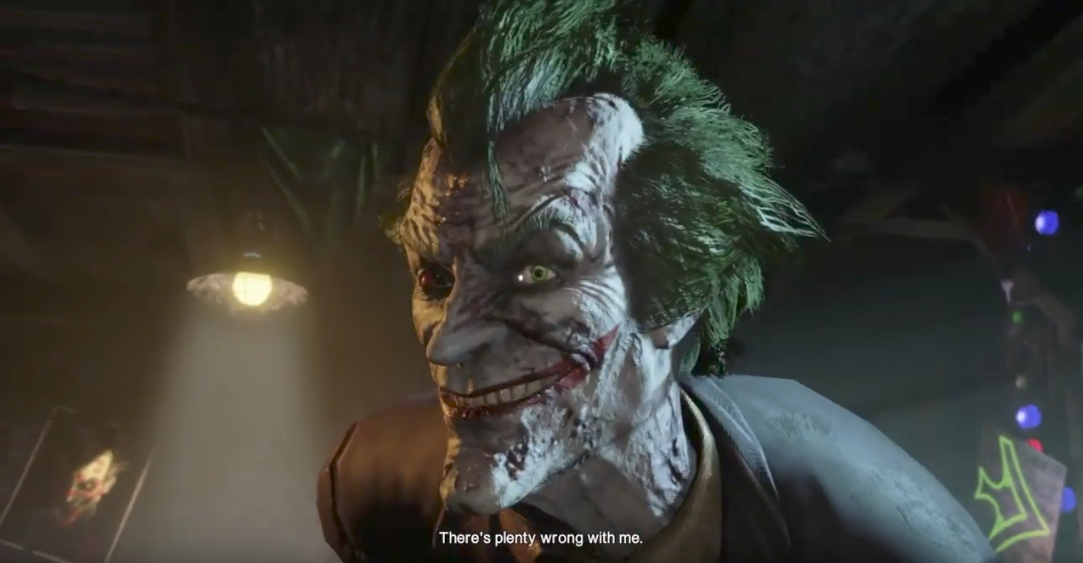
Tuesday, February 19, 2019

Let's Play Batman: Return to Arkham City: Episode 8

I probably shouldn't admit this, but looking back on it, the entirety of Episode 7 could have been lifted out of the timeline without too many adverse effects. Sure, we got the first entrance into Penguin's museum, and the Zsasz backstory will be relevant later on, but the presence of those sensor jammers (even though they're technically part of the main story missions) doesn't have much of an impact on the plot. That said, Episode 8, on the other hand, is jam-packed with plot development, compelling twists and turns, and top notch gameplay action!


Despite all the above sensor jammer-bashing, we do have to deal with the aftermath of that "side" mission at the top of this episode, when Penguin broadcasts to his henchmen who failed to protect his devices, as we make our way back topside. For this little audio interlude, I used the opening theme of Penguin's third dedicated episode in Batman: the Animated Series, titled "Birds of a Feather". In this episode, Penguin convinces himself that he's reformed his villainous ways after a lengthy prison sentence, and attempts to join high society... with disastrous results. I thought the upbeat, operatic string section provided a nice juxtaposition to the brutality he was threatening to inflict on his workforce.

Once we finally get into the museum for real, we're presented with a sticky situation: three of Penguin's goons are torturing an undercover cop, who is part of a strike team sent in by Commissioner Gordon. While this happens, the in-game music starts off as a track from the extended soundtrack, appropriately titled "Trophy Room," since the scene takes place in the Trophy Room. However, once we're done beating down the enemies and we start talking to the cop - the strongly named Elvis Jones - all the music goes away. So I inserted a variant track that's very similar to "Trophy Room," except without the subtle driving percussion. This cue extends though a tour of the trophy room itself, including two separate display cabinets set up for Bruce Wayne and Batman... imagine Penguin's disappointment if he ever managed to catch our hero!


After a confrontation with the Penguin himself, he predictably resorts to throwing a bunch of henchmen at us, in a fight scored by the in-game track "It's Initiation Time." This fight also includes a TITAN-enhanced henchman, which was the inspiration for the next bit of personal music: the TITAN henchmen boss battle theme from Arkham Asylum. This plays while we're explaining the situation to the newest entry to tonight's support team, Oracle (a.k.a. Barbara Gordon), and continues while I explore the way forward. While I start with the full version of the music, as this sequence continues I also utilize the track's component parts: the strings and percussion and the horn section.


And that's it for personal music, excluding the track I used for the "last time on" recap (which was also from the last episode) and the brief moment where I returned to the Arkham Asylum main menu theme for selecting an upgrade. Tune in next time for what would be the mid-season finale, if this series was split in half, a-la the later seasons of The Walking Dead.

Tuesday, February 12, 2019

Let's Play Batman: Return to Arkham City: Episode 7

It might be hard to believe, but a full two-thirds of Episode 7 of my Batman: Return to Arkham City Let's Play is part of the main story missions. Watch the video below and see if you can which parts are mandatory, and which are side missions:


If you guessed that the first "act" was the one comprised of side missions, you'd be absolutely right. But it's understandable if you thought the rest of the episode wasn't particularly story-centric, since by the end of the episode, we're still not able to progress very far into Penguin's museum, which is the goal of our primary objective. But sometimes you have to go a long distance out of your way in order to come back a short distance correctly.

You see, Penguin had set up his base of operations inside the Cyrus Pinkney Natural History museum, which, as a municipal structure, I should have been able to hack my way inside using the Cryptographic Sequencer. But since Oswald Cobblepot has access to military grade equipment for some reason, he was able to block the signal back to the Batcave using communications jammers, which are inconveniently spread all across the map. So while destroying them is necessary for progressing through the main story, it's also a task that could be pretty easily isolated and lifted out if necessary.


But before getting to that in the episode, I tackle a pair of actual side missions: gliding through advanced augmented reality obstacle courses and chasing after a couple more of Victor Zsasz's ringing phones. This Zsasz element provides the only real opportunity to name this episode after a character, even though we were introduced to the self-scarred serial killer in the previous episode, and we won't complete his side mission until many episodes later. But since Calendar Man's only appearance was in the previous episode and we don't get our first real meeting with the Penguin until next time, I was left with precious few choices.

Meanwhile, the AR side missions provide the only real chance to insert any personal music - namely the Arkham Asylum Main Theme while I'm in the pause menu searching for the next mission. I know I said I wasn't going to highlight any future uses of this track, but it's basically the only one in this episode, so I'm making an exception. Oh, there is one other track I added: after destroying the third jammer, Batman does some VO commentary about how he's now able to get into the museum. This happens after the predator challenge music stings out, so I spiced this moment up with a track from the extended soundtrack (which we also heard earlier in this episode, upon entering the museum for the first time) called "Entering Penguin's Turf."

Tuesday, January 29, 2019

Let's Play Batman: Return to Arkham City - Episode 6

We're getting to the point in this playthrough where side missions will fill the majority of the next two episodes. Don't get me wrong, there are still plenty of fun and exciting developments, and we do keep the story going with at least one important plot point per episode. But this is what happens when the "network" extends your episode order from 14 to 21 from last season...


I know I said I wasn't going to detail every time I used the Arkham Asylum main theme to cover time spent in the pause menu, but this episode is significant because it marks the switch from the version of the song ripped from the game's audio files that I found on the internet, to the version on the official soundtrack album, titled "Enter the Asylum." If you'll recall, I don't just restart the track at the beginning each time I use it during a menu sequence; instead, I pick it up from where I left off last time. It just so happened that I reached the end of the track during the last episode, so I thought this would be a good time to showcase the two different versions.

After we rescue medic Adam Hamasaki from the first Riddler room, we're provided with a radio frequency that we have to plug into our Cryptographic Sequencer. After doing so, Edward Nigma tells us that we need to complete more Riddler challenges (i.e. collect trophies, solve riddles, achieve physical tasks, etc.) in order to proceed with the side mission - but he does so all while there is no music playing in the background, so I cut in some Riddler-related ambient music that's not on the game's official soundtrack. Actually, full disclosure, we got a similar radio frequency from Eddie Burlow, the first Riddler hostage in the courthouse, but I ended up cutting that part out of the previous episode. It just didn't seem necessary to have both the frequency AND the introduction of the riddle-solving box that we receive, but in hindsight, perhaps I should have maintained the integrity of the full gameplay experience.


Speaking of the courthouse, that's where we meet Calendar Man, this episode's "title character." He doesn't have anything to do with the main story, and his appearance qualifies as more of an easter egg than a side mission. (If you launch the game and visit him on every date that's circled on that calendar on the wall, he has a different thing to say each time.) But I had to save Victor Zsasz (another more impactful character who we meet in this episode) for Episode 7, since we're short on story-related characters in this section of the playthrough, which is focused on side missions and Riddler challenges.

Later in the episode, I get a little too preoccupied with solving some of these challenges, and take far too much time trying to pick up a trophy that involves piloting a Remote Controlled Batarang through a small tunnel to hit a switch at the end. Rather than trimming out all my unsuccessful attempts and making myself seem more competent than I actually am, I sped up the footage and set it to the ultimate comedic montage music, "Yakety Sax" by Boots Randolph and Spider Rich, as popularized in the Benny Hill Show.

And that's about it for the personal music... minus one more trip back to the Arkham Asylum main theme, but... NO NO PLEASE DON'T CLOSE THE WINDO--

Friday, January 25, 2019

Let's Play Batman: Return to Arkham City - Episode 5

Episode 5 starts out as though we're getting back on track with the game's primary objective, but very quickly devolves into more side mission nonsense. However, one of the missions introduced in this episode has some pretty significant stakes, since it involves... well, I won't spoil the surprise, why don't you go ahead and watch the full episode below:


Pretty wild stuff, eh? My favorite part was when I jumped over the... oh, wait. You didn't watch the full episode yet? That's OK, I'll wait...

...

The first piece of music that I cut into the episode technically happens during the "Last Time On" recap, but I'm not counting that as personal music because it's an extension of the first track that plays in the actual episode. On the official soundtrack, this one is called "I Know What You Guys Are Thinking," and it's my favorite "ambient/explore" theme in the entire Arkham universe - so much so that I set the climactic phrase as my ringtone back when this game first came out in 2011.

The first truly personal musical addition in this episode comes after we defeat Penguin's henchmen in the GCPD lab, while we learn how to use the cryptographic sequencer to hack security consoles. Since it's Penguin's fault that we're locked in here in the first place, I use a track from Oswald Chesterfield Cobblepot's first appearance in the Animated Series called "I've Got Batman In My Basement." Since the music is basically the only redeeming quality of that episode, I won't say much more about it, but I do think this track fits amazingly well with this bit of gameplay (with a bit of music editing on my part).

Soon after exiting the GCPD, I get sidetracked by the first of two side missions that will occupy most of this episode. After pausing the game to check on my primary objective, my eye is drawn to a distress beacon on the roof of a nearby building. While I listen in to Hugo Strange discussing the situation with one of his TYGER guards, I pump in the intro of the nefarious psychiatrist's only Animated Series appearance, "The Strange Secret of Bruce Wayne." This episode presents a much more dramatic and believable method of Strange discovering Batman's secret identity than the explanation given in the game - which you can hear in the Riddler interview tapes, one of the pieces of bonus content you get as a reward for solving the Riddler challenges throughout the game.

It turns out that distress beacon was placed by none other than Bane, the muscle-head from whom the TITAN formula was derived back in Arkham Asylum. The moment where we first enter the Krank Co. Toys factory and see the roided up villain happens without music, so I piped in the intro from Bane's only Animated Series episode, which shares his name. Although actually, since music from that episode doesn't appear on any of the official soundtrack albums, what you hear in the Let's Play is captured directly from the DVD. I probably shouldn't admit doing that on the internet, but... fair use, maybe?

After talking to Bane and unlocking his side mission "Fragile Alliance," I use some music from Arkham Asylum to fill in the space before heading back outside. This is one of the two layers that comprises Bane's boss music from the first game, which is also not on the official soundtrack, but which can be found by the super descriptive name "Boss Bane 02." The fully mixed version of this cue actually plays later in Arkham City, and appears on the extended soundtrack, but we'll save that for when it shows up.


The last piece of personal music happens after we unlock the second side mission in the episode: "Enigma Conundrum," named after Edward Nigma, aka the Riddler. You see, he has taken the doctors and guards from the church hostage, and is forcing Batman to solve his challenges in order to set them free. As part of this, we get to use the Enigma Machine - not the World War II code breaker, but rather a word-matching device to answer riddles. Only problem is, there's no music when we pause the game to use the device, so I cut in the second part of the theme from Riddler's first Animated Series episode, "If You're So Smart, Why Aren't You Rich?" You might remember this cue from when we first met Riddler in Episode 1, but if a piece of music is worth using, it's worth using twice!

Thursday, January 24, 2019

Let's Play Batman: Return to Arkham City - Episode 4

I've fallen behind on these blog commentaries to accompany my Let's Play of Batman: Return to Arkham City, because... well, there are no excuses, I just didn't do them. But I'll make up for it with rapid fire posts about episodes 4 and 5, starting right now.


Jumping right into a breakdown of my personally added music, I once again cut in the main menu music from Arkham Asylum while I'm picking my next upgrade, which I believe is the fourth overall. Since there will be a lot more of these upgrades throughout the course of the game, with most (although not all) being accompanied by this music, I'm not going to note each one individually from here on out. The most interesting thing about this particular upgrade is that it is selected not by Batman, but by Catwoman, since they share experience points and can purchase upgrades for each other. Since you only play as Catwoman a handful of times during the game, it makes a lot more sense to always get the Batman ones, which is what I do here.


But even though we play as Catwoman for the majority of this episode, the character I would pick to represent Episode 4 is Poison Ivy. Even though she does significantly factor into the story later on down the line, this is the episode where she gets the most screen time, and it's the only one where we fight against her brainwashed henchmen. Notably, her role in Arkham City pales in comparison to both the preceding and subsequent games in the Arkham trilogy, so check out my Let's Plays of Return to Arkham Asylum and Arkham Knight for your Pamela Isley fix.

After we're done with the Catwoman segment, we get an in-game music-less cutscene when Batman talks to Joker using the smartphone our hero finds taped to his chest. For this key conversation, I use the same cue from the Animated Series episode "The Last Laugh" that we heard back in Episode 2, after scanning Joker's sniper rifle. I don't feel too bad about reusing it so soon, since it is bar none the best example of Joker's musical leitmotif in the series.

This chat is the last time that Batman uses the phone itself, since he knows the importance of using a good hands-free system while fighting crime. For the brief moment when Batman inserts the SIM card into his gauntlet-based Bat-bluetooth, I use the sting from the extended soundtrack cue "Meet Mr. Hammer," which we saw in the last episode.

Immediately after that, we call up Alfred to give him the latest update: Mr. Freeze has been working on a cure for Joker's (and my) infected blood. Since the topic of conversation is everyone's favorite cryogenic scientist, I use the introduction to Mr. Freeze's first Animated Series appearance, an episode titled "Heart of Ice."

The only other personal music in the episode is another brief instance of the track "Watcher in the Wings" from the extended soundtrack, to go over the second part of the side mission with the same name, and then one more use of the Arkham Asylum main theme for another upgrade... but I said I wouldn't talk about those individually anymore. Stay tuned for another blog recap coming real soon, and new episodes every Tuesday!

Thursday, January 10, 2019

Let's Play Batman: Return to Arkham City - Episode 3

It's to talk about Episode 3 of Batman: Return to Arkham City, where we finally learn the primary conflict that will drive the rest of the game's action. Spoilers will follow, so be sure to watch the episode (either in its embedded form, or on YouTube proper) before reading on.


First let's get the discussion about the personal music I've added to this episode out of the way, since it'll be quite brief. The vast majority of the action is accompanied by the in-game soundtrack, so the only part I had to score was when I was picking an upgrade after a fight with some Joker henchmen caused me to level up. The most prominently featured piece of music from this episode is a track from the official Arkham City album called "Wham. Gotcha!" That title is a reference to a line of dialogue spoken by a henchman early in the Steel Mill exploration, but the bulk of the track plays during the predator challenge in the smelting chamber, where we have to rescue Dr. Stacy Baker. There is another piece of music that plays multiple times in this episode, most prominently when we fight the giant one-armed mini-boss towards the end, for whom the track is named on the unreleased extended soundtrack.

Since I wasn't able to personalize this episode much through the music, I'd like to talk about a couple of other personal touches I made. The first is the fairly silly way I started the episode, where I tried to liven up the various gadget tutorials by doing my best Alfred impression. I always wondered why there wasn't more open communication between Batman and his loyal butler during some of these exploration sequences, but luckily with my own commentary, I can make that happen!


The only other part really worth mentioning is at the very end of the episode, which concludes with two spoiler-ridden cutscenes back to back. When you play Return to Arkham City, these cutscenes are separated by a Catwoman segment, but I thought it would be more narratively interesting to end this (admittedly short) episode with the plot information imparted in that second cutscene than saving it for the beginning of the following episode after we've cut away to the B-Story. Don't worry, you'll be able to see the continuing adventures of Selina Kyle in next week's video.

That's it for this week! Fair warning, things go a little off the rails next time, as I get distracted by side missions more than I probably should. But what better way to show off the immersive nature of this game than to wander aimlessly around the wonderful world of Arkham City!

Wednesday, January 2, 2019

Let's Play Batman: Return to Arkham City, Episode 2

It's a new year, which means we're going to be inundated with firsts - first baby born in 2019, first official workday of 2019, first presidential tweetstorm of 2019... and also my first video of 2019! Here's episode 2 of my Let's Play of Batman: Return to Arkham City, the PS4 remaster of the 2011 masterpiece:


I've already explained the idea behind this project in my previous post (also my last post of 2018), so I'll stick to a quick recap get into an explanation of my personal music cues fairly quickly. First of all, it should become clear in this episode that I'm taking a pretty slow-paced, meandering approach to this playthrough - I'll frequently stop to listen to various bits of henchmen banter, tackle side missions as they come, and generally take my time to enjoy the sights and sounds of Arkham City. So, pretty much the opposite of a speedrun. But with a game as deep and detailed as Arkham City, there's plenty of interesting stuff to pay attention to no matter what speed you play.

Now let's move on to the personal music cues I've added to this episode. Again, there aren't many, since most of this early part of the game is scored. And again, the first one in this episode happens during a trip to the pause menu. As we discover right after the "last time on" tease (a feature that I'm pretty proud of, by the way - they'll get more complex as the series goes on), we find out that the events of Episode 1 earned me enough experience points to level up. While selecting my first upgrade (the Critical Strikes, naturally), I use the same music that I previously used for the pause menu: "Enter the Asylum" from the Arkham Asylum official soundtrack. However, attentive listeners will notice that I start the track where I left off in the last episode! Because why should you be forced to listen to the same thing twice?


After leaving Two-Face strung up in the courthouse, there's a mysterious figure watching from the rooftop where I picked up the first Riddler trophy. Approaching this guy causes him to vanish in a puff of smoke, leaving a strange symbol behind. Scanning this symbol with Detective Mode's Environmental Analysis feature triggers the "Watcher in the Wings" side mission and automatically brings you to the map screen, which is where my personal music comes in. What you hear is actually the official theme song of this mission (which appears on the Arkham City extended soundtrack), although it doesn't play in the game until you meet this guy several times.

This episode marks the first appearances of Harley Quinn and the Joker, although the latter only shows up on a tiny TV monitor with his face obscured. This happens after scanning the sniper rifle situated at the top of the church, which Joker was remotely controlling, and it triggers a speech from the clown prince of crime. This cutscene usually occurs without music, so I piped in Joker's musical motif from the Batman: The Animated Series episode "The Last Laugh." I was somewhat conflicted about putting this track here, since Mark Hamill's voice acting is more than enough to carry a scene without any musical accompaniment, but I couldn't resist the chance to put in some unique TAS flair.

Stay tuned next week for the next exciting episode!

Friday, December 28, 2018

Let's Play Batman: Return to Arkham City, Episode 1

As a Christmas gift to myself this year, I finally posted the first episode of a project I've been working on for (technically) more than two years: a Let's Play of the Batman: Return to Arkham collection. This remaster of the first two games in the Arkham trilogy came out in late 2016, but it took me a while to play through both games at a level with which I was satisfied, and then of course my unique postproduction approach adds a lot of time to the backend. It was not until early 2018 by the time I completed uploading videos for Return to Arkham Asylum, and while part of me wanted to wait until I had finished editing and exporting all the episodes of Return to Arkham City before posting to YouTube, that side obviously lost out in my internal debate. So without further ado, here's Episode 1:


First, a word about the video quality. I've learned a lot about exporting and encoding since my Let's Play of Arkham Knight from 2016, so this is my first Let's Play video in full HD (only 720p, but still, that's better than the alternative). You may have to view the video in YouTube to get the full benefit of that, since I'm not sure if the embedded video player allows you to change the size. Once I'm done with Return to Arkham City (RTAC for short), my plan is to re-upload all the videos from the other two games in the same format, but that's a story for the future.

Next, I want to address the commentary. I explain near the top of this first episode that the style I use is post commentary (as opposed to live commentary), but I also add another wrinkle to it by recording my commentary from the perspective of the game's main character, rather than as myself playing the game. Is this cheesy? Definitely. Does it make for a more unique and immersive experience for you, the viewers? I sure hope so. Is it more fun for me to record it this way? Without a doubt.


And finally, here's some info about the music in these videos. When I recorded footage for Arkham Knight, I turned the in-game music volume all the way down, mostly to make it easier to trim sections of the game and steal audio from elsewhere. The consequence of this was that I had to score the entire game myself, which I did mostly using music from the Arkham soundtrack albums, but I also brought in some tracks from other Batman-related media. Conversely, I left the in-game music volume turned up for my Return to Arkham Let's Plays, but there are still several points where the game has no music, and I do not shy away from adding in my own music to fill the void at these times. As a rule, I don't indicate when this is happening, except for some sporadic mentions in the commentary, but this is a heads-up to keep your ears open.

That's it from me! I'll be posting a new video each week (on Tuesdays), barring any unforeseen issues, so check back here and subscribe to my YouTube channel to stay up to date! Happy Batman-ing!

UPDATE: I've decided to use these blog posts to point out the personal music additions that I make in each episode in a director's commentary sort of way, since I didn't title them in the videos like I did with my Let's Play of Arkham Knight from 2016. There aren't a lot of moments where I had to supplement the in-game music with personal scoring, but I thought that Arkham purists and Batman music trivia buffs might enjoy checking out this information. I would also suggest not reading this part until having watched the episode, at least once, just for spoiler reasons.

The first bit of personal music comes in just about as soon as we take control of the game's main character, right after Hugo Strange leaves Bruce Wayne alone in the new inmate processing center. This short cue - it's just about 10 seconds long - goes with a joke that I'm pretty happy with: a variation of the classic *record scratch* *freeze frame* trope made popular in 80s movies. And since it also serves as the introduction of my commentary-as-Batman narrative device, I thought the first few bars of the opening sequence from Batman: The Animated Series would fit well here.

We don't hear another bit of personal music in this episode until we put on the batsuit for the first time and get access to the pause menu screen. Normally when a player pauses the game to look at the map, check the current objectives, read character bios, or choose new upgrades, the music cuts out until they unpause. However, I figured that there's no reason for you, the viewers, to have to sit through a prolonged dry spell while I navigated the various menus, so I spliced in the main menu music from Batman: Arkham Asylum, which appears on the official soundtrack album as "Enter the Asylum."

Soon after perusing the pause menus, I stumble on the first of many Riddler secrets that are scattered throughout Arkham City. Upon solving the puzzle and picking up the green glowing trophies, the game automatically brings you to a new menu screen and launches into a message from Edward Nygma himself. Since these menu sequences usually play without music, I had the opportunity to take a page from my previous Arkham Let's Plays and score this moment with music from Riddler's first appearance in Batman: The Animated series, an episode titled "If You're So Smart, Why Aren't You Rich?"

So that's it, only three personal cues in this episode! The number will increase steadily later on, as we stray from the main story and get more into side missions, but for now, happy watching!

Friday, December 14, 2018

2019 National League All-Acquired Roster

UPDATE #1, as of 12/16/18:

All three of the changes to this lineup were reported last week, but only just became official as of the MLB.com transaction page. The addition of Andrew McCutchen (1,756 fantasy points / 11.3 points per game) to the Philadelphia outfield pushes Johnny Field into the center field platoon picture, even though he only technically qualified as a corner outfielder in 2018. Tanner Roark (1,163 / 37.5) hasn't been a top of the rotation pitcher since 2016, but at this early point in the offseason, he's got a good shot to stick in this rotation. And Jeurys Familia (1,329 / 19.0) will return to his original team in New York, but he won't reprise the closer's role he had for them since 2015, but rather will continue in the setup capacity for which he pitched in Oakland after his mid-2018 trade.


===

As I set up in my last post highlighting the American League All-Acquired Roster, the cutoff point for inclusion in this particular update of the 2019 All-Acquired rosters was prior to the week beginning 12/10/18, which will allow us to focus entirely on pre-Winter Meetings action. I don't think I mentioned that I'm using only transactions that have been reported on MLB.com's Transaction page, so let me just clear that up now. With all that said, let's check out the top players having been acquired by National League teams this offseason!


STARTING PITCHER

Image from Arizona Sports
Like its AL counterpart, the NL All-Acquired squad boasts a top of the rotation lefty, although the senior circuit's version came via free agent signing rather than blockbuster trade. The consensus top starting pitcher on the free agent market, Patrick Corbin (2,213 fantasy points / 67.1 points per game) turned in a stellar season with the Diamondbacks, which he parlayed into a six-year, $140 million contract with the Nationals. We'll see whether this financial outlay from the Lerner family prevents homegrown superstar outfielder Bryce Harper from returning to Washington (which would keep him out of the All-Acquired landscape altogether), but at least the Nats have a loaded rotation, even after trading away Tanner Roark in a swap that occurred after the cutoff point.

Unlike its AL counterpart, the NL All-Acquired player pool doesn't even include enough healthy starting pitchers to staff a full rotation, even including the above-mentioned Roark. Going by 2018 fantasy points, the next pitcher on the list is Garrett Richards (696 / 43.5), who the Padres signed to a two-year deal typical for hurlers recovering from Tommy John surgery, but he likely won't be a factor until 2020 at the earliest. Former potential ace in the making Luke Weaver (683 / 22.8) went from the Cardinals to the Diamondbacks in a huge trade that we'll talk about later on. But after those two we have another TJ victim Artie Lewicki (120 / 9.2 with the Tigers, before going to Arizona via waiver claim) and Triple-A starter Mike Hauschild (60 / 30.0 in one start and one relief appearance for the Blue Jays - he signed a minor league deal with the Cardinals).


RELIEF PITCHER

Image from New York Post
In addition to an ace starter, the NL also acquired a star closer in Edwin Diaz (2,672 / 36.6), the top-scoring reliever in all of baseball in 2018. Arguably the key piece in a Mariners/Mets blockbuster that went down right after the start of Hanukkah, Diaz will give New York NL just one year of cheap production before his ludicrous save totals drive his price up in arbitration. In the very first trade of the offseason (or rather of the "post-2018 season," since the playoffs were still going on), the Marlins sent power reliever Kyle Barraclough (625 / 10.2) to the Nationals, in a prelude of pitching acquisitions to come. I'm listing Barraclough above lefty Jose Alvarez (717 / 9.4), who went from the Angels to the Phillies in a curious one-for-one swap, not just due to the slight points-per-game advantage, but also because left-handed specialists with unimpressive peripheral stats just aren't that exciting. Speaking of which, lefty James Pazos (520 / 8.7) went from the Mariners to the Phillies in yet another blockbuster, alongside bounceback candidate Juan Nicasio (189 / 4.1).

Although he doesn't appear on my new truncated database, having missed the entire 2018 season while recovering from Tommy John surgery of his own, it's worth mentioning that Washington signed former St. Louis closer Trevor Rosenthal. And looking ahead to deals announced after the start of the Winter Meetings, this already-impressive bullpen will be filled out further by the likes of Jeurys Familia (back to the Mets), Joe Kelly (Dodgers), and Alex Claudio (Brewers).


CATCHER

Sticking with the Nats, they're responsible for both of the top two NL All-Acquired backstops. First, they signed late-blooming Kurt Suzuki (1,015 / 9.7) for his second stint with the team, after he was granted free agency from the Braves, and then they traded for defensive specialist Yan Gomes (1,053 / 9.4) from the Indians. While they both hit right-handed, and thus aren't well suited for a traditional platoon role, the differing skillsets each of them brings to the table should complement each other well. Elsewhere in the NL East, Atlanta reunited with a familiar face in Brian McCann (408 / 6.5) after he had his 2019 option year declined by the Astros.


FIRST BASE

Paul GoldschmidtRemember that D-Backs/Cardinals trade I mentioned earlier? The one with Luke Weaver? Well, he was the primary piece going to Arizona in exchange for Paul Goldschmidt (2,196 / 13.9), one of the top first baseman, not just in the last year, but in the last DECADE. Goldy does it all, averaging 31 homers, 105 RBI, and 18 steals per season over his eight-year career, with a .930 OPS (45 percent above league average), six consecutive All-Star appearances, four Silver Slugger awards, and three Gold Gloves. Sure he'll be a free agent after next season, so he's unlikely to make a huge impact to the St. Louis franchise, but adding that type of production to an already-solid lineup makes the Cards a force in an already-crowded NL Central division in 2019.


SECOND BASE

Image from WFAN Radio
Remember when I said that Edwin Diaz was "arguably" the key piece in that Mariners/Mets blockbuster? The main argument against him is Robinson Cano (1,033 / 12.9), who returns to a familiar city, having started his career with the Yankees. Cano has some red flags, as he's playing out the decline years of a megadeal (which was negotiated by Mets GM Brodie Van Wagenen back when he was still Cano's agent at CAA), and he's fresh off an 80-game suspension for performance enhancing drugs. But as his solid per-game numbers indicate, he still has plenty left in his bat, and his defense isn't as bad as people give him credit for, as he's only posted a negative dWAR (according to Baseball Reference Wins Above Replacement) once in the last 10 seasons.


SHORTSTOP

Jean SeguraSticking with middle infielders shipped out by Seattle, the new shortstop in Philadelphia will be Jean Segura (1,749 / 12.1). Why would Mariners GM Jerry Dipoto trade away a 2018 All-Star just one year after signing him to a five-year extension? You mean, beyond Dipoto's compulsion with making any and every trade proposed by an opposing GM? Maybe it has to do with reports of some bad clubhouse chemistry on Segura's part, which would fit with Philly's pursuit of admitted non-hustler Manny Machado. Or maybe it's just a full commitment to the rebuild on the part of the Seattle front office. Either way, Segura is a clear upgrade at SS over incumbent All-Acquired utility infielders Greg Garcia (332 / 2.9) and Erik Gonzalez (331 / 4.1).


THIRD BASE

Image from Meridian Star
If there was ever a candidate for a one-year "pillow" contract it was former AL MVP Josh Donaldson (603 / 11.6), who suffered through an injury-plagued last couple of years with the Blue Jays (and briefly the Indians). With third base prospect Austin Riley waiting in the wings in Atlanta, Braves GM Alex Anthopolous did a good job picking up a near term upgrade at the hot corner while not blocking the path of a youngster who could become a core piece sooner rather than later. Although he only racked up fewer than twice as many points as former Orioles DH/sometimes third baseman Pedro Alvarez (331 / 7.4), the superior talent level on both sides of the ball is clear. As things stand, however, Alvarez is the leading non-catcher candidate to serve as DH if this team were to play in an AL ballpark.


CENTER FIELD

It's a good thing this team has such a star-studded infield mix, because there's nothing much doing at all in the NL outfield market (at least up to my cutoff point). There is the makings of a low-impact platoon situation in center field with two players signed to minor league pacts. Switch-hitting Abraham Almonte (219 / 4.4) signed on with the Diamondbacks following an early trip to free agency (he was released by the Royals during the 2018 season). Meanwhile, Ryan LaMarre (348 / 4.6) was picked up by the Braves after splitting last year between the Twins and the White Sox.


CORNER OUTFIELD

As of the start of the Winter Meetings, the most accomplished MLB outfielder to be acquired by an NL team was Lonnie Chisenhall (255 / 8.8) formerly of the Indians. He'll serve as a stopgap in Pittsburgh until injured regular right fielder Gregory Polanco is ready to return. The best bet to see time on the opposite side of the grass is Johnny Field (507 / 6.1), who split his debut 2018 season between Tampa Bay and Minnesota, before joining up with the Cubs. Of course, looking forward to deals that were announced up to yesterday, the Phillies helped out the cause by signing Andrew McCutchen, who will get a chance to help out the in-state rival of his former team.


That's it for the NL roster! Return to the 2018-19 All-Acquired Hub page to see the starting lineup/rotation represented in graphical form and to link to the American League roster!

Wednesday, December 12, 2018

2019 American League All-Acquired Roster

UPDATE #1, as of 12/16/18

We'll see how long these weekly updates continue, but as of now, this project is still fresh in my mind, and there are some new developments, especially on the AL side, so I want to go over the new developments. As always, you can return to the All-Acquired Rosters Hub page for a visual representation of both lineups (with new additions highlighted in yellow in the "Movement" column at the far left), but here's the analysis:

First things first, the rotation is starting to come into focus after the previously reported deals for Ivan Nova (traded from the Pirates to the White Sox) and Tyson Ross (signed as a free agent with the Tigers) have been officially announced. While these two pitchers had similar fantasy point production last season, they have decidedly different outlooks for 2019: Nova (who checked in at 1,113 points and 38.3 points per game) profiles as a solid innings-eater type, while Ross (who finished with 1,056 and 34.1, split between the rotation and the bullpen of San Diego and St. Louis, respectively) has considerably more upside if he can harness his electric stuff and stay on the field.

Speaking of the Tigers, on the offensive side, Jordy Mercer (894 / 7.6) solidifies the middle infield, allowing Aledmys Diaz to shift over to third base. But the real story here is at DH, where Edwin Encarnacion (1,800 / 13.1) will essentially swap places with Carlos Santana in Seattle, as Mariners GM Jerry Dipoto continues his crazy dealing. Luckily, since Santana was dealt within the league, he can remain on the same All-Acquired team in a 1B/DH rotation with his former teammate. The other player heading to Cleveland in this three-team trade, Jake Bauers (930 / 9.7) is a first baseman by trade, but given the presence of two outstanding defenders in the outfield in Mallex Smith and Billy Hamilton (1,251 / 8.2, whose contract with the Royals was also reported last week), it's OK to sacrifice some defense at one spot in favor of a little more pop... at least until some bigger moves come along.

===

As of the first week of December (my somewhat arbitrary cutoff point), AL teams have been significantly more active in the transactional space than their NL counterparts, by a score of 63 to 43. Although, as we'll see, that doesn't necessarily correlate to the amount of high impact players acquired. I thought about going chronologically, so we could watch these lineups unfold in real time, but if you want to follow along with the calendar, you can check out MLB.com's Transactions page. With that in mind, here's a position by position look at the AL All-Acquired Team!

STARTING PITCHER

Image from The Ringer
The biggest pitching acquisition for the AL came when the Mariners traded lefty starter James Paxton (1,719 fantasy points / 61.4 points per game) to the Yankees for a package centered on twice-traded prospect Justus Sheffield (-25 / -8.3 in his limited debut season), who would also likely make this early-December rotation given the lack of options. In fact, the only other starting option with more than 200 fantasy points was Jefry Rodriguez (212 / 15.4), who started eight of his first 14 MLB games in 2018 with the Nationals, before being sent to the Indians as one of two players in exchange for catcher Yan Gomes.

Digging deeper, just to get to a full starting five, the Tigers signed Matt Moore (143 / 3.7) after his abysmal season with the Rangers led to a move to the bullpen and a subsequent declining of his contract option for 2019. Parker Bridwell (-71 / -14.2) had a decent season for the Angels in 2017, but was (effectively) non-tendered last month and picked up by the Yankees on a minor league deal. And Dillon Peters (31 / 4.4) looked to have a shot in the Marlins rotation last year, but ended the season in the minors and was shipped to the Angels in a minor trade. It's also worth noting that Drew Smyly, who will miss the start of 2019 recovering from the Tommy John surgery that took his entire 2018 season, went from the Cubs to the Rangers in a cost-saving move, and he could be a factor by mid-season.

However, this will be the last time we hear about many of the pitchers in the above paragraph, since some fairly notable rotation moves have come to light after my cutoff point for this post, which happened to be the start of the Winter Meetings (12/10). Suffice it to say, names like Tyson Ross, Ivan Nova, and maybe even Charlie Morton and Lance Lynn will be showing up in my next update.


RELIEF PITCHER

Jesse ChavezRemember when Jesse Chavez (1,201 / 19.4) hinted that he would retire if the Cubs didn't want him back in 2019 after he pitched like a lights-out relief ace there following a trade from the Rangers? Well, they didn't end up re-signing him, but he did return to the club that made his opportunity in Chicago possible, agreeing to a two-year deal to go back to Texas. While Chavez had a heck of a season, if you'd rather headline your bullpen with someone who has more closing experience, look no further than Alex Colome (1,101 / 15.7), who spent most of 2018 as a setup-pitcher in Seattle, after coming over from Tampa Bay midseason, but now finds himself on the White Sox thanks to Mariners GM Jerry Dipoto's wheeling and dealing.

Speaking of Dipoto, veteran middle reliever Anthony Swarzak (188 / 6.5) came TO Seattle as a means of offsetting some salary in a different blockbuster deal (see the upcoming NL section for more info on that one). In a head-scratcher of a move, the Angels acquired hard-throwing-but-struggling righty Luis Garcia (303 / 5.1) from the Phillies in exchange for a quality lefty (Jose Alvarez). And Oliver Drake (258 / 5.9), who set a major league record by pitching for five (5!) different teams in 2018, has already been claimed twice off waivers during the offseason: once by the Rays (from the Twins) and then again by the Blue Jays. If I were a gambler, I'd say the odds are infinitesimal that he remains in Toronto to start the 2019 season.


CATCHER

The first two AL All-Acquired catching options, chronologically speaking, came courtesy of (you guessed it) Jerry Dipoto. First, he shipped out previous starter Mike Zunino (794 / 7.0) to the Rays in one of his lesser blockbusters, then he picked up Omar Narvaez (736 / 7.6) from Chicago AL in the above-mentioned Alex Colome trade. However, both of those two were eclipsed (offensively speaking) by Robinson Chirinos (1,055 / 9.5) who was picked up by the Astros after surprisingly being non-tendered by their cross-state rival Rangers.


FIRST BASE

Image from MarinersBlog
In yet another Dipoto-centered acquisition, the Mariners picked up Carlos Santana (1,820 / 11.3) from the Phillies, although his inclusion was mostly to offset salary and free up first base for Philadelphia rather than any desire for a switch-hitting power hitter on Seattle's part. In fact, it's rumored that Jerry DEAL-poto might be looking to flip Santana for prospects in a continuation of this epic roster tear-down. "Slamtana" unseats C.J. Cron (1,537 / 11.0), who the Twins claimed off waivers from the Rays, although he will keep a spot in the starting lineup as the DH (his primary "position" in 2018).


SECOND BASE

Sticking with the Twins, they are the unexpected beneficiaries of some poor planning on the part of the Brewers last year. Milwaukee acquired Jonathan Schoop (1,179 / 9.0) at the trade deadline, even after making the decision to shift starting third baseman Travis Shaw to the keystone to make room for Mike Moustakas (another midseason acquisition). But the former Orioles second baseman never panned out for the Brew Crew, and GM David Stearns decided to non-tender Schoop rather than pay him an estimated $10mm+ in arbitration. That's when Minnesota swept in and picked up the Curacao native for $2.5mm less than his projected arb salary, in hopes that Schoop will return to his 2017 form that landed him on the AL East Divisional All-Star squad.


SHORTSTOP

Aledmys DíazContinuing around the horn (rather than going numerically), the top shortstop acquired by an AL team is Aledmys Diaz (1,211 / 9.3). After breaking out with an All-Star season for the Cardinals in 2016, he lost some of his luster the following year, and was then shipped to Toronto prior to 2018. While north of the border, he filled in for both the injured Troy Tulowitzki and the injured Josh Donaldson, so he's got eligibility in both left-infield spots. Despite having big time talents at both of those positions, the Astros acquired Diaz in a minor swap, where he figures to fill a utility infield role next season.


THIRD BASE

The third base situation is the most volatile for the AL All-Acquired team as it stands right now, with several imperfect options looking at some kind of timeshare. The only one who technically qualified at third base was Tommy La Stella (385 / 3.1), who was recently shipped from the Cubs to the Angels after Chicago NL acquired Ronald Torreyes (183 / 4.5)... who was subsequently non-tendered and picked up by the Twins. While still billed as a shortstop prospect, J.P. Crawford (305 / 6.2) played a handful of games at third base for the Phillies, and it's unclear where he'll play after coming over to Seattle along with Santana. Then further down into straight-up utility territory, we have Chris Owings (569 / 5.4), who was primarily an outfielder last year, but does have experience at 2B and 3B as well.


CENTER FIELD

Image from MarinersBlog
Remember that first Jerry Dipoto blockbuster I mentioned? The one that sent Mike Zunino to Tampa Bay? Well, the return going back to Seattle was headlined by Mallex Smith (1,545 / 11.0), a speed-and-defense center fielder who was once briefly a member of the Mariners, when he stopped through on his way to the Rays in what was essentially a three-team deal. While there's no one who approaches Smith's level of production in the pre-cutoff talent pool, Billy Hamilton's deal with the Royals just went through yesterday, so there is at least some depth, beyond honorable mentions Tim Locastro and Jake Smolinski.


CORNER OUTFIELD

Carlos Santana was not the only veteran bopper to make his way to Seattle for monetary reasons: Jay Bruce (735 / 7.8) came over from the Mets as a way to offset some salary due to the most accomplished player in that particular blockbuster (tune in next post to find out who that is!), but he instantly steps in as the top AL acquired corner outfield option. Playing opposite Bruce is someone who was sent away from Seattle in the Mallex Smith trade, the defensively gifted Guillermo Heredia (561 / 4.5) who figures to fill the same role as Smith did last year in Tampa Bay. The only other outfielder in this pool with more than 100 fantasy points last year is Jordan Luplow (227 / 6.1) who went from the Pirates to the Indians in a swap of low-level, future-minded pieces.


That's it for the AL roster! Return to the 2018-19 All-Acquired Hub page to see the starting lineup/rotation represented in graphical form and to link to the National League roster!