Saturday, May 17, 2014

Magic: Alpha in M14 Reprints, part 2

In case you missed it and are interested, I analyzed the first 6 of the 12 Magic cards (by collectors' number) from the original Alpha set that were reprinted in the newest Magic 2014 core set. Let's get right back to it with the second batch:

I never truly understood Sengir Vampire's name until I saw an interview with Levon Helm, drummer for folk rock group The Band. The laid-back Tennessee native was talking about Richard Manuel's role, and said that, although several members of the group perform vocals on various songs, they always considered Richard their singer. But because of his southern drawl, the phrase came out sounding like "sengir." And then I realized: Sengir Vampire is perfectly suited to be the lead singer in a band made of vampires. Look at his M14 reprint (whose art first appeared in Torment, the only expansion set in which Vampire appears) - he's dressed just like a 70's era rock star, and he has the face and body language of someone who's launching into the chorus of an epic power ballad. (His off-screen hand is totally holding the mic stand.) Even his original artwork could be a shot in an avant-garde music video. He hasn't been a core set staple (he was on the bench from Fourth thru Ninth editions, and has been in only every other set since Tenth), but he's a flavor win (just ask all his homies in the Homelands set) and I'm glad he's back.

Dragons are a staple of any game based on fantasy (as opposed to hard sci-fi) - there was even a whole half of a Duel Deck and a From the Vault set based on these mythical creatures. Most Dragons have an ability colloquially known as firebreathing (named for the card), which means they work best in a mono (or very heavy) red deck to ensure they have access to enough red mana to adequately pump them up. But I find them useful in any deck, not only for the huge flying bodies they provide, but also because of the pure morale swing that happens when an opponent sees one of these guys enter the battlefield on your side.

Every review of a set that includes Fog (or Fog-like cards) that I've ever read says the same thing: It's one of the worst cards in the game, only playable if your deck is extremely tempo-focused, and even then it's usually not worth using up one of your precious card slots for the effect it provides. I've never ran one of these in my deck, but when I played with the White version of Fog, it invariably ended up doing nothing if I was winning and at best offering a one-turn reprieve from utter destruction otherwise. Don't get me wrong, the card does belong in a very real and very annoying deck archetype, but I don't recommend either playing one of these decks or playing against one.

Giant Growth is the last of the "3-for-1" cycle from Alpha Edition that still gets reprinted. The other four are Lightning Bolt (last tournament legal printing was Magic 2011), which deals 3 damage, Healing Salve (Eighth Edition), which heals 3 life or prevents 3 damage, Dark Ritual (Mercadian Masques), which adds 3 black mana, and the ludicrously O.P. Ancestral Recall (which was discontinued before even Revised Edition), which lets target player draw 3 cards... for 1 mana. That's why even the cheapest version of this card goes for nearly $900 on the open market. But back to Giant Growth: it's simple, it's straightforward, and it's remained nearly unchanged since the very beginning (gains vs. gets is a trivial wording change in my mind, although I'm sure the R&D folks at Wizards would disagree with me). Flavor Fail Note: This is the only Alpha reprint not to feature flavor text.

Giant Spider is the Sub-Zero of Magic sets - the only core set this guy has missed since the very beginning was last year's M13. It even showed up in the Portal starter set, from which it gets its current art. Reach is a very important mechanic for green decks, since they have a famous vendetta against flying creatures, thus they don't have a lot of dudes that can answer threats in the air. Other than its resemblance to a Lord of the Rings villain, it's just a solid, fat butt blocker that's considerably better in Limited than Constructed play.

Despite having a relatively low-upside ability with an expensive cost to activate, the Rod was in every core set through M10 before taking a three-year break until this year. The cheapest "pinging" creatures cost exponentially less to use, as their CMC is just 3, and then they deal their damage by tapping alone without requiring an activation cost. The facts that the Rod requires only colorless mana and that it can't get pinged itself are points in its favor, but there aren't a lot of one-drops that require seven total mana to kill, and a 20-turn clock starting on turn five is not an effective endgame strategy. Props to this card being the only artifact on this list, but other than that, there's not much to recommend this... thing.


So there you have it: 12 of the game's most enduring cards that call back to the very beginning of Magic's storied history. Sometimes I think that if I spent less time thinking about the game's history and more time learning about how to build the best decks from the best cards, I might be a little better at the game. But then I remind myself that every Magic card is at least half flavor (sometimes more if italicized text accompanies the picture), and it's okay if I lose a few more matches as long as I have a more complete game experience.

Friday, May 16, 2014

Magic: Alpha in M14 Reprints, part 1

Serra Angel = Anita Ekberg /boggle
Those of you who have been following the collectible card game Magic: The Gathering since its inception in 1993 will have noticed that the overall look of the cards has changed several times over the years. Well, not the backs of the cards, otherwise you couldn't shuffle older and newer cards into the same deck without giving vital information away. Although if you can show me someone with 20-year-old cards in good enough condition that they wouldn't be immediately distinguishable from cards out of a just-opened pack, I'll show you someone who can sell those cards for A LOT of money.

The first major visual changes to a Core Set corresponded to the first major rules changes of Classic Sixth Edition (which welcomed the stack), six years after the release of the first (Alpha) edition. Card types were clarified ("Creature" spells replaced "Summon" spells), expansion symbols and collectors' numbers were added, and basic lands had everything in their text box replaced by a gigantic mana symbol. Four years later, corresponding to the tenth anniversary of Alpha's release, Eighth Edition became the first core set to be printed with the "modern" layout: the font was changed from the ornate Goudy Medieval to the more standard Matrix Bold, the border was reduced, and each text box got a clear border. Tenth Edition in 2007 was the first core set since Beta to be printed with black borders, and that visual style has persisted ever since, even when Wizards started releasing a core set every year instead of every other year.

There is purportedly another change coming up with the release of Magic 2015 in July of this year - I know the math doesn't quite add up, but I guess you just have to think of Magic sets like new car models. From what I've heard, the font will change (to an in-house one this time, called Beleren, after the original Blue Planeswalker) and the border will shrink. Just when I had planned to take a break from the game after the Theros block resolved, Wizards had to put just enough change on the stack to keep me interested. You see, I'm what you might call an amateur Magic historian. So in light of this upcoming never-before-seen layout change, I'd like to take a look back at the most enduring cards in the game, by analyzing (in a two-part post) the 12 cards from the original Alpha set that have been reprinted in the most recent and (for the moment) still active Core Set - Magic 2014.

M14 marked the first reprint of Blessing beyond the Alpha-Beta-Unlimited-Revised-Fourth Edition situation (I know that's technically five editions, but again with the confusing math), which means it gets its first ever new artwork. (Side note: based on my admittedly non-comprehensive research, none of the artwork from the original Alpha cards remains in any modern legal reprint. I don't know off the top of my head what the oldest art is to still survive - my guess would be Pacifism, originally from Mirage - but that's definitely a project I'd be excited to take on at a later date.) The M14 version of Blessing is also its first printing to include rules text that clearly defines what the card does - according to the Alpha rules, you should be able to tap one white mana (abbreviated as {W}) to give ANY target creature +1/+1. The Fourth Edition text was close, but still needlessly complicated: "Target creature Blessing enchants gets +1/+1 until end of turn." More importantly, the reprint introduces us to a new character via flavor text, Ardanna of the Angelic Council, who will surely take the Magic world by storm.

Ah, the original Serra Angel, arguably the hottest chick ever represented on a Magic card (see comparison with La Dolce Vita above). Not much has changed on this card except for the addition of the Vigilance keyword ability to replace "Does not tap when attacking" or "Attacking does not cause Serra Angel to tap" as it appeared in Revised and Fourth edition. In contrast to Blessing, the first ever Creature with the Angel subtype has been reprinted in every edition since Seventh (she got her current art in Ninth Edition, with Seventh and Eighth using an alternate version), plus the Divine vs. Demonic Duel Deck and the first Commander casual supplement.

The Alpha set included 10 creatures of the Wall subtype, three of which have been reprinted in the yearly core set era starting in 2010: Wall of Bone (M10), Wall of Fire (M10 and M13), and Wall of Swords (M14). Originally it was a characteristic of the type Wall that it could not attack, but starting in Tenth Edition (the last set in which Angelic Wall appeared, the first time with its current art), that characteristic was removed, and each Wall was errata'd to include the keyword ability "Defender" in the rules text, with a parenthetical reminder. This change likely happened so that a creature could be a Changeling (i.e. every creature type at all times, introduced in Lorwyn, the block immediately following Tenth Edition) and still attack as normal.

Speaking of Changelings - all of which have the Shapeshifter creature type - Clone was errata'd in Ninth Edition (where it also got its current art) to be a Shapeshifter, after being referred to merely as "Clone" even through its Onslaught printing, after "Summon" had been replaced with "Creature." Of all the cards on this list, Clone is possibly the best example of how the expression of Magic's rules have evolved over time. The card's ability seems pretty basic, but in the game's infancy it took a lot of complicated verbiage to explain - 47 words in all. The new errata'd version has been streamlined to 16 words that actually cover more situations than the original (i.e. the possibility of Clone working in multiplayer matches) AND allow enough space for some cool flavor text.

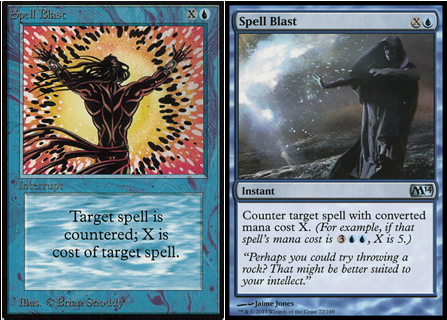
Remember Classic Sixth Edition that I referenced before? Well, that's the last time Spell Blast was reprinted, which means it was one of the first card types to be changed from "Interrupt" to "Instant" in the big time rules change. I once read (and agree with) the criticism that you don't want to be paying MORE mana to counter an opponent's spell than the player paid to cast the spell to begin with, but sometimes it's better to have the option to make a spell not to come into play than not, even at an exorbitant cost. Also, I have the suspicion that Wizards just put this card in the core set to have an excuse to explain the concept of converted mana cost in a parenthetical reminder (cf. Strionic Resonator and triggered abilities). Rules Change of Note: the change from the passive voice ("Target spell is countered") to the imperative ("Counter target spell...").

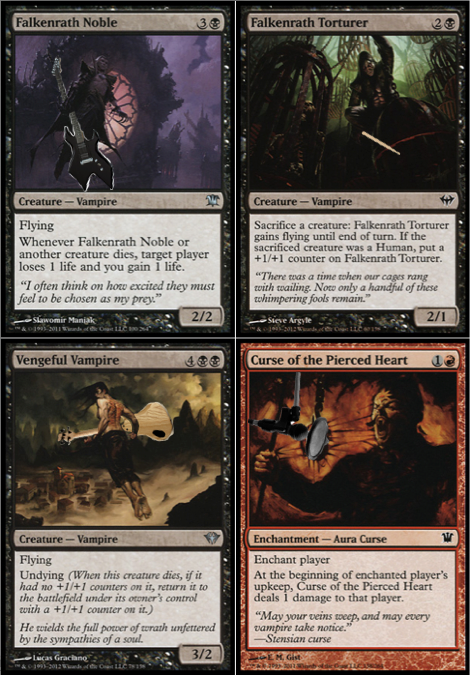
Nightmare is one of those cards where a pun seemingly unsuspectingly became an official part of the game's rules, although now it's a little less pointed with the addition of Horse to its creature type. The first of the 21 creatures with the same type that now exist is back from a three year absence after not missing one core set since the very beginning! He definitely went out on top, being the featured foil rare in a Magic 2010 intro pack, but now he's back and with new artwork to boot. With mono black devotion being a working archetype these days - the Born of the Gods event deck was based around the Gray Merchant of Asphodel ability.

Back next time with the final six!

Tuesday, May 13, 2014

Thoughts About Game of Thrones and Magic

Sunday's episode of Game of Thrones, "The Laws of Gods and Men," aired on Sunday, which means that, according to industry jargon, watching it on Monday (as I did) would technically be a "live-plus-one viewing," since I watched it one day after it had aired. So then if I review it on Tuesday, that review goes up on Day Live +2. But before I start getting confused by how they measure those TV ratings, all those +'s got me thinking of Magic: The Gathering (as in +1/+1 counters). And also the term God is used in both tonight's GoT episode and MtG's most recent expansion block, which takes place on the plane of Theros. I've paid devotion to three Theran Gods in my time in the Planeswalker Program, each representing one or a pair of the five colors of mana (abbreviated WUBRG). I noticed that some characters on Game of Thrones also correspond to the same color wheel (if not the same pantheon) as used in the game of Magic.

#ImpressiveVisualEffects
The first mention of color I noticed in "Laws of Gods and Men" (or, for more industry jargon, Episode 406) is when a jovial pirate (with very good taste) tells an old joke involving a ship's captain and a red shirt - a joke that my father and I had been telling since the holiday parties of my childhood. Suffice it to say, he joins up with Stannis Baratheon, the possibly rightful heir to the eponymous throne, who is himself very well acquainted with red mana. After all, his most trusted and most powerful ally is known as the Red Woman. And he lives in Dragonstone, and dragons usually cost red mana to summon in Magic. Speaking of Magic colors, the Iron Bank is clearly colorless, since I'm pretty sure Stannis and Davos's skiff (Is skiff appropriate?) sailed right past the Colossus of Akros.

And speaking of dragons, we got a good look at one of Daenerys's's dragons, which used its firebreathing ability to burninate / barbecue some sheep. Seeing as firebreathing is a red card, Dany definitely costs red, but she's all into justice too, so white makes sense. Plus Jorah Mormont and Barristan Selmy (JR and BS for short) are knights, which are usually white. Plus her rule wsa forged in the Dothraki plains and all. Should there be a third color, since she's a contender for the throne? Probably blue, since she wears blue, and also based on the way she gains control of all these armies...

See the resemblance?

I think a character who definitely wields three colors well is Tywin Lannister, one of the few people actually fit to be king, as evidenced by the fact that he's basically acting king. Right away I pegged House Lannister as identifying with White, Red, and Black, based on both their standard and the way they act -- and if they all three go with Tywin, it allows his three offspring to each get a different two-color combination (also known as "guild" in the nerd jargon). Jamie, the Kingslayer, inherits red and white: he's got a sense of honor, but his passion and incendiary nature  often get the better of him. Tyrion, also referred to as Kingslayer this episode, seems a good fit for black and white: he was master of coin at one point, so he fits in with the coinsmiths and the users of the extort ability word. Cersei is black and red: referred to as the "mother of madness," need I say more? Also this way it allows the late King Joffrey (before he was placed in the Lannister graveyard, so to speak) to go back to the three-color-combo, since he inherited all three colors from his true parents, heyo!

I thought a lot about what colors the rest of the houses might be, but when you go up north, things start to get so that you almost have to venture into Dungeons and Dragons alignment territory: Wildlings are Chaotic Evil, the whole Bolton/Frey contingent is Neutral Evil. If Targaryen (or House Stormborn, for easier spelling, but not to be confused with House Swarmborn) is Chaotic Good while the Lannisters are probably Lawful Neutral, with a little bit of all the spectrum mixed in throughout the bloodline, then House Stark is Neutral Good. But as none of them appear in this episode, let's go to some other random musings to end today's thoughts:


- Back to Magic: The Night's (Knight's?) Watch is obvi mono Black (hello, Castle Black, duh), but who cares, since we didn't see any of them in this episode anyway.

- Prince Oberyn, whom we did see, pretty clearly embodies the precepts of the Red Green combination. I mean, the trademark RG Planeswalker Xenagos is named "der Hedonist" in German. Not that its name has any bearing on game play...

- I could picture a good Duel Deck: Ramsay Snow (mono black, Human Berserker) vs. Yara Greyjoy (mono green, Human Scout). Each side would have an Alfie Allen card: one would be Theon of the Iron Islands and the other would be Reek of Dreadfort. #FlavorWin

- Theon/Reek went deep with his personal identity crisis this episode. Maybe it was the scars, or the performance, or the pale and drawn look, but I kept equating his relationship with Ramsay to what would happen if there were a Good-aligned Gollum and an Evil-aligned Frodo.

- More Magic: idea for King's Landing mirrored pairs: Varys, White/Black, Human Advisor with lifelink. Grand Maester General Veers, White/Black, Human Cleric with deathtouch. Maybe they both have extort? Maybe neither?

- And finally the last line of HBO's blurb about the episode referenced a Throne Room, which I equated not to the throne on which the game is based, but on the music from the Throne Room stage in the Genesis port of Mortal Kombat, even though that music is really based on the theme that appears in The Pit stage of the arcade game. #VideoGameBGMTrivia

Monday, May 5, 2014

Astrology Baseball: Checking in for May

The stars have shifted, we're in the throes of Taurus, and it's time to check in with my astrology baseball league. Last year I sunk a lot of time into this project, tinkering with each team's roster every week, subbing out slumping and injured players for more relevant ones. This year I was not nearly as ambitious, only periodically checking the standings and only making the odd change here and there. However, today, as I was checking the fantasy stats of the top players in the leagues to determine my first round of All-Star voting, I saw that some of said best players were not being fully utilized by their starry affiliates. And given that today's the first day of a matchup that begins in a new month, I thought it was a fine milestone to do some lineup adjustments. Whether this will turn into a monthly thing, who can know, but for now, here's what I've gleaned from the state of major league baseball through watching the stars.


First, it's no wonder that the Rockies are doing as well as they are given the monsterful performance of Troy Tulowitzki (fantasy's top hitter, according to my point system) and the unforeseen breakout of Charlie Blackmon (who has already equaled his 2013 HR, RBI, and BB totals, but in 50 fewer games). I was astute enough to grab Blackmon off the waiver wire for my own fantasy team, but I was also foolish enough to draft Yasiel Puig (currently day to day having crashed into ANOTHER wall) in front of fantasy's number 2 hitter Giancarlo Stanton, who's putting up the types of numbers he couldn't produce for me last year when I picked him first. I think I've officially changed my draft day stance from "once bitten, twice shy" to "he couldn't possibly disappoint so severely two years in a row."

Tulo and Stanton's performances have helped put their respective astrology teams (Libra and Scorpio) at the tops of their respective divisions (Air and Water). Capricorn, meanwhile, is leading the Earth division, and they got to that point without the help of the game's top relief pitcher Francisco Rodriguez. I obviously hadn't been paying enough attention to the Brewers' closer situation (to be fair, MLB.com's rankings indicated that Jim Henderson would get the first crack at the job), and the veteran has been reaping the benefits of his club's hot streak to start the season. It looks like the old Sea-Goats are climbing back to the powerhouse they were in 2012 rather than the .500 mediocrity of 2013.

The two best starters in the game right now - Johnny Cueto of Aquarius and Jose Fernandez of Leo - have yet to lead their teams to a winning record. But possibly the changes I've made - getting Julio Teheran and Nate Eovaldi in the AQU rotation, and swapping out the slumping Pablo Sandoval for Mark Reynolds and hoping Jesse Chavez's brilliance as a fill-in starter for the A's continues on the LEO side - will improve their fortunes. The only other active starter to average more than 100 points per game is another dude I picked up on waivers, Tim Hudson. Funny how my two big pickups this year both play for the Cancer astrology team, yet they currently are ahead of only the winless Pisces Fish in the standings. I just hope they can turn things around by birthday, otherwise we'll both be in for a long summer.

Saturday, May 3, 2014

Liveblogging: Astros vs. Mariners, 5/3/14

As I look at the lineup from MLB.tv's free game of the day, featuring Mariners 2013 co-ace Hisashi Iwakuma in Houston, I notice that there is no sign of top prospect George Springer in the Astros lineup. Springer made his major league debut last month and thus has never faced Iwakuma, who is making just his 2014 debut this afternoon. Mariners fans (or at least their broadcasters) sure are happy to see the Tokyo native return to the mound, as he missed the first month of the season with a sprained finger tendon on his pitching hand. Top 6 2B Jose Altuve (who  has always done well against Iwakuma, according to a reminder from the Astros broadcaster) got another strong hit against him to start the game, but didn't end up coming around to score.

I noticed right away that the starting lineup graphics from the CSN Houston broadcast (again courtesy of MLB.tv) reminded me a lot of the graphics from MLB 14 The Show on PS3, but interestingly enough, so did the strange "ghosting" I sometimes see on especially strong throws by fielders. What I once attributed to a flaw in the programing of the game might be an inherent issue in how the console presents the game of baseball...

King Felix Hernandez's partner in crime last year ran into some trouble after a Marwin Gonzalez "curved" an infield single into a Jonathan Villar triple for the first run of the game. With his appearance at no fewer than five positions this year, I think Gonzalez has earned a UT in front of his name, in the old All-Star Baseball style, which makes him that much valuable to roster-building. Altuve, the pitcher's old nemesis, produced another run with a sac fly, making that a H and an RBI for him, although it took him two different plate appearances.

Altuve's opposing 2B, and one of the most talked-about players of the offseason, Robinson Cano cut Houston lead in half with a bloop single that scored a Stefen Romero triple, but did not make it to scoring position that inning, proving that the sequence 1B-3B is inherently more valuable than 3B-1B. Matters of sequence and play order, which in baseball is most strongly reflected in lineup construction, are what's known in Magic as "tempo." Having a good tempo relies heavily on the "mana curve," which is industry jargon for making sure you have enough resources to make a strong play each turn. If you equate spots in the lineup with turns, and players in the lineup as individual cards, it's easy to see how one can be a microcosm for the other!

Iwakuma has remained sharp, unlike Dallas Keuchel (again, pronounced KAI-cull), who walked the bases loaded in the 7th. It was apparent to everyone, especially Seattle manager Lloyd McClendon, that Houston's Bo Porter hadn't correctly managed his resources in terms of pitching, as he was obviously stalling for time while the reliever who was obviously going to replace Keuchel needed an inordinately long time to warm up. The former outfielder who last managed the Pirates in 2005, stormed out of the dugout, fuming about something, which apparently not only scared Porter into making a pitching change, but also scared reliever Jose Cisnero into walking the next batter (yes, with the bases loaded) to tie the game. That's one of my favorite plays to watch, because it requires such good discipline: Not only from the batter, to lay off the tough pitches, but also from the fan, to remain interested for the immense amount of time it takes to develop.

But that was just the beginning for the Mariners, who really ramped into some serious damage with run-scoring base hits from Canadian representative Michael Saunders, the aforementioned Cano, and my starting fantasy 3B Kyle Seager, extending his hitting streak. This was all followed by a two-run home run by the not-quite fantasy relevant Justin Smoak, proving that the sequence of X-HR is always more valuable than HR-X, where X is any positive offensive play in the game.

The sequence of Gonzalez-Villar struck again for two quick runs, but this time following a solo shot from former A's prospect Chris Carter, playing his natural position of DH. Jose Altuve created another run with his heads up baserunning, but this time it wasn't even against Iwakuma, as low-leverage reliever Dominic Leone had come on mid-inning. But he was out after that play of what was all of a sudden a close game, giving way to lefty specialist Joe Beimel. You can see here that McClendon is setting up the classic LOOGY/Set Up/Closer dynamic, provided the M's don't break it open again.

Speaking of classic bullpen usage, I believe Bo Porter could have avoided some drama earlier in the game if he had been willing to revisit the often-overlooked concept of what I'll refer to as the Long Save. Some non-nerds might not know, but there are two conditions to earning a save: 1) pitch the ninth with a small lead, etc., and 2) pitch the final three innings of any game. Dallas Keuchel has had a pretty good season so far, with both primitive and advanced metrics pegging his ERA at right around 3 1/2, but he hasn't had the track record of a guy who can consistently pitch past the 6th inning effectively, and would be most effective when combined with a long reliever, or spot starter who could certainly pitch three innings effectively. Guys such as Jerome Williams or Paul Clemens both fit that mold on the Astros roster. Bringing in one such "Long Closer at the start of the seventh (or at least having one ready to go by then) would have been a much faster play, and would probably not have drawn such ire from the opposing manager.

On second thought, seeing as the seventh inning ended with a caught-stealing play, leaving lefty Jason Castro still at bat, Beimel will remain in the game for the lefty-on-lefty matchup only, forcing McClendon to waste time with a non-commercial-break pitching change  to bring in Yoervis Medina. At least he made the call quickly so as not to provoke a tantrum from the other bench. Medina's a classic middle relief, bridge to the closer guys, who you really want to see work quickly and drama-free if they're on your team, but are also not that surprised to see them get hit hard, since there is so much volatility among relievers. Like what just happened when 3B (and fellow Iwakuma-nemesis) Matt Dominguez, Chris Carter, and Alex Presley (batting in George Springer's future spot in the lineup) combined for big hits to put the Astros within one, with the familiar tough out Marwin Gonzalez (3-3 today) coming to the plate. Let's see what happens!

UPDATE: Right after I was going on about traditional bullpen use, Seattle's second-highest profile Dominican free agent signing, Fernando Rodney heroically came in to record the four-out save, but not without a lot of "heavy breathing" as the TV pundits put it. Another game in the books from the wild AL West!

Monday, April 28, 2014

Magic: The Gathering - Journey into Nyx Prerelease

Another fourth of the year has gone by, so it must be time for another Magic: The Gathering Prerelease event! For those of you who weren't nerds in the late 90's, Magic is a collectible trading card game that releases its best new cards in the form of expert level expansion sets, which always come in blocks of three sets that share the same gameplay and storyline related thematic elements. This weekend's set was Journey into Nyx, the third set in the Ancient Greek mythology themed top-down Theros block - named for the first set in the block, and the prerelease event of which I attended last September. I skipped the middle events but did indulge in a Fat Pack from the more generically named Born of the Gods (BNG).

L to R: Prognostic Sphinx, Xenagos, God of Revels, and Doomwake Giant

Like the other two sets in this block, this prerelease event involved building a Sealed Deck, made from the cards you purchase at the event, some (or all) of them making their debut. Each sealed pack (i.e. pool to choose from) includes six booster packs of 15 cards each (so roughly 90 playable cards total), one of which is weighted toward a color of your choice. Back in Theros (THS), I picked Blue (U), not only because I consider myself a blue mage at heart, but because the blue promotional card that you're guaranteed to get in your "seeded booster pack" (Shipbreaker Kraken) was one that I would be happy building around. A 6/6 for six mana is already pretty big and efficient for blue, but the ability to perma-tap four creatures AND swing for 10 on a card that is flavor-relevant to boot? Sign me up!

The Journey into Nyx (JOU) promo card for Black (B) is not a card to build around, but I made the choice to go for that color path (Forged in Tyranny) for various reasons that I don't have to discuss here, since I know you want to hear about the cards and deck building that went on at Aero Hobbies and Games this past Saturday! Since JOU is the third set in the block, you get access to packs from the other two sets as well, so before the match I did some extensive research into all the cards in the block to prepare. For those interested, I aggregated the rankings (on a 0 to 5 scale) from my two new favorite magic sites, ThoughtScour and ChannelFireball, into a database also sortable by color, set, type and converted mana cost. Those not interested can skip the preceding sentence.

Just picking a color for your seeded pack does not guarantee that you'll get to run a deck in that color, but the guaranteed promo rare is a good place to start. Doomwake Giant, a 4/6 for five mana, is a powerful, efficient creature on its own that was tied for the best Black card in the block (average 4.25 rating), according to my research.  However it's also an enchantment creature, so it can make use of the new Constellation ability to ping all your opponent's creatures for -1/-1 when it enters the battlefield. Not a very effective board clear in a format full of giant monsters and ever-growing heroes, but I did use it to take out a couple of problematic weenies over the course of the tournament.

After opening all my packs and going down the list by aggregate ranking, the next highest upside card I had was Keepsake Gorgon, a classic defensive creature with deathtouch and a fat butt (a term that refers to having greater toughness (5) than power (2)). Then when I saw the two top Black commons in the JOU set - Bloodcrazed Hoplite (although I was noticeably light in heroic triggers) and Pharika's Chosen (in keeping with the deathtouch theme) - and a few top notch removal spells - both conditional (Asphyxiate, Feast of Dreams) and unconditional (Lash of the Whip) - I was content to try my luck in my chosen color. Not just my aforementioned predilection for Blue magic, but also one particular relevant rare, drew me to my second color: Curse of the Swine. Being able to replace any number of my opponent's creatures with 2/2 Boar tokens (read: bacon) could be the benchmark of a U/B control deck - plus it's also flavor relevant. Add to that little trick three beefy sirens (one War-Wing and two of the Cloaked variety) and some conditional counter magic (portmanteau'd into An(Nul)lify) and we were in business.

One of the high-impact cards in my seeded pack almost pushed me into a splash of Green: Pharika, God of Affliction. She sure is cheap (3 mana), but I didn't think I'd have a lot of chances to use her ability (turning creatures from a graveyard into Pharika's Chosens), and splashing a card that relies on devotion to get full use out of it didn't seem to make much sense. So even though I had some good heroic triggers in G (Feral Invocation and Nyxborn Wolf), a nice graveyard synergy in the Nyx Weaver, and a Golden Hind for mana ramping, I decided against it. At the last second I almost splashed some White for the sake of another evasive heroic dude (Akroan Skyguard), the set's only good tapper (Akroan Mastiff), and a couple of the good bestow creatures (Heliod's Emissary and Observant Alseid), but in the end I decided to go with a straight two-color combo.

There were 20 people at this prerelease, more than at any other Magic event I had attended, so we needed to play five full rounds to determine a winner. I ended up in fifth place with a record of 3-2: I won my first two matchups pretty handily, got swept due to mana issues in my third, came back from a first game loss in match four, and then got swept in the final matchup due to some poor decisions. My deck also may or may not have been outclassed in the last one, but honestly, after six full hours of Magic, the fatigue starts to set in. When I had an adequate land-to-playable ratio, I was mostly able to control the board with a combination of my army of fliers and timely deployment of removal and counter-magic. Benthic Giant actually proved to be the MVP of two different games: the first time, his hexproof ability allowed him to stay on the battlefield while fearlessly attack into inferior blockers, and second, I was discarded him to buff my Erebos's Emissary-bestowed Cloaked Siren to fly in for lethal damage. But my favorite play of the afternoon came when I was facing a Cavern Lampad-bestowed Elite Skirmisher who had me on a two turn clock. On my turn, after his second attack, I used my best heroic trigger, Triton Tactics, to UNtap my opponent's intimidating creature, putting it in range of my Asphyxiate, FTW. Needless to say, the really strange look I got after the first part of that combo was justified by the look of sheer disappointment when I completed it.

We all got a bonus booster pack for participating, and what did I pull as my rare but ANOTHER Pharika. Since I'm not likely to build a Golgari deck in the near future (I never was a fan of affliction as a concept), those two Gods are likely to hit the trading block (like the pre-banned Deathrite Shaman I pulled back in the day). However, I'm not entirely sure what I would trade them for. When Phenax, God of Deception (read: God of Milling) first made his debut in Born of the Gods, I went on a quest to build an EDH deck with him as my commander, which kind of scratched my constructed itch for a while. As of now, I'm more interested in exploring more limited play, where players have to rely less on either infinite knowledge of past expansion sets (legacy) or infinite financial resources to buy four copies of all the best cards (standard). Whatever the future holds for my relationship with M:tG, I thoroughly enjoyed playing with others at the conclusion of another fine expansion block.

Thursday, April 24, 2014

All-Acquired 2014 Exhibition Series: Game 1

Mark Trumbo takes his hacks, representing the National League
Over the past couple of weeks, I've been compiling a database of the more than 1,300 players included in MLB 14: The Show with an eye towards facilitating the various roster construction based projects on which I like to spend my time. Having the most recent MLB-branded game allows me to plug my custom lineups into the PS3 and see what might happen in a hypothetical game situation. Because while it's a lot of fun (for me, at least) to build these rosters and write them down on paper, nothing compares with seeing your work brought to life in hyper-realistic 720p via the game's simulation engine.

The first of these projects is not only the least labor intensive, but also the one with the longest track record on this blog: the AL and NL All-Acquired Teams. These two rosters, one per league, are made up of the top players who changed teams during the 2013-14 offseason, and thus serve as a sort of summary of the top trades, free agent signings, and wavier wire pick-ups of the winter. The last time I got to see this project brought to life in a video game setting was back in 2011, and a lot has changed since then, so let's get right down to the World Series formatted showdown between the two teams. Rather than going through the lineups player by player, I'll combine my analysis with play-by-play commentary, starting with Game 1, and possibly continuing if there are more storylines I want to address.

I used 2013's World Series teams to represent each league, and it only makes sense that the AL should have home field advantage, since Boston won it all last year. Thus the first player introduced is the AL's top acquired, and most enigmatic, starting pitcher: Japanese phenom Masahiro Tanaka. When creating these rosters, I had to use the first downloadable update (dated 4/7) as my base, since the game's default rosters lacked such key acquired players as Tanaka and new Miami 3B Casey McGehee. The disparity between these two players pretty much sums up the differences between the two leagues in general: a lot of high-impact, franchise player types for the AL and a lot of middling placeholder types for the NL.

Speaking of placeholder types, the first batter to step in against Tanaka is new Miami 2B Rafael Furcal, despite the fact that he hasn't yet played a single inning in a Marlins uniform due to a hamstring strain. His presence in this lineup illustrates one of the main differences between crafting a roster for a video game (which is based on talent and potential) versus crafting a roster for a fantasy team (which is based on real-life playing time). I decided to ignore Furcal's current placement on the DL because he has a higher ceiling than replacement options Mark Ellis or Emilio Bonifacio, and because this NL roster needs all the help it can get, especially offensively.

On the pitching side (again, as long as you ignore current DL status) the NL sports more high upside types, particularly considering that this thought experiment takes the form of a short series. Relying on a rotation staffed primarily of near-40-year-olds - Bartolo Colon (40), Tim Hudson (38) and A.J. Burnett (37) - to stay healthy over an entire 162-game season is a risky proposition indeed. But as of now, Fister got a break, as Jacoby Ellsbury - who got on base via a leadoff walk and then promptly stole second base - promptly got thrown out trying to steal third. A questionable decision by the AI, given that there was one out, he was already in scoring position, and arguably the AL's best left handed hitter (Robinson Cano) was at the plate.

A Jarrod Saltalamacchia homer over the green monster in the next inning drew first blood in the next inning - a fitting player to strike first in our venue as he late of the Red Sox himself, signing with the Marlins as a free agent. Then the wheels started to fall off for the AL club, as they allowed another run the following inning on a wild throw to first while attempting to complete a Curtis Granderson swinging strikeout on a pitch in the dirt. This does not bode well for the Yankees, as Tanaka's nasty splitter is likely to lead to a lot of similar plays, and if Brian McCann (also signed by New York in the offseason) can't handle those throws to first regularly, it's gonna be a long season in the Bronx.

The NL manufactured a couple more runs, chasing Tanaka out of the game after 4.2 innings. In to relieve was Houston's big signing, Scott Feldman. I don't generally like to load up these video game rosters with starting pitchers, since it's unrealistic and can be overpowered, but Feldman was one of two extra starters I allowed on each roster to fill out the "Long Relief" spots. Actually, one thing about the game's ranking system is that it somewhat overvalues relievers - Grant Balfour is good (rated 83 overall), but I don't see him adding more value to a team than Masahiro Tanaka (81). However, I appreciate that peculiarity because it's a built-in way to keep CPU-generated rosters from filling up their bullpens with starters.

No sooner did Feldman enter the game than two former Cardinals on the AL team made it a competitive affair. First David Freese hit a solo homer, then an inning later Carlos Beltran took out a two-run shot. I don't know if the game's AI has a built-in vengeance-meter, because with Salty's homer earlier in the game, that's three players who put the hurt on their former team at the plate. Of course for the purposes of this experiment, the "Red Sox" and "Cardinals" really represent the AL and NL, but there's no way for the game to know that.

Those two long balls amounted to the only offense the AL could muster however, and despite an in-game injury to NL setup man LaTroy Hawkins (he struck out Ian Kinsler, but bounced his first pitch to Cano and had to leave the game "holding his arm"), the bullpen was able to close it out in Game 1. After a little roster tweaking - Francisco Rodriguez will likely be called up to take the Hawk's roster spot - we'll see which league comes out on top over the course of the series!

Saturday, April 12, 2014

Video Game Review: MLB 14 The Show

When I put my new (for me) copy of MLB 14 The Show into my PS3 for the first time (it won't hit shelves for the PS4 for about another month), the first thing I saw was... a screen prompting me to download and install the latest updates, which took upwards of 20 minutes. It's loading times like these that make me nostalgic for All-Star Baseball 2001, the crowning achievement of baseball video gaming in the cartridge (i.e. no waiting) era. As it turns out, the default hitting mode makes the gameplay feel a lot like a clunkier version of that same game, but more on that later. First, I should mention the second thing I saw (and the first thing I heard) - an intricate opening movie showcasing gameplay footage highlight reels of the six major award winners from 2013 (Rookie of the Year, Cy Young, and MVP, one for each league) set to the song "Rival" by Black Rebel Motorcycle Club.

This opening title sequence gave me a lot of emotions to digest. First was disappointment, in that the polygonal character models and choppy swing animations still remind me too much of the early 2000's PS1 version of the same series (remember when it was Andruw Jones on the box art instead of Miguel Cabrera?). Then admiration, for the sheer level of detail in aspects such as stadium design, uniform variety (Jose Fernandez was shown in no fewer than four distinct jersey styles) and even stitching (the D in Detroit never looked so fancy). Then quizzicalness, as I was trying to figure out what the title song was. The only knowledge I have of BRMC is their song from Batman: Arkham City - The Album. Although it's nice that they have a video game track record, it's a decidedly less baseball-centric theme song than "Tessie" from EA's MVP Baseball 2005, the gold standard of both baseball video games and baseball video game soundtracks, in my (admittedly somewhat limited) opinion.

How little has changed from 2001 to 2013, except the aspect ratio and pixel count...

As it turns out, I was digesting these emotions long enough after the movie was over for the game to launch into demo mode, before I even selected a preferred difficulty level (my choices were Beginner or Experienced). As fate would have it, the two teams that the AI chose to pit against each other were two teams to which I have an extra special attachment: the Oakland Athletics (personal) and the New York Yankees (family). The initial introduction of the teams and stadium by play by play caller Matt Vasgersian was just as impressive and detailed (in its own way) as the intricate uniform stitching - they've even got the names and likenesses of the base coaches! Watching the gameplay itself is very reminiscent of watching a regular MLB game, especially in the pacing - I counted an average of about 15 seconds between pitches, but at least in the early innings, these seconds were filled not only with player animations (batters stepping out of the box, pitchers wandering around the mound) but also fun infographics about the matchup/weather/etc. Changing the mode to "Fast Play" reduces the between pitch time by about 10 seconds, making the proceedings feel slightly more like the old days of baseball gaming.

I only got through watching one full inning of the game before I was tempted to hit the Select button on my controller to join in the game. Somehow it knew to put me in control of the A's, my favorite team in all the major leagues (maybe this was because they were the home team). However, there was something notably out of date about the pitcher I was to control - it was Jarrod Parker, who WAS slated to be Oakland's Opening Day starter, until he went down for the season after undergoing Tommy John surgery (the second of his career) which was announced on March 17. His presence at the top of the rotation brings up two interesting questions about how the game: 1) what date were the default rosters finalized and 2) how it handles injuries to key players. In a game that lets you control a dynasty for multiple years, it doesn't seem right to leave players out of the game entirely just because they're slated to miss one season, but I have to believe that if the programmers knew about Parker's injury, they would have moved him out of the Opening Day slot. More research is needed to find this out - it's only been a couple hours of gameplay after all.

Parker faced a Yankees starting lineup that was accurate, to a man, to my projected lineup for them (which was the same as ESPN's AL preview, but slightly different than Sports Illustrated's - but only in Brett Gardner's spot in the batting order). The only notable change for the A's lineup (not including batting order) was probably due to the presence of left handed pitcher CC Sabathia on the mound - they have Nate Freiman in there as the DH, as if this were still 2013 and the Rule 5 pick had to stay on the major league roster all season. In reality, Freiman started the year in the minors, but I don't begrudge the game this inconsistency. After all, there was no way to predict Daric Barton's hot spring (that sounds like a late night Skinemax TV show, doesn't it?) or that the A's would carry TWO left-handed hitting first basemen on their roster in this day of platoons.

The pitching interface no longer follows EA's model of holding down the button corresponding to the pitch you want until it fills up a power meter, and then releasing/re-pressing it just at the right moment. Instead, you only need a single button press, corresponding to the smallest point on a rapidly expanding and contracting circle, like shooting free throws in old timey basketball video games. I walked a couple batters, but also struck out two, in my first inning of work. Coming up to the plate, I was surprised to see a moveable target in the strike zone, presumably representing where I wanted to swing. This is the same setup as the All-Star Baseball's of the late 90's, but with one extremely important difference - in the old N64 classics, they showed you where the ball was heading, giving you a point of reference for your own target. In this system, you just have to guess. I ended up hitting a home run in my first ever at bat - a lined shot from Yoenis Cespedes that literally hit off the right field foul pole - but my next three batters proceeded to strike out swinging. Then when I gave up a home run to Jacoby Ellsbury in the next inning, I knew it was time to leave this gameplay stuff for the birds and try out a little roster construction.
The layout of the roster management section is insanely in-depth. You can sort players not only by position, league (you can/must set lineups for all levels all the way down to A-ball), and overall rating, but by advanced statistics such as RC and WAR, salary, and how many option years that player has remaining. I knew right away that my All-Acquired exhibition series is not only going to look awesome to watch, but the teams will also be super fun to put together with this new and improved user interface. I'm still in the dark as far as when the rosters were finalized judging by the top two players in the Free Agent category: Johan Santana didn't sign with the Orioles until March 4, which makes sense, but Chris Getz caught on with the Blue Jays back on January 20. Could it be that there are just some inconsistencies when it comes to non-roster invitees? Or maybe not even baseball video game programmers pay as much attention to the MLB transactions column as I do...

While I might be done with trying to actually play the baseball aspect of the game (I'm not the first to complain about the offensive woes of this series), the overall experience looks like a lot of fun. I'm definitely looking forward to hours of roster tinkering and to getting more familiar with the songs on the soundtrack, and to using the game as a simulation engine to preview alternate realities. It would have been nice to experience the game in the full graphical splendor of the PS4, but knowing me, I won't get around to buying a baseball game for that system until the PS5 is released.

Thursday, April 10, 2014

Non-FastCast Hero: Victor Martinez

I made a snarky tweet last night that was poorly-timed, inadequately researched and which might have contributed to taking the karmic wind out of the Dodgers' sails in the late going. It was the middle of the 10th inning, Tigers catcher/first baseman Victor Martinez had just hit a go-ahead home run, Los Angeles's pitcher slot was coming up first in the inning (at least according to MLB.com's Gameday app) and Yasiel Puig was not in the starting lineup. So I made the strategic suggestion that he might pinch hit to lead off the inning, if he promised not to slide. Had I looked at the game summary, I would have known that a) Gameday gave me some wrong information and it was actually Hanley Ramirez due to hit first, and b) the speculation was all moot anyway because Puig had already come in to pinch hit in the 9th inning. Well, now my mistake is forever enshrined in a server deep in the Library of Congress... but it's from mistakes that you learn the most, right?

Speaking of learning, "watching" the Tigers shift their lineup construction to play in Dodger Stadium bespeaks a competitive spirit that is hard not to admire, despite how much I want to see them not win any more playoff games (especially against the A's, but also in general - because of their history against the A's). Victor Martinez, primarily a DH since signing with Detroit in 2011, has expressed a willingness to move back behind the plate on a more regular basis, specifically for series in NL ballparks such as this one. What's more, when the game went into extra innings, first baseman Miguel Cabrera shifted from first to third, allowing V-Mart to remove his mask and pads, and finish the game at a less strenuous position (he is 35 years old and missed all of 2012 with a knee injury, after all).

#DigTheDreads
I put "watching" in quotes in the previous paragraph because without cable (or satellite) or MLB.tv, it's difficult to really watch any baseball action except the highlights, which is why I pay so much attention to MLB.com's FastCast. Speaking of which, Martinez's heroic extra-inning performance didn't even merit the cold-open highlight spot on yesterday's FastCast. That honor went to Jayson Werth, whose 8th inning grand slam put the Nationals on top of the Marlins. I guess Detroit's win makes more sense if you see it in the context of Los Angeles mounting an impressive comeback against Joe Nathan to tie the game in the 9th, only to have their own closer Kenley Jansen give up the lead they would never regain. Also featured in yesterday's FastCast was Ervin Santana's Braves debut, in which he's showing off some pretty groovy dreads.

While browsing around MLB's media archive after watching this morning's show, I discovered that MLB puts out a FastCast not just every day of the major league season, or even every day of spring training, but every day of the year! I had previously resisted signing up for MLB.tv because it's seriously doubtful that I'd do anything else with my time if I had access to every pitch of the MLB season at my fingertips. But knowing that there is an archive of daily highlight reels, documenting not only in-game events, but also off-the-field news, is a slippery slope in itself. I still need to leave some time in the day to play MLB 14: The Show...

Tuesday, April 1, 2014

FastCast Hero #1: Neil Walker

Every day (or at least every day that I've cared to check) the good folks at MLB Advanced Media put out a nifty video recap of the day's baseball action called the FastCast. Each of these expertly narrated pieces generally feature one highlight (or a group of related highlights) as a cold open before going through the rest of the games. The cold open highlight yesterday (Opening Day, 3/31/14) featured Pirates 2B Neil Walker hitting a walk-off home run. On the surface, this event bodes well in terms of momentum for a Pittsburgh team/fan base that had been without a winning season for two decades before last year.

But now I'd like to talk a little more about Neil himself. He's a hometown hero of sorts, born in Pittsburgh in 1985 and drafted by the Pirates in the first round in 2004. His best offensive season was 2010, in which an .811 OPS and 12.0 fantasy points per game earned him top 5 of Rookie of the Year voting. Last year, he actually scored the highest rWAR of his career (4.0, after averaging 2.4 his first three years) due to a drastic improvement with his defense (according to baseball reference, his glove was worth 1.2 wins alone). According to MLB, Walker was ranked 228 overall, or roughly 15th among second basemen, making him not draftworthy in most leagues.

However, Walker does end up on at least one fantasy team of note this year: the Virgo Maidens. His big Opening Day performance helped put his astrological team pretty even in their matchup with the Pisces Fish as the second day of the season draws to a close. Pisces had some 2B trouble themselves with their projected opening day starter Jurickson Profar going down with an injury. The absence of Profar (who dropped from 126 to 380 in MLB's ranks after the injury) is not nearly as troubling for the Fish as it is for the Rangers because a) Texas has to deal with his absence in real life, and b) Pisces has Dustin Ackley (ranked 283) and Dan Uggla (340) in the depth chart as opposed to Josh Wilson (unranked) and Donnie Murphy (824, but who incidentally is also a Pisces, but not on their 40-man roster).

Pisces is also of course dealing with the extended absence of Mr. ESPN the Magazine cover story himself Clayton Kershaw, who went on the DL for the first time in his career after signing a record breaking deal. Coincidence? Probably not, considering he was shuttled back and forth to Australia in a publicity stunt, resulting in a shortened spring training and unfamiliar preparation rhythms. But maybe as the new face of the storied Dodgers franchise, he should be able to be a durable warrior and pitch through any kind of adversity. But then again, just ask how well that worked out for Los Angeles's previous poster boy, Matt Kemp. Kemp (53), meanwhile, wouldn't even help his astrology team, the Libra Scales, if he weren't on the DL - currently he's behind Andrew McCutchen (4), Carlos Gonzalez (5), Bryce Harper (19), and Jose Bautista (40) for the available OF/DH spots (not to mention neck and neck with Yoenis Cespedes (49) and Starling Marte (56) on the bench). But before you gawk at how unfair that offensive force is for one Astrological sign, keep in mind that their only 1B eligible player within MLB's top 860 is free agent Ty Wigginton. Funny how the universe has it's own way of working things out.

Tying it all back together to yesterday's (it is almost not even yesterday's) MLB FastCast, the final highlight unfurled a fact that I was sadly already aware of: that Oakland's loss to Cleveland makes it a record 10 straight opening day losses for the A's. But hey, even Jason Giambi's A's (in fact especially Jason Giambi's A's) were famous for starting off slow and heating up in the second half. Now that Giambi's on the Indians, let's see if the traditions collide... but not until tomorrow, on account of all the rain.