Wednesday, July 27, 2011

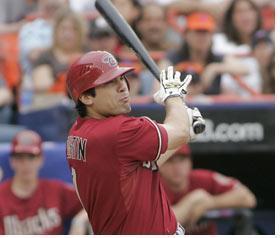
Developed Teams 2011: Arizona Diamondbacks

My grand plan was to profile the Diamondbacks in honor of their fair city playing host to the 2011 All-Star Game. But that was over two weeks ago and we're now closer to the Trade Deadline than the mid-summer classic. However, it's better late than never, and The Plan will continue as promised... if a little behind schedule.


For such a young team - having existed for just 13 short seasons - they have a remarkable store of talent. Their offensive prowess is evident from the list above, even if the key middle-of-the-order bats didn't spend considerable time actually playing for the Diamondbacks. Dan Uggla was picked up by the Marlins Rule 5 style before his debut, and put up very impressive power numbers for the Fish. Carlos Gonzalez was a major piece of a blockbuster trade to the A's while still in the minors (the same trade in which the D-Backs parted with Brett Anderson, btw). Carlos Quentin played about a full season's worth of games over his first two seasons in Arizona before having his best years in the south side of Chicago.

Of the recently-developed Diamondbacks still with the team, the breakout performances of Justin Upton and Miguel Montero have more than overshadowed Stephen Drew's disappointing production. Mark Reynolds just left the team last year, and we know he can mash, but he also can strike out a Major League record amount of times. The guys on the bench are nothing spectacular - Cust and Barajas are the only two who have spent any significant time starting for a Major League team. The rest are solid backups, which is more than some teams I've looked at for this project can say.

What really amazes me about the D-Backs is the abundance of pitching that has come out of their system over the years. Not all of it is top-shelf talent, but using just the players included on MLB 11: The Show's rosters, the 'Backs have 29 pitchers to their name. It's interesting that the game's youngest team (tied) has developed twice as many pitchers as the game's oldest team (bonus points if you can name that team. Hint: they already have an entry in this project).

As I said, not all of them are that high-caliber. Their three highest-ranked pitchers (according to MLB.com's preseason rankings) fall between 100 and 120: one is a potential star who's shown flashes of brilliance but can't escape injury (Brett Anderson), another has the exact same description, just replace "injury" with "mediocrity" (Max Scherzer), and the third is currently playing out the veteran star closer fantasy (Jose Valverde).

Brad Penny has had a nice career for himself (he's another guy who started his Major League career with Florida after lingering in the Arizona farm system), and Chris Capuano has been living comeback to comeback. It was of course an act of purest optimism to have put Brandon Webb on that list at all, seeing as he hasn't pitched since 2009. But the Sports Illustrated baseball preview had his name there, and MLB has him as the next-highest ranked pitcher after the above three I already mentioned, so I figured, whatever.

After Valverde, their bullpen gets a little weak, but thankfully they have enough surplus starters to back them up, even if everyone not mentioned above has struggled mightily this year. But, as I've mentioned many times before, this team was put together with pre-season rankings, since that's when I started compiling these lists, believe it or not. And since it's taken me so long to get through THIS much of the project, imagine how much more complicated it would have been while trying to keep up to date with all the stats...

Tuesday, July 19, 2011

Watching Games on "Double-Bloop"

Throughout most of this season, I've been somewhat neglectful of the actual standings, stats, and on-the-field proceedings, preferring to focus on historical data in the form of my various fanciful projects. But every once in a while, the stars of the baseball world align and draw you to the television for an especially memorable event. The Home Run Derby/All-Star Game was one such event. This weekend's four-games-in-three-days series between the Oakland A's and the Anaheim Angels was another.

I love watching the games live whenever I can, but more often than not my schedule requires me to record the games and revisit them later via DVR. When watching the games on delay, I find it increasingly difficult to limit my use of fast-forward to the commercials, and sit through the entire telecast. If a pitcher is taking his sweet time "setting the tempo" or a batter steps out of the box to adjust his unmentionables, or there's a break in the action to collect shards of broken glass from the field, I find myself double-blooping forward.*

Quadruple-Bloop (Double-Double-Bloop)
* "Double-Bloop" is a term I first heard from my cousin referring to watching a previously recorded program on the DVR at an increased speed. It was based on the sound made by TiVo systems when you push the fast-forward button two times in quick succession. As it happens, I don't have TiVo, but I still use the term... in the same way as I don't always use the Kleenex or Band-Aid brands, yet I'll still ask for them. 10 points for Branded America.

However, due to the uncertain nature of DVR technology, I'll often find myself wanting to skip just a few minutes of treacle here and there, but end up blasting way too far into the future or intermittently stopping and starting so much that it basically doesn't save any time and only adds to the frustration. So while speeding through Sunday afternoon's game last night, I developed a system of watching games on double-bloop that provides a good overview/summary while still letting you get through the game in less time than it takes to watch Return of the King.

First of all, I will watch the first three innings uninterrupted. This gives me a chance to see every hitter in the lineup bat at least once, get a sense of how each pitcher is throwing, and evaluate how the two teams look on the field. I've noted many times that Baseball is broken up into thirds, and in my experience, the first third of a game is usually the most telling about how the general tone of the game will play out. For example, when the A's tagged the Angels for 8 runs in the first inning last night, you could be pretty.... pretty..... pretty sure how the rest of the game would turn out.

Then, when the away team's pitcher walks off the mound after the third inning, and the increased speed begins, I immediately fix my eyes on the game status graphic in the corner/along the top of the screen. A lot of times, the action happening on the field is too fast to follow without getting dizzy, so I use the graphic as a visual cue to point out things it might be worth watching. This is also a strategy I picked up from my cousin, but for some reason, the system just clicked last night.

The first thing I look at is the score. If any number of the score changes, I immediately hit play and even skip back one or two 30-second intervals (if your system doesn't do that automatically on double-bloop). Scoring plays aren't always the most exciting or highlight-worthy, but runs are explicitly what win games and what most tangibly shift the momentum in a game. Even if it's not an especially interesting play, I still like to have a good handle on who scored, who drove him in, against whom, and generally who was involved in the play.

The next thing I look at is the number of outs. If at any time the number of outs jumps to two (as it will at least 17 times every game), I will push play and watch until the final out of the inning. Again, two-out plays aren't necessarily any more exciting than one- or no-out plays, but as far as getting a feel for the overall progress of the game, it's especially nice to see how a pitcher finishes off the opposition and also to see the between-innings line score. If we jump right from a one-on, one-out situation to a commercial, that indicates a double-play, so I will usually stop and skip back to see it, because double plays are generally either exciting or well-executed fundamentally - or both.

There are exceptions and situations not covered by these rudimentary rules. For instance, what about pitching changes? Spectacular diving catches? Benches-clearing brawls? The system isn't perfect - in fact, it hasn't been beta tested beyond the course of one game. But this is how I have decided to do it, and will continue to until I discover something better. And I've deemed it exciting enough to put out here on the Internets for all to see. Prove me right, people! Prove me right...

Thursday, July 14, 2011

The All-Star Game!

Remember when the All-Star game happened two days ago?  Well, I wrote something about it yesterday!  Here's a link to Charge-Shot!!!, a blog that holds a very special place in my heart... specifically a place that occurs on Wednesday afternoons...

All-Star Tuesday: One Year Later

Monday, July 11, 2011

Liveblogging the 2011 State Farm Home Run Derby!

11:08pm EST


And will you look at that!?  Cano has come back, not only to tie Gonzalez, but to beat him with two outs to spare!  Just when I was beginning to lose interest.  Just when I thought it was not about the competition.  Just when I thought the rest of the broadcast would be comprised of the first-timer going through the motions and flaming out after an impressive two rounds, he comes back with a flair for the dramatic and wins it all, proving that the Derby can be exciting and unbelievable and fun for the whole family.

We've had a lot of fun here tonight, but what we should take away from all this is that it's never too late for a feat of sheer will to help you overcome nearly insurmountable odds.  And that you should never give up, no matter how stacked the circumstances are against you.  And that it's not over until it's over.

I hope you've all had fun reading my real-time thoughts about the amazing piece of history we just saw occur.  And since I've still got an hour before my flight starts boarding, I've got nothing left to do but recount it in my head over and over....


10:51pm EST


Fielder's long road to 15 he needs to keep his league alive in this competition is off to a slow start.  I think we can call this one right now for the American League, both in terms of cumulative totals (53-19) and in that the eventual winner will come from the AL.  The NL may have won its first All-Star game in a long time last year, but they will have to wait until next year to seek triumph in the Derby.

So it comes down to this, a battle between AL contestants, between AL East players, between representatives from perhaps the most storied rivalry in the sport right now, the Yankees and the Red Sox.  Each has exactly the same home run total coming in (not that it matters).  Each has exactly the same on the line.

It's looking a little one-sided now, as Gonzalez continues his hot streak and gives Cano an equally astronomical mark to reach as he puts up a 13-spot on the board in the finals.  Pretty straightforward now as Cano is finished unless he can perform exactly as he did in the second round.  No flameouts allowed, or the Yankee's night is finished!


10:28pm EST


It's always around this time in the Home Run Derby that my interest starts to fade.  I've seen all the contestants take their swings.  This cumulative second round is really just an extension of the first round, which we've already seen happen.  The competition aspect is a little muted, unless Prince Fielder can follow up his awesome swing-off performance (5 HRs in 5 swings!) with an even more impressive second round - the lone NL representative will need another 5 just to put him ahead of the leader's first round performance, and that's assuming Gonzalez goes homerless in his next 10 outs.

Meanwhile Ortiz added 4 to his total, pulling him even with Gonzalez, so that all his teammate needs to surpass the team captain is one more.  Cano continues to mash, all but assuring him a spot in the final two.  (Although he'd better pull back if he wants to have anything left in the tank for the non-cumulative final round.)  Thus unless Fielder goes on a spree of 10+ homers in a row, he's pretty much out for the count.  Is it me, or does making the first and second rounds cumulative put way too much emphasis on the first round?  I guess the competition part is less important than just seeing all those power hitters up there doing their things.

Wow, Cano just blasted his 11th in the second round, to go with his 8 in the first round.  I predict a flameout, just like what happened to Jason Giambi in the fated 2001 contest when he lost to Luis Gonzalez after setting a first-round record.  To return to the present, Adrian Gonzalez just eliminated his teammate and captain with a single home run, but keeps on blasting more and more, tying Cano with 20 total homers.  (At least now each contestant has an equal chance of flameout.)  Fielder, the NL team captain now needs to belt at least 15 bombs in this second round to remain in contention.  At least he's going last to maintain the drama.  Although it's looking more and more like the blowout we knew it would be in the first round....


9:47pm EST


The two batters last to hit are the "Team Captains" of the AL and NL squads.  I'm watching this from an airport bar, sitting too far away to read any of the closed captions of the commentary, so I'm not exactly sure how this works.  In the rules, it says the top home run totals advance to the next rounds, so what should it matter what team they're on or who their captain is?  But I guess leadership counts for something, as David Ortiz and Prince Fielder get last ups.

I remember when "Big Papi" went through a scare a couple of years ago, where commentators and fans pronounced him gone from the ranks of serious home run threats.  But although he'll likely never again approach the 50-homer totals he's amassed in seasons past, he's still showing some pop out here in the desert.

Prince Fielder is an appropriate contestant to be up right now, especially considering all the hype surrounding the new Moneyball movie coming out.  (No, I haven't seen the trailers, and no, I don't plan to, despite my fascination with both the Oakland A's and the entertainment industry; Spoiler Free is the Way to Be.)  Some of you might recall that back in 2002, the A's draft team was terrified that the Brewers, who picked before the A's, would deprive them of their prize, outfielder Nick Swisher.  How happy they were when supposedly sentimental reasons (Fielder's father, Cecil, played for the Brewers in the past) led to Prince's selection, leaving Swisher for the A's.  And it's a good thing Beane didn't pick Fielder when he had the chance - when your team is second-to-last in the league with a .337 Slugging Percentage, who needs an offensive force with 50-homer potential?

Well, it's settled!  Or is it?  A-Gon and Robbie Cano are definitely advancing, but then we have three guys tied with five home runs apiece all vying for the last two spots.  It looks like we're going into a 5-swing tie-breaking swing-off for each three.  Since the totals from the first two rounds are cumulative, these tie-breaker round homers don't count towards that total.  It's nice that there's still a chance for equal participation from AL and NL... although the advantage clearly goes to the two AL-guys with high totals.

The final tally (swing-off totals in parenthesis, advancing players highlighted):


AL: 26
Gonzalez: 9
Cano: 8
Bautista: 4
Ortiz: 5 (+4)

NL: 15
Holliday: 5 (+2)
Weeks: 3
Kemp: 2
Fielder: 5 (+5!)


9:19pm EST


Jose Bautista: where did this guy come from, am I right?  Someone without any real history of smacking a lot of home runs last year suddenly discovers some amazing power and leads the league getting a chance to start in Toronto.  Now he's on pace to do something that has been done only eight (8) times in Major League history: finish the year with more than 60 home runs.  He's not going to set any Derby records with just four homers, but I'd rather have someone who can hit them in games than hit them in exhibitions any day.

I've got to say, I'm not too excited by Matt Kemp's chances to put up a lot of dingers here in Arizona.  He is famous for smacking hitting his homers to straightaway center field, and this park has a gigantic wall up there, plus it is extra deep.  I hope he doesn't try to change his approach to pull or push too much, because it's that straight-out power that helps him succeed in the 395-foot-to-CF Dodger Stadium. And sure enough, he didn't get one out of there until his final outs, with most of his hardest hits landing for flyouts to straightaway center.  I've got to say, I'm not very optimistic about the National League's chances so far...

AL: 21
Gonzalez: 9
Cano: 8
Bautista: 4

NL: 10
Holliday: 5
Weeks: 3
Kemp: 2


8:59pm EST


Wow, Cano's off to a hot start.  Three bombs in his first four swings.  If only he hit enough dingers during the season to crack the top ten in homers in the AL, it might justify his presence a little more?  Maybe it has something to do with his position - he and Rickie Weeks are both second basemen, not a position historically noted for home run power.  And yet there's his teammate, Curtis Granderson (second in the league in HR) providing Cano with a rosin bag and pumping up the crowd rather than taking cuts at the plate.  Puzzling...

Cano does have some kind of sweet swing, though, doesn't he?  Which brings me to another concern that potential #HRDerby contestants seemingly should have: the effect that taking so many "fake" swings has on one's regular-season swing.  Maybe it's some weird confirmation bias, but it seems to me that in the past, players who have performed well in the Home Run Derby suddenly experience a drop in power production immediately following the exhibition.  Perhaps Rickie Weeks is aware of that possibility and is using his bright-blue neon shoes as a superstitious way to combat this real or imagined trend.

I don't know if anyone has conducted any kind of study on this, but Weeks seems to be most likely to suffer a post-derby power outage than the rest of these contestants.  He only last year developed his power stroke, and who knows how all this emphasis on his big flies will affect his approach at the plate in the future.  Perhaps his poor showing in this year's Derby (only 3 home runs) will cause him to second-guess his swing and start making adjustments.  I wish him continued success - if only for the sake of his younger brother, who has just taken the first steps on what promises to be a long and fruitful career with the Oakland A's - but don't care too much about the rest of 2011, seeing as he's not on my fantasy team.

AL: 17
Gonzalez: 9
Cano: 8

NL: 8
Holliday: 5
Weeks: 3


8:41pm, EST

Looking at the list of players appearing in the 2011 State Farm Home Run Derby in Phoenix tonight, I can't help but cock my head to the side in slight confusion at how they select the participants.  I get that there are four representatives from the AL and four from the NL, but shouldn't it be the top Home Run hitters from each league?  You'd think so, but then why is Adrian Gonzalez (tied for 10th in the AL) stepping in to lead off for this squad?

And I know Matt Holliday did a good job of picking up his team when Phat Albert was down with that wrist injury, but when his another one of his teammates (Lance Berkman) is surprisingly leading the National League in Home Runs, don't you think he deserves to be up there swinging the bat, rather than commenting from the sidelines?  As much fun as it is to see the hulking, bald-headed, cornfed Sooner swing the bat, dude's not even in the top ten in the league.

I have to plead ignorance here; do the powers that be on the Home Run Derby committee go down the line of the players with the highest HR totals in each league until they get four that say yes?  Or is there some algorithm they make use of to determine the best contestants - one that takes into account home run totals from the current year, the previous year, while also weighing in some special "showmanship quotient" to make sure the broadcast is entertaining?

Maybe Berkman was approached for this honor and declined.  His amazing first-half comeback makes for a great story, but maybe he doesn't want to jinx it by putting himself in this kind of spotlight.  Maybe at age 35 and with a troubling injury history he's worried he might tweak something over the course of several dozen exhibition swings.  Or maybe he wasn't even asked, for some undisclosed reason.  Even after thinking about all these questions during the first commercial break, I haven't been able to figure it out.  Respond with thoughts in the comments section, or Tweet them at me why not at @Hunter_S_Batman

AL - Adrian Gonzalez: 9

NL - Matt Holliday: 5

Saturday, July 9, 2011

Developed Teams 2011: Philadelphia Phillies

Last week, in addition to meeting a White Sox fan from Chicago, I also met a Phillies fan from Philadelphia (imagine that).  I know several Phillies phans, but this is the first I've met since starting this Developed Teams project for my blog, so it brought to mind what might happen if we put a roster together with only the players that the Phillies developed and shepherded (most if not all of the way) to the majors.  Here it is:


When I did this project in the past, it was almost as difficult finding enough position players for the Phillies as it was to find starting pitchers for the Reds.  There were almost no hitters to spare, but luckily I could scrounge up just enough to fill a lineup card.  The majority of the heavy hitters are recently developed and hence still with the team (although Rollins, Utley, and Howard are all three reaching maturity and have all three had their issues with injuries).  Domonic Brown is in there over Pat Burrell cuz he was just ranked so darn high before his pre-season wrist injury, and it seemed wrong not to have such a sure future star in this lineup, even despite his lack of experience.  And Carlos Ruiz is becoming one of the most solid catchers in the National League.

As far as players the Phillies have let go, speed demon Michael Bourn is probably the best right now - he's tearing it up on the basepaths currently leading the league in steals.  Scott Rolen and Marlon Byrd are both well past their primes, but can also both contribute with their bats.  Pat Burrell is a former franchise-type player who's recently been relegated to spot-starter duty.  Nick Punto is still a solid backup utility infielder and "Tofu" Lou Marson is a fan favorite in Cleveland.

Starting pitching is this club's biggest strength by far - the Phillies are one of the few clubs who have managed to develop more quality starters than relievers.  Looking at just 2011, you'll see more struggling pitchers (Myers, Floyd, Drabek, Happ) than successful ones (Hamels, Wolf, Carrasco)... and even one who hasn't pitched yet in '011, and likely won't (Silva).  But as far as track record goes (or in Drabek's case, enormous potential), they definitely have all proven to be effective starters at some point in their major league careers.  Ryan Madson is the only pitcher who's had a taste of closing (at least they had one!), and Kyle Kendrick has proven himself an effective swingman.

If we were going by 2011 alone - which it is now more conceivable to do, since we've got half a season under our belts... although I will refrain from that and stick to my guns about using mostly pre-season predictions - Josh Outman would have replaced Silva on the list of long relievers, due to his (so far) successful comeback from a lost 2010 season.  Also in the bullpen, Simon would be out (citing lack of production more than his recent troubles with the law) and Tejeda has barely played this year.  Taking their places would be surprising success story Antonio Bastardo (0.84 ERA, 5 saves, in 32 innings) and Taylor Buchholz, a bargain-bin pickup by the Mets who is actually contributing at the major league level.

Strengths:
- Starting pitching across the board.  Veterans, prospects, mid-level starters, you name it.  Plenty of quality innings from this staff.
- A powerful middle of the lineup, provided it can stay healthy.  And good tablesetters at the top, with plenty of speed.
- A pretty versatile and talented bench to boot, with all positions adequately covered.

Weaknesses:
- Although it doesn't show up in this 25-man roster, a complete lack of depth.  Philly developed only 15 hitters total, which leaves just two (2) to stock in the "minors" in case of injury.


Next time, in honor of Tuesday's All-Star Game in Phoenix, I'll be profiling the Developed Arizona Diamondbacks.

Thursday, July 7, 2011

Developed Teams 2011: Chicago White Sox

Last week, I met someone from Chicago.  "Are you a Cubs fan?" I asked, expecting her to shower her support on the lovable losers.  "Nope," she replied, "White Sox... even though I'm from the North Side."  Now, although I have somewhat of a professional relationship with the Cubs, I've always admired the White Sox, mostly due to Frank Thomas and memories of one of my friends from 3rd grade who wore his Sox cap until it turned into a Sox yarmulke.  So here's a team made up of all the best players developed by the Chicago White Sox:


Not a lot of developed Sox are still with the team: only 7 by my count - and the two batters on the bench are only there because of a lack of an established backup catcher or utility infielder.  The only two batters in the lineup have had subpar seasons from the left side of the infield.  And the only pitcher in the rotation is actually having a decent season despite a typically lackluster strikeout/walk ratio.  The bullpen has a couple of strong arms: one projected closer who's been bumped to middle relief, and vice versa.

The high turnover rate makes this developed team one of the most exciting, because it includes a lot of people we are not used to seeing in Sox uniforms.  Some of them - most notably Chris Young, Gio Gonzalez, and Mike Morse - never suited up for the Sox in the majors.  Others - such as Magglio Ordonez, Carlos Lee, and Jon Garland - were Sox mainstays who played some of the best years of their careers in pinstripes.

You'll notice a glut of outfielders, of varying age and skill.  I picked Cameron to start, partly because he had the most secure projected starting job out of Spring Training and partly because he's had the longest and best career out of the other two backups.  His actual 2011 hasn't been up to snuff, but the same can be said for the other options.

Also remember that Mike Morse started the season as an outfielder and is only at first base for the Nationals due to an injury to Adam LaRoche... but before you accuse me of switching stuff around midseason after I explicitly said I was basing these lists mostly on preseason predictions, let me say that I already had Morse listed as a first baseman because that's his position on MLB 11 The Show.  I made the conscious choice to put him at first over Brandon Allen (despite the current Arizona Diamondback's higher rating in the MLB.com predictions) due to his slightly higher production in '10.  And unlike Cameron, that choice is paying off.

The pitching staff has a couple of promising breakout hits: Daniel Hudson, who absolutely KILLED IT after his trade to Arizona last year, and Gio(vanny) Gonzalez, who's currently anchoring my fantasy rotation.  Mark Buehrle and Jon Garland provide "veteran leadership."  And such nondescript starters as Clayton Richard and Brandon McCarthy are making names for themselves in other rotations.

Recap:

Strengths:
- Good mix of young and veteran hitters would produce strong numbers if they ever got a chance to all play together.
- Lots of budding stars anchored by cool veterans in the rotation (plus they've got starters to spare).
- Established relievers join some young prospects in the bullpen.

Weaknesses:
- Lack of infield versatility off the bench, putting a lot of pressure on starters to stay healthy.
- No one pitcher who has served as a successful closer for multiple seasons.


Next time: Philadelphia Phillies

Thursday, June 30, 2011

Developed Teams 2011: Los Angeles Dodgers

It's not every day that a Major League team declares bankruptcy. The news of Frank McCourt's latest sleazy and foolish dealings has dominated the headlines, with the prospect of MLB taking over the team looming like a stormcloud over the fair city of Los Angeles. In honor of their tarnished image being all over the news, let's give a shout out to the Los Angeles Dodgers and a team made up of all the players they've developed.


Their lineup contains only two players (if you count Loney as the AL-only DH) who have stuck around since being developed, which points to a very aggressive style of general manager. Of the stars who have since left the team, only Adrian Beltre and Russell Martin put up significant numbers while with the Dodgers. (Remember Beltre's career 2004 and Martin's breakout 2007?) Paul Konerko was traded after just 55 games with the boys in blue, before becoming a star in Chicago. And Victorino, Gutierrez, and Santana never saw major league time with the Dodgers, traded away while still in the prospect stage. The one notable stickaround is legitimate first-half MVP candidate Matt Kemp, who may not even be voted into the All-Star Game (travesty of travesties!).

I won't even mention the suspect middle infield or extremely questionable bench in the interest of shortening these articles (I've done seven in roughly a month, so with half the season left to go, I'll have to average more than two a week to finish this project by the playoffs) and in favor of spending more time talking about the awesome homegrown pitching staff! Kershaw and Billingsley are set to become a lefty-righty combo for the ages. Kuroda is a Japanese import, so technically he was developed by his home country, but technically he did start his major league career with LA. Lilly took a roundabout path to get back to his hometown(ish) team, but now he's back where he started, in more ways than one!

With the exception of Joel Hanrahan (also traded away before pitching for the Dodgers' big club), the bullpen is in even worse shape than the bench. Broxton and Kuo are injured (injured bad). Saito has pitched all of 2.0 innings in '11 and Feliciano (an off-season pickup by the Yankees) hasn't played at all. And Kenley Jansen is proving that he more accurately profiles as the closer of tomorrow than the closer of today.

To recap:

The Strengths: 
- A potent middle-of-the-order attack running four-deep on a good day.
- Outfield defense, as all 3 spots are manned by career centerfielders (two of them above-average defensively).
- A legitimate ace pitcher backed by a good mix of crafty veterans and solid performers with some upside left.

The Weaknesses:
- A bench that doesn't include any real power threats or late-inning defensive whizzes.
- A bullpen filled with a lot of potential, but few legitimate performers.

Wednesday, June 29, 2011

Developed Teams 2011: Cincinnati Reds

I originally resolved to cover this developed team after I was able to see them play at Dodger Stadium. (Also because I have a certain professional interest in the team and the city from the most recent TV show I worked on.) But that was now more than two weeks ago and in the time I've let this project go by the wayside, the Dodgers have become a much more interesting and relevant team to cover than the Reds. However, a plan's a plan, and I'll get to the Dodgers next time.


When I attempted similar versions of this project in the past (once in 2000 to coincide with All-Star Baseball 2001 on the N64 and once in 2005 with MVP '05 for the PS2), the Reds were almost impossible to compile because of a pure lack of pitching. I would be hard-pressed to think of five starters developed by the Reds between those two years combined. And as you can see, all but two pitchers out of 12 on the staff are currently with the Reds, and none of the key players were around as far back as 2005. What we're seeing here is a clear trend in the direction of developing good young arms, which has seemed to serve Cincinnati well (if their 2010 trip to the playoffs is any indication).

The Big Donkey himself, in all his glory.
But young arms aren't all that's recently come out of the Reds' pipeline. In addition to future All-Star Johnny Cueto and disappointing/injured Cuban import Aroldis Chapman, the Reds have former MVP Joey Votto, budding outfield star Jay Bruce, and quietly solid Drew Stubbs to their credit. Although they're languishing around .500, their incredible offense is not to blame - they lead the league in hits and runs, and are 3rd in AVG & home runs. No, what's holding them back at the moment is a combination of ineffectiveness and injury regarding several key starting pitchers. If I had a nickel for every major league team for which that's their problem, I'd have the majority of the nickels.

What about the ones the Reds let get away? Well, the list is rather small. The only big bopper, Adam Dunn, has to play out of position with Votto occupying first base and no DH in the National League. Although the way he's playing now - in his first year as a full-time DH - I'd rather have his division rival Austin Kearns out there in left; at least he contributes a (very) little with his glove. Edwin Encarnacion was another guy in danger of being slapped with the "full-time DH" mark, until Toronto decided to give him some playing time at the hot corner.

What this team is lacking in star power, it makes up for in... actually having enough players to field a full roster. Not very impressive, I know, but the couple legitimate (at least on paper) power threats do show tremendous promise and those young arms have mostly upside. If I'm still playing videogames in 2016, I'll bet this team suddenly becomes one to watch.

Saturday, June 18, 2011

Developed Teams 2011: Atlanta Braves

Remember that discussion about players with the longest tenures with one team? A few weeks back, that spurred the Developed Teams project. Well, I just found out the answer to the question of who's had the longest active tenure with one team: It's Chipper Jones of the Atlanta Braves. He's right in front of Todd Helton from the Rockies, the one about whom the discussion took place. In honor of Chipper's incredible career - he's up there with Mickey Mantle on the list of greatest switch-hitters of all time - let's profile a team made up of the Braves' best homegrown talent:


There's Chipper himself -
doesn't he look so young...
As with the other teams in this series, I'll start with the players still on the real life Braves. Unlike most of the other teams in this series, those players make up the real crux of the story. There's Chipper Jones, obviously, whose marvelous career I won't try to explain in a sound byte. There's star outfielder Jason Heyward, whose potential is somewhere up around the cumulo-nimbuses. Perennial All-Star Brian McCann (Erickson?) and converted infielder (and batting title contender) Martin Prado make up the rest of the still-on-the-team lineup.


Three of the four dedicated relievers on the Developed squad still play for the Braves - indeed, two are rising stars. The rotation as it stands above - drawn up based on pre-season rankings and ignoring season-ending injuries - consists of mostly current Braves, including two rookies. If I were to have made the rotation using 2011 stats to date, it would contain many fewer current Braves...

The thing is: those other starter candidates are still on the team, in the bullpen. That's right, the number of decent Starters by the Braves outnumbers their number of decent Relievers. And remember, it's a lot easier to be a good reliever than a good starter. And that's not even counting what Charlie Morton (who didn't make my list all those months ago) is doing for the Pirates. There's Matt Harrison (who wasn't even ranked by MLB) and Jason Marquis (who's bouncing back like we knew he should) as well.

Adam Wainwright, when he
pitched for Danville in 2000.
He won't throw a pitch in 2011
Kyle Davies was struggling in the majors, but he's currently in the middle of a pennant race, pitching for the Northwest Arkansas Naturals. I wonder if they're named after the original The Natural. I mean, it's plausible, right? The movie was from 1984 and the team only adopted that name in 2008.

In addition to developing a wealth of starting pitching, the Braves have three very strong shortstop candidates. However, they don't really have a true center fielder. The two candidates - Jeff "Frenchy" Francoeur and veteran bench/DH type (though still listed as CF) Andruw Jones - display a characteristic shared by a great many of these former/developed Braves: they have great baseball names (c'mon, who's ever seen it spelled with a "u" before?).

LaRoche hearkens back to "LaLoosh" in another '80s baseball movie. (It could have been Freddie Freeman, who's currently pulling his weight in his rookie season.) Andrus is the only active major leaguer with the name "Elvis" and Escobar is the only person ever in baseball associated with the name "Yunel." DeRosa has a nice ring to it. And just marvel at the syllables involved in Saltalamacchia (5 on a good day).

A solid team, especially considering Kelly Johnson is going the extra mile to prove that 2010 was no fluke. Next time, I'll look at a team I saw play recently, the Cincinnati Reds.

Sunday, June 5, 2011

Developed Team 2011: Anaheim Angels of Anaheim

Interestingly enough, the next team on the Yankees' AL West road trip is the We Hate Playing In the O.C. Angels of Anaheim. Interestingly enough, the next time the Yankees come to Anaheim: September 11th. Hey, the Yankees have to play somewhere on the 10th anniversary of the 9/11 attacks, why not sunny southern California?


What do we always start with? That's right, a whopping 12 members of this 25-man squad I've selected are still currently with the team (or would be, discounting DL stints). The Angels do seem like a team that has a near constant stream of talent coming through the pipeline, which is why they usually don't make too much of a splash on the Free Agent market. Not a lot of big power hitters (incidentally, their biggest (and most injured) slugger is one of those pesky, hard-to-classify, foreign-type players), which is why they're also near the bottom of the league in slugging percentage as well.

They also have a shortage of developed outfielders, which is why two of the four they're carrying (Jim Edmonds and Garret Anderson) have announced their retirements prior to 2011. As you've (hopefully) seen in my most recent entry on the New York Yankees, I've decided to discount certain retirements/unsigned statuses (Troy Glaus), and injuries (Kendry(s) Morales) in the interest of fielding the coolest and best team possible.

The two active outfielders on the team have that power-outage problem I mentioned before, but they bring plenty of speed to the table. They'll join Erick Aybar as the main table setters, hoping for plenty of line drive base hits from contact hitters Howie Kendrick and Alberto Callaspo, cuz the only legitimate home run threat NOT on the 1000 day DL is Mike Napoli.

The top of their rotation is made up of two solid pitchers still with the team: Jered Weaver (currently anchoring my Fantasy team) and Ervin Santana. The next two in the rotation have since been traded to be starters on other team. And the last has recently become a starter after spending some time as a reliever. Five solid starters, but not much depth after that.

The bullpen has plenty of depth, with three pitchers of closer-quality. The rest of the bullpen has some questionable characters in it - some because of ability in addition to injuries and circumstance - but it's quantity over quality for this team. Interestingly enough, one of the only key players to not have spent a significant time on the Angels during their actual careers is one of those closer-types: former closer Bobby Jenks.

Jenks also serves as a cautionary tale about using the player evaluation system of a videogame. When I re-created this developed team on MLB 11 The Show, the game had Bobby Jenks ranked above all the starters on the team, including Jered Weaver and John Lackey. How can a guy who'll give you 70 innings with a 3.51 ERA is better to have than a guy who'll give you 218 innings with a 3.98 ERA? Sometimes games are weird.

Overall, this team has some pretty solid arms and a bullpen that will protect a lot of leads, but the offense (much like their offense from much of the mid-2000s) will have to rely on scrappy base hits and smart baserunning more than big time power to score runs. I could run a 162 game simulation with them, but it would be on a system with some questionable evaluatory and presentational quirks. I'll just stick to imagination and move on to my next team on the list. [But likely only after I return from my week-long venture to E3...]