Friday, November 30, 2012

AL West Divisional All-Stars 2012

It's Friday, a new Undercover Boss airs this evening on CBS (if you liked Stephen Cloobeck from the Season 3 premiere, be sure to tune in), and I deserve to write about the division that houses my favorite team. So let's move out west but stay in the same league for today's installment of the 2012 Divisional All-Stars. Here's the lineup and analysis:

AL WEST DIVISIONAL ALL-STARS


As has been the case for the last couple of years, the offense on this squad is very Texas-heavy. We all know how well Josh Hamilton was doing before his famous caffeine overdose slowed the former MVP's production. What we DON'T know is what team will be willing to shell out for his services next year and beyond. Adrian Beltre, an All-Star with both his bat (5.5 oWAR) and his glove (1.4 dWAR), successfully defends his starting 3B crown from last year. Recent astrological research shows that Ian Kinsler, who had been incorrectly languishing on the Gemini team, actually belongs to Cancer, my own sign's team. That little gaffe on my part very well might have cost us the fantasy-astrology championship. Mike Napoli was named to his first actual All-Star team this year, the fifth in a row in which he reached 20 home runs - pretty impressive for a catcher.

The Angels are represented with two of the highest-profile players in the league. Last off-season, Albert Pujols went through the same free agent rigamarole Josh Hamilton is currently going through, although Mike Trout's Rookie of the Year presence in the Angels outfield will likely prevent his going to the same team where Phat Albert ended up. The A's also have two players on this team, but despite Josh Reddick winning a gold glove, Yoenis Cespedes finishing second in ROY voting, and each picking up some MVP votes, the players repping the Green & Gold flew much lower under the radar than their counterparts. You'll notice also that I was a little liberal with assigning positions, considering Hamilton played mostly in CF and Cespedes played in LF. However, both players spent enough time at their secondary positions to qualify in fantasy, and it wasn't worth relegating Hamilton to the Wild Card team in favor of Michael Young's 1,457 points at DH.

It took us the entire offense, but we finally have a Mariner on this list: in the year of his perfect game, King Felix Hernandez headlines this staff as he did in 2009 and '10. Last year he finished behind the trio of Jered Weaver, Dan Haren, and C.J. Wilson, of which only the first pitcher returns this year, after leading the league in wins and WHIP. First-time All-Star Matt Harrison makes the divisional team for the first time as a starter: in 2010 he made the squad as a swingman, and in 2011 he started for the Wild Card team. Yu Darvish also makes his first appearance, which is appropriate since it's his first year since coming to the majors from Japan. Jason Vargas has come into his own as a solid middle-of-the-rotation starter just in time for his last year of arbitration eligibility.

Joe Nathan hasn't been a star reliever since he dominated the AL Central with Minnesota in 2009, but a weak closer class this year gives him the crown once again at age 37. My close personal friend Jerry Blevins (he signed my book of stats during Spring Training 2011) and rookie Robbie Ross hold it down from the left side, while it's interesting that the three righty relievers in this bullpen have all spent time as starters earlier in their careers. Depending on what happens with free agents Zack Greinke and Dan Haren, Angels swingman Jerome Williams might find himself with an opportunity to start full time.

Thursday, November 29, 2012

AL Central Divisional All-Stars

In the past, I have always ordered this feature by league and geographically by division, but this year I thought I'd mix it up and jump around a bit. So without further ado, here's the 2012 version of the...

AL CENTRAL DIVISIONAL ALL-STARS


Three key positions from the AL Champion Detroit Tigers remain intact in this lineup - I guess you don't get to the World Series with schlubs in the 1, 3, and 4 spots in the order. Austin Jackson makes his first appearance in this feature in his third full season with an OPS more than 100 points above his previous career high. Miguel Cabrera and Prince Fielder on the other hand have never missed an appearance: Miggy was the AL Central's starting 1B the last 3 years running and the change back to his original position only seemed to increase his production, what with his MVP/Triple Crown performance. Fielder has bounced around a little: he started at 1B for the NL Central last year (ahead of both Joey Votto and Albert Pujols), was relegated to the Wild Card team in 2010 (behind Votto and Pujols), and earned a spot as the NL Central's DH in 2009 (behind Pujols, but ahead of Votto and the surprisingly resurgent Derrek Lee).

Sandwiched between those Tigers is one of two Twins to merit inclusion on this list (surprising based on how dismal their season was). While Joe Mauer will likely never approach his legendary 2009 that led to a record contract, but his high batting average and plate discipline still make him one of the top catchers in the game. Speaking of impossible-to-live-up-to contracts, Alex Rios has had two out of three good seasons since leaving the team that signed him and going to Chicago, even garnering some MVP votes in 2012 for the first time in his career. Back to the Twins, left fielder Josh Willingham returns from last year where he DH'd for the AL West team representing the A's. As Willingham's 2011 placement indicates, I tend to play fast and loose with the DH position even in the AL, since many teams are using it not as a full-time spot, but as a way to rest their veterans on a regular basis. But the Royals' regular DH Billy Butler happened to be the best candidate to fill that position on this team. Jason Kipnis just missed rookie eligibility (not that it would have mattered with the likes of Mike Trout in the equation), but he could develop the power/speed abilities worth building a team around.

Except for 2009 when he played second-fiddle to Zack Greinke's unbelievable season, Justin Verlander has been the ace of the AL Central staff every year since I started this feature, and deservedly so. Chris Sale graduated from Divisional All-Star setup man to Divisional All-Star SP2, and his teammate Jake Peavy makes his first appearance on this list in his first injury-free season since before he joined the White Sox in '09. Scherzer and Fister are repeats (Scherzer is in fact a three-peat), although Fister's place on the '11 list is somewhat controversial: he pitched more innings for Seattle, which would place him in the AL West, but he scored more points for Detroit. I'm usually very scientific about these things, but sometimes the heart has to triumph over the head.

Talk about the volatility of Major League relief pitchers - exactly ONE member of this bullpen showed up on any other divisional All-Star team since 2009: Vinnie Pestano of the Indians. His teammate gained the closer role with a mediocre season after Jose Valverde (famously perfect in save situations in '11) flamed out and lost his job in the playoffs. Anthony Swarzak on the Twins can't seem to hold on to a starter spot, which makes it questionable why he needs to be included here, but I'm a sucker for a swingman.

With this new system I have in place, who can tell which team will show up here tomorrow? The only way to find out is to tune in!

Wednesday, November 28, 2012

NL East Divisional All-Stars 2012

Since I'm taking a more casual, relaxed approach to my quest towards 100% completion of LEGO: The Lord of the Rings, it's going to be a while until I have anything of note to report on that front. Let's just say at this point I'm focusing my efforts on unlocking the score multipliers so I'll be able to purchase all the interesting characters at a much faster rate. The one time I strayed from this plan was to purchase the "8-bit music" upgrade, which, to my complete and utter disappointment, WASN'T an 8-bit rendition of Howard Shore's music that we love so well, but a dull, boring, generic background tune - at least for the overworld. I haven't tried it out in-level yet, so I may yet be pleasantly surprised.

My next project - a video Power Hour based on Batman: The Animated Series - is nearing completion, so expect a detailed analysis of that as soon as it's ready to hit the presses (by which I mean probably YouTube). So until then, let me return to a best-loved feature of mine, one that was not published last year due to my unhealthy yet creatively productive obsession with Batman: Arkham City - Major League Baseball Divisional All-Stars! To recap: these are lineups consisting of the best players at each position in each division (East, West, Central, and one Wild Card - screw the new two-team setup). I'll provide the lineup (arranged according to my projected batting order) and then provide some analysis, including mentioning runners-up when applicable. Hope you enjoy the first of eight painstakingly researched lineups!

NL EAST DIVISIONAL ALL-STARS


Jose Reyes may have played for a different team than in 2011, but he stayed in the same division, which allowed him to repeat as starting SS and leadoff hitter for the NL East squad. He hit 50 points lower than his league-leading .337 average last year, but not for lack of trying: his 716 plate appearances were the most of anyone in the league. The NL East is known for producing a glut of star shortstops, and 2012 was no exception: Jimmy Rollins was not only the 2nd-highest scoring SS, but he was also the team's 9th-highest scorer overall, allowing him to claim a spot on this lineup as the DH - which is ironic because J-Roll won a Gold Glove in 2012. I chose to bat him 6th (or "second leadoff") rather than 2nd despite his point advantage over Michael Bourn because, as an NL team, this squad won't have Rollins available to start every day and I didn't want to gum up the chemistry in such a crucial spot in the order. Plus, as table-setters go, Bourn is probably the better fit with a 30 point advantage in OBP.

I wanted the heart of the order to alternate handedness of the batters, so I sandwiched David Wright (who had a nice comeback after injuries kept the 2010 starting 3B off the list in 2011) between two power lefties making their first Divisional All-Star appearances: Jason Heyward (who flashed 20/20 power/speed after suffering through a sophomore slump last year) and Adam LaRoche (who took advantage of an injury to NL East 1B stalwart Ryan Howard to post Silver Slugger numbers). Carlos Ruiz's rise to prominence as an elite backstop perfectly coincides with runner-up Brian McCann's slide into mediocrity: the Braves' hometown hero missed inclusion this year for the first time since I started blogging this feature in 2009. In a similar vein, slugging 2B Dan Uggla (who had held the spot two years running, first with the Marlins, then with the Braves) fell to Danny Espinosa by the margin of one point.

Perhaps the most shocking development in this year's NL East pitching staff is the absence of 3-time ace Roy Halladay (twice for the NL East, once for the AL East). In his place is surprise Cy Young winner R.A. Dickey. The ulnar collateral ligament-less knuckleballer, ranked 303 by MLB prior to the season, ended up leading the league in innings, strikeouts, complete games, and shutouts. He's followed by a trio of lefties: Cole Hamels (who was supposed to be the Phillies' SP3, but was forced to take on the role of ace), Gio Gonzalez (who led the league in wins), and Cliff Lee (who couldn't buy a win with his $21.5mm 2012 salary, despite a league-best 7.39 K/BB ratio). I'm pleased to announce that Stephen Strasburg will make an appearance on this team, despite being shut down in the most controversial personnel decision of the year.

Craig Kimbrel was once again the closer to beat in the NL, pushing the division's newest bullpen addition (Jonathan Papelbon, 1,966 points) to the curb. Just when we had gotten used to seeing Tyler Clippard in the setup role, an injury to Drew Storen made him the de facto closer, but fortunately his replacement Craig Stammen did quite well. Despite Frank Francisco's 5.50+ ERA, the Mets never committed to making Bobby Parnell the full-time closer. This team has the luxury of having both a long lefty (Gorzelanny) and a situational lefty (O'Flaherty), which should make playing matchups that much easier. Kris Medlen was one of the best starters down the stretch after being a very effective reliever the rest of the season, so the swingman role is a perfect place to put him.

Thursday, November 22, 2012

True Adventurer, Part 2: Story Mode

Thanksgiving is a day for reminding ourselves what we have to be thankful for. Right now I personally am thankful that I had some time off work where I was able to play through the story mode of LEGO: The Lord of the Rings. I was going to review it piecemeal, similar to how I chronicled my journey through Batman: Arkham City, but I found that I just in fact couldn't bring myself to stop adventuring long enough to reflect. With the main story behind me, I'm ready to take a pause before embarking on my quest for 100% completion.

SPOILERS FOLLOW


Upon playing through Weathertop and finding myself at Rivendell, I realized I had to amend my previous statements about multiple hub worlds: there is in fact only ONE giant Middle Earth hub world, but the various cities are spaced so far apart that at the time I thought I was dealing with multiple locations. This feature sets up a nice dichotomy between the actual action-packed levels on one hand and the low-key hub world on the other, through which you have to travel in order to reach the next level. You can use the map to go directly to certain locations, but only after you've unlocked the "Map Stone" for that area, but it's more fun to wander through the landscape and listen to the majestic music pulled right from the movie soundtracks. Plus, if you quick-travel, you miss out on all the side-quests and hidden Mithril Bricks hidden throughout the land!

I'll go into the rewards-collection process in my next post - before you can even begin thinking about collecting all the prizes in the game, you need to unlock more characters/items than are available to you simply from playing through the story mode. Suffice it to say, the game provides you with just enough resources to progress, but not to thrive in the treasure hunting business. For example, if you have to shoot down some boulders that are blocking your path on the Pass of Caradhras, you now have Legolas who's equipped with a bow. Or if there's a crack in the floor of the Mines of Moria that you have to smash through, Gimli's axe will do the trick. (And if that crack is situated high up on the wall, don't worry: one of the bigger characters can pick Gimli up and toss him! Just don't tell the Elf...) But forget about grabbing those orange handles or blowing up those shiny metallic LEGO bricks until way down the road.

Speaking of the mines of Moria, I was immediately struck by the lack of a boss fight with Gandalf vs. the Balrog - I guess you have to play The Third Age if you want to re-live that scene - but I was immediately gratified when we got to play as Gandalf as he plummeted through the chasm and fought the Balrog in free-fall. Plus we revisit the wizard's fight with the ancient demon on top of the peak of Zirak-Zigil two levels later, when Frodo sees the events in a dream while wandering through the Emyn Muil with Sam. But that doesn't happen until after you finish the levels associated with Fellowship and watch the game's credits roll, for the first of three times. At this point I was 10.8% done with the game.

Speaking of Frodo and Sam's adventures, it seems like this game struggles a bit with coming up with meaningful gameplay in the chapters that feature the Hobbits. For example, there's a long sequence where you have to search for fish to distract Gollum enough to punch him, and in the Dead Marshes using Frodo's Elven cloak to hide from the Black Riders over and over gets pretty repetitive. Thankfully the monotony is broken up by... Treebeard and the Ents! While these characters brought only minutes of slow-talking boredom to the table, it's much more fun to smash orcs and toss huge boulders while playing as them. Except for the missed opportunity to remove Aragorn's unnecessary red-herring death of falling off the cliff at the conclusion of the Warg Attack, the rest of The Two Towers plays out extremely satisfyingly, including an epic trip to Helm's Deep. My progress now stood at 19.7%.

Speaking of missed opportunities to remove superfluous bits added to the movie, I don't know why they found it necessary to keep in the whole bit of Frodo sending Sam away at the stairs of Cirith Ungol. I will speak out against that decision as long as I am able. On the other hand, a section of the movie that was cut but shouldn't have been was EVERYTHING THAT TOOK PLACE IN MINAS TIRITH! You don't meet Denethor, you don't get to play as Gandalf and Pippin inside the gates of the city, nothing! At least it's satisfying to fight the Witch King as Eowyn and to take out all the Oliphaunts with Aragorn and Legolas. The fight at the Black Gate was less so, as you basically just find three different yet similar ways to dispatch some trolls (which we'd already seen in Moria), before switching back to Sam and Frodo, who I'm glad to say get a costume change for their trek up Mount Doom. After completing Return of the King, I was 29.9% of the way through. That's a lot of ground to cover for my next post. But if anyone's up to the task....

Saturday, November 17, 2012

True Adventurer, Part 1: Live-Reviewing LEGO The Lord of the Rings

As we enter the holiday season, it's not uncommon for most Americans to have a lot on their plate. I am happy to say that at the moment I am no different. The Baseball season just ended, and rather than be content watching the World Baseball Classic qualifying rounds, I've taken it upon myself to create an extensive sortable database of every significant player in the Major Leagues this season. I was two teams away from completing said database when I came to realize that Part 3 of R. Kelly's masterful hip-hopera Trapped in the Closet is set to come out next week on IFC. So naturally we had to celebrate the occasion with a screening of Parts 1 & 2 accompanied by the drinking game associated with them: Trashed in the Closet. Also, I'm deep in the process of creating a Batman: The Animated Series video power hour - not because I'm unhealthily obsessed with drinking games, but because I consider making power hours an art form. And this is all on top of my day-career of producing unscripted television. If you're interested in seeing how that's going, you should tune in to A&E at 10pm on Sunday, December 2 for the uplifting competition show Be the Boss.

But sometimes there's an event that immediately circumvents every other project an obligation in one's life. Such an event was the arrival of my anxiously-awaited copy of LEGO The Lord of the Rings from Traveller's Tales and Warner Bros. Interactive Entertainment. As soon as I was able, I eagerly fed the disk to my PS3 and dove into the experience. Right away, before you're even prompted to Press Start for the main menu, you hear Galadriel's immortal first lines lifted straight from the movie's audio: "I amar prestar aen... the world has changed..." Upon formally creating your file and starting the game, a cinematic takes you through the rest of the prologue, almost exactly as it appears in the movies except with LEGO minifigs instead of real actors. Of course you get the bits of LEGO humor - one of the seven Dwarf lords raises up a mug of (not)beer instead of his ring of power and one of the nine humans drops his on the ground - that are just subtle enough to remind players that they are not in fact watching a straight shot-for-shot LEGO adaptation of the films.

When gameplay starts, you are still in the world of the Prologue, controlling three of the Second Age's most distinguished characters: Elrond (of whom there was talk of receiving an exclusive minifig with the purchase of a "Special Edition" of the game, but to my knowledge that promotion never came to pass), Elendil the High King of Arnor (whose sword, Narsil, has the ability to destroy "Morgul" LEGO objects, the first taste of the character-specific abilities that are the hallmark of the LEGO games), and his son Isildur. The three parts of the tutorial-esque first level take you from the epic conclusion of the Battle of Dagorlad, through Isildur cutting the One Ring from Sauron's hand, to his refusal to cast the Ring into the fires of Mount Doom at Elrond's behest. Right around the time that we entered the Cracks of Doom (don't laugh, that's what it's called in the book too), a horn blast informed me that I had collected enough LEGO studs to achieve "True Adventurer" status, returning to the term from LEGO Indiana JonesLEGO Star Wars used "True Jedi" and in the LEGO Batman series you could become a "Super Hero," but they all mean the same thing.

Let me now take a pause from reviewing the game to write perhaps the nerdiest thought I've ever had: the events of the prologue take place in the year 3441 of the Second Age. Here's the entry on that year from Appendix B, the Tale of Years: "Sauron overthrown by Elendil and Gil-galad, who perish. Isildur takes the One Ring." Now towards the beginning the Fellowship of the Ring movie, we see Gandalf travel to Gondor to do some research into the matter of Frodo's ring by way of reading some ancient scrolls. As he mutters what he's reading out loud, we hear him say:
                    GANDALF
              (reading)
          The year 3434 of the Second Age...here
          follows the account of Isildur, High King
          of Gondor, and the finding of the ring of
          power.
Well, mishter Peter Jachshun should have read Appendixch B a little closher, cuz it CLEARLY SHTATESH that Shawruon washn't overthrown until shix yearsh later, OBVIOUSHLY!!1 I sure hope shomeone got fired for THAT little blunder. That is all...

Anyway, after the prologue - for the completion of which I earned the trophy "The Strength of Men Failed" - I was awarded the characters Elendil and Isildur, plus three more mystery folks that I could buy. I can already see the economics of this game taking shape. As I choose to continue the story, the cinematic takes us to the night of Bilbo's long-expected party. The star of The Hobbit has already decided to leave The Shire for one last adventure, and we see him reluctantly agree to leave his ring behind before he walks out onto the road. Immediately after that, Frodo comes in, and just as immediately after that, Gandalf explains the danger he's in and sets he and Sam out on his quest. No passage of 17 years between the two events. No confusion on Gandalf's part as to the true nature of Frodo's Ring. Dramatic break from the source material, but you know what? I have no problem with that.

Since becoming a story producer, I've come to realize that sometimes the best story you can tell isn't the most faithful retelling of what happened in reality, but rather an amalgamation of truth, exaggeration, and fiction. The story flows much quicker this way (even if it makes Frodo a much younger character) and gets players into the first open world section of the game: Hobbiton. Now this is next to impossible to prove, but long ago, back when the LEGO Lord of the Rings licensing agreement was nothing but a twinkle in Kjeld Kirk Christiansen's eye, I jotted down some preliminary ideas of how I'd like to see a potential LEGO Lord of the Rings video game play out. This was back in the day where they only had hub worlds from which you could access all the levels, such as the Mos Eisley Cantina from LEGO Star Wars II, or the Batcave from LEGO Batman. I wasn't sure if the technology would support it, but I thought the only way to adequately express the scope of Middle Earth was to have multiple hub worlds after each level, so that we could have the characters spend time in all the different locations that don't necessarily lend themselves to a whole level's worth of gameplay.

But at this point in my playthrough, all I had seen was Hobbiton, where Frodo and Sam could run around the countryside, using the special items in Sam's inventory to light LEGO fires, dig LEGO dirt patches, and grow LEGO plants. The inventory is another new feature in this game, which really helps expand the possibilities, however it's a little frustrating in that I couldn't figure out how to put an item away once I'd pulled it out. From there we meet Merry and Pippin, and enter the second level, which consists of sneaking away from The Black Rider (which is also the name of the level). But this sneaking is interspersed with a short mini-boss fight where you play as Gandalf as he does battle with Saruman. Another short word about the timeline: Appendix B CLEARLY SHTATESH that Gandalf is imprisoned in Orthanc (Saruman's stronghold) on July 10 of the year 3018 of the Third Age, where he is held prisoner until September 18. Frodo and his party don't leave Hobbiton until September 23. In my opinion, it's another good change to have these events happen simultaneously.

The level ends with a frantic race to the Buckleberry Ferry, where we control Frodo as he flees the Black Riders and runs straight towards the camera (think Batman fleeing from Killer Croc in Arkham Asylum). After a cinematic introducing us to Bree, I was absolutely thrilled to find that my idea of multiple hub worlds was indeed applied to this game! I was delighted that I was on the same page as the game's eventual developers, but somewhat disappointed that my obviously good ideas didn't directly impact the development of the game, except for inasmuch as they became part of the collective unconscious...

In Bree I was fortunate enough to have a friend join me, so I could check out the split-screen multiplayer mode. We were able to embark on a couple of sidequests, one of which involved forging items at the blacksmith's shop in exchange for upgrades that were available to buy. I opted not to purchase the "Quest Finder" for 50,000 studs (a little less than half my bank at the time) since I was pretty sure I'd want to save my studs for more interesting prizes ahead. Next time I'll pick up with how multiplayer and the events of Weathertop translate into an actual gameplay level. Until then, never stop adventuring!

Sunday, October 28, 2012

The Arc of Frodo

As the lowest-rated World Series in history (and one of the most boring in recent memory) draws towards its inevitable conclusion, it's time to turn our thoughts away from the baseball diamond for a spell, and focus on some more exciting real-world pastimes. LEGO The Lord of the Rings - the latest videogame installment in the popular partnership between Warner Bros. Interactive Entertainment, TT Games, and the LEGO Group - doesn't hit shelves until November 13, but the brick and... brick sets have been out since May, which has given us fans plenty of time to get excited about once again controlling our favorite Middle Earthlings in an interactive entertainment setting.

Way back before the above-mentioned sets were even released, I wrote about the impending possibility of a LEGO LOTR videogame, and wondered whether it would be based solely on the movies, or more directly on the source material. That question has firmly been answered: it's the former, which is undoubtedly the easier, more recognizable, and more marketable choice, and I have no problem with that. And as the books and the movies (and thus the LEGO game) follow pretty much the same timeline, I'd like to pictorially examine the progression of the lead character (or at least the lead Hobbit) Frodo Baggins over the course of said timeline.

9/21/3001 (year 1401 of the Shire Reckoning)
We first meet Frodo on the eve of his Uncle Bilbo's 111th birthday party. At this point he's 33 years old, which is the "coming of age" year for Hobbits. He's wearing just a regular party shirt and has the boyish smile of youth. In both the movies and the LEGO sets, they make a big deal of him reading a book when we first see him, and maybe it was just for the sight gag of seeing a tiny Hobbit-sized minifig next to a giant tome nearly his own height. It is at this time that he takes over ownership of Bag End and comes into possession of the Ring.

9/23/3018
One of the most confusing timeline jumps in the movies comes between the night of Bilbo's disappearance after his party and when Gandalf returns to Hobbiton to warn Frodo of his imminent danger. In the books, 17 years pass between those two points, and Frodo is now 50 - the same age as Bilbo when he undertook his big adventure in The Hobbit. Ostensibly the same amount of time passes in the movies, but it's tough to pick up with the absence of explanation or timestamps, and given that Frodo doesn't appear to age at all during that time (the Ring gives its owner unnaturally long life). He wears this outfit (the addition of a jacket and dark green cloak) from when he sets out with his three Hobbit companions, through Bree, Weathertop, Rivendell, the Mines of Moria, and up to the gates of Lorien.

2/16/3019
When the Fellowship takes refuge in the Elven city of Lothlorien, they are all given special Elven cloaks that help conceal them from unfriendly eyes. It's hard to see in this picture, but Frodo is now wearing this slightly different-colored cloak, and his encounter with the Mirror of Galadriel has given his face a sterner, more focused look. He wears this outfit during the battle of Amon Hen, while wandering through Emyn Muil (where he and Sam first encounter Smeagol/Gollum), their ensuing passage through the Dead Marshes, and his first encounter with Faramir.

3/7/3019
I'm taking my cue from the movies for this costume change (hence the actual action figure inspired by the movies), since from the time we see Frodo and Sam are taken by Faramir in Ithilien, neither of them are seen with their jackets on for the remainder of the journey. I guess the southern portions of Middle Earth start to get hot with the first onset of spring. This is his costume when Gollum guides the Hobbits up the pass of Cirith Ungol and into Shelob's Lair. Just a quick word about a major inconsistency between the books and the movies at this point - it's both nonsensical (plotwise) and extremely out of character to add the "Parting of Sam and Frodo" vignette to an already crowded 200-minute third film. Gollum's plan to deliver the Hobbits to a frighteningly murderous giant spider is already evil and deceptive enough without adding a lesser deception involving framing Sam for eating their remaining food supply. It adds unnecessary time and complications to a part of the film that has to move the story along quickly and it makes no sense based on everything we've seen Sam and Frodo go through at this point. This is a scene worthy only of the extended edition DVD that should have been cut from the theatrical version. I sincerely hope it's not included in the upcoming videogame.

3/14/3019
After Sam rescues Frodo from the Orcs of Cirith Ungol, they set out for Mount Doom disguised as orcs themselves. They trek across the plain of Gorgoroth for 11 days before they reach their destination, whereupon at the very Cracks of Doom, as Frodo is about to fulfill his mission, his mind is overtaken by the Ring and he claims it as his own. The shirt should be a shade of white rather than green, but this is the crazed look that Frodo would have had on his face as he exclaimed, "The Ring is mine!" It's only due to Gollum's fearsome attack and fortunate loss of balance does the Ring end up being destroyed.

So this is the progression through which Frodo goes over the course of the three movies. I don't know if players of the game will get a different minifig version of him for each one of these costume changes or if we'll just have to use our imagination. But rest assured come 11/13, I'll have a full report. Until then, I guess I'll watch the Tigers try to start an improbable comeback tonight. It would be disappointing (yet altogether fitting) if Justin Verlander only managed one start against the Giants in the Fall Classic after shutting down the A's and the Yankees. At least he gets to go home to Kate Upton after they lose - I wonder if she makes him put on the Randy Johnson moustache so she can angrily tear it off his face...

Wednesday, October 24, 2012

Fantasy Points = Real Life Wins /boggle

Hey everybody, the World Series starts today! The San Francisco Giants are coming off the momentum of having completed their postseason's second improbable three-game winning streak in the face of elimination while the Detroit Tigers have enjoyed six full days of inactivity while they waited for their Fall Classic opponent to be decided. I wonder who has the momentum going into this one? But Game 1 starter Barry Zito has his work cut out for him, since there's one very important game-changer that the Giants don't have: Justin Verlander.


But enough about what's happening in the actual world of baseball, let's talk more about the fantasy point system I've been using to evaluate players all season. It is indeed the same system I've been using for the last decade, but has now become infinitely easier to calculate thanks to ESPN's fully-customizable fantasy baseball program. I've mentioned those guys so many times that they should seriously be sponsoring this site by now... maybe my chances would be better if I used their standard scoring instead of my own system. But this is what I'm used to, and furthermore, I'm setting out to prove that the aggregate point totals of all the players on a team pretty accurately reflects that team's wins. First, here's how the point system shakes out:


I know baseball is a game of 3's, but this fantasy point system is essentially based on 5's. Batters get 5 points each for runs scored and driven in. Then we move to the basic building blocks of run production: Total Bases. Each one is worth 5 points: 5 for a single, 10 for a double, 15 for a triple, 20 for a home run. The progression makes sense - the more bases you reach per hit, not only do you put yourself in a better position to score, but the more potential runs you stand to drive in. Scoring position also plays a part in why steals are worth so many points - if you successfully steal a base, you at least put yourself in scoring position, whereas if you are caught, you erase yourself as a baserunner in a nonessential play. You lose a point every time you have a hitless at-bat, with an extra point lost for a strikeout (because in that situation you can't even advance the runner). A walk is worth three-fifths of a base hit, which is somewhat of a compromise, considering it puts you on base, but gives you very little chance of driving in a run in turn.

I'll be the first to admit that win-loss percentage is overvalued in this system, but in fantasy you want to make sure you're drafting the top pitchers on each team, which in terms of starters, are generally the ones in the position to rack up the most wins. The measure of the top relievers on each team is generally saves, hence the big point value there. Hey, I'm not saying it's a perfect system. Keeping with the motif of 5, each pitcher gains 5 points for each out pitched (which works out to 15 per inning) but loses 5 points for each baserunner allowed (via either a hit or walk). In another three-fifths compromise, a strikeout gains a pitcher an extra 3 points, which essentially makes each batter struck out worth 8 total points. Each run allowed costs a pitcher 10, because allowing runs is how a pitcher loses games after all.

Normally this point system is used to evaluate players personally, but for this experiment, I ran the combined stats of each team through the program to see how total points scored (both batting and pitching combined) corresponds with how many games that team won. However, I didn't use the exact same formula when calculating the team statistics - or, rather, I did and then I quickly realized where I went wrong and made some adjustments. The first adjustment was for batters: sure runs are important (scoring them is, after all, how you win games), but that's no reason to count them twice - i.e. for both runs scored and runs driven in. And while I don't think it's fair to exclude unearned runs as if they don't count, I removed RBI from the scoring. For pitchers, it doesn't make sense to include in the scoring system the very statistic you're trying to test for, so I removed wins and losses. There is also no reason a team should be rewarded for winning a close game, so saves had to go as well. This next chart contains the new points for each team in terms of both batting (BPts) and pitching (PPts). The most important column for our purposes are the last two: total points (TPts) and points divided by total team wins (TPts/W). Check out the results:


Lots of numbers, I know, but here's an overview of the important stuff we learned to look for in math class:

  • BPts range from 13,787 (NYY) to 9,668 (HOU) with an average of 11,692. This number speaks volumes about the Yankees' offense, as their park ranked just 17th in terms of ESPN's park factors. The median is 11,803 (the average between KCR and TOR) - just slightly higher than the mean.
  • PPts range from 12,354 (TBR) to 5,507 (COL) - a much larger spread. I guess the effects of the humidor in Denver are finally wearing off as we're starting to return to the batting/pitching discrepancies of the pre-2002 days. The average team scored 9,424 PPts, with the median at 9,657 (between PIT and CHW).
  • TPts range from 24,105 (WAS) to 17,153 (HOU). Notice, much to my delight, that the highest point total corresponds to the team with the most wins and vice versa for the team with the fewest wins. In the old system (including all the stats) the Astros were still on the bottom, but the Yankees had the top spot. These two teams also occupy the top and bottom spots respectively in terms of points per game. The average is 21,116 and the median is 21,583 (ARI and LAD).

Now for the new and exciting category: TPts/W, which shows how many points each team scores per win. The first thing we notice is that the team with the fewest wins (55) has the most TPts/W (HOU with 311.873). However, BAL has the fewest TPts/W with 229.204 and they managed 6 fewer wins than the top squad (WAS with 98). This anomaly kind of makes sense, considering this was a team that was not expected to play well. Plus, they vastly outperformed their run differential - based on their runs scored vs. runs allowed, they should have managed only 82 wins. It might be the case that fantasy points have a better correlation with a team's expected performance than their actual performance, but that's a question for a different day.

Not that there isn't a decisive pattern emerging already as it stands: teams with the six lowest TPts/W all won at least 90 games, while the teams with the six highest TPts/W all won fewer than 70 games. It seems that teams that win more games use their points more efficiently in that it takes fewer of them to get a W. However, there's a lot more work to be done: the average of all 30 teams is 263.117 TPts/W, and the 3 teams closest to that figure won 88 (STL, 261.136), 73 (TOR, 265.110), and 90 (TBR, 265.378) games, respectively. So there's clearly not a precise correlation. However, that analysis will have to wait, as we've just had a sighting of the Justin Verlander we've come to expect in the playoffs in San Francisco. Let's watch some World Series!

Tuesday, October 16, 2012

2013 Free Agents

It's been a week and a weekend since the 2012 playoffs started with the inaugural Wild Card Games, and a whole lot has happened since then. We saw 20 out of a possible 20 Division Series games, and now four games into the Championship Serieses, the Giants and Cardinals are in a dead heat, while the Tigers don't appear to be losing any momentum (especially since the Yankees will be welcomed to Detroit tonight by Justin Verlander). While there is decidedly still a lot of playoff baseball left to be played in the next two weeks, I'm going to leave coverage of those games in more capable hands and look ahead to what excitement this offseason might bring.

The most newsworthy proceedings that occur during the Hot Stove season has to be the filing and signing of free agents. Everybody loves to see high-profile players jump over to new teams, and free agency is the perfect stage on which to display that spectacle, what with the tense negotiations, multi-million dollar contracts, and the press conferences with the new jerseys awkwardly worn over suit jackets. And then of course there is the always exhilarating potential surprise appearance of the Mystery Team.

I'm so excited about this year's free agent class that I've been keeping track of them throughout the season - along with many other things in my extensive Baseball Database work-in-progress. I last updated this document with stats and info through the All-Star Break (7/9/12), and while teams are free to negotiate and sign contract extensions with their own impending free agents at any point during the year, I thought a lineup made of the best potential free agents as of the Midsummer Classic would help put this offseason's complete list in a little perspective:


Just a few short words about this preliminary list (because the real analysis will come later) - notice that four of these 18 players ended the season on different teams than the ones they were on at the All-Star Break. This should give you some insight into the types of players GMs like to move at the Trade Deadline - it makes sense to try to get something in return for the dudes whose commitment to the team is coming to an end. Now let's see what happened to those four players as well as the rest of the rest of the top free agents of 2013.


For this lineup, I've included two more columns: one that details the type of contract the player has just completed and one describing the monetary value linked to said contract. But before we run the numbers, you should notice three players missing from the previous list who were re-signed to extensions before the end of the season. Edwin Encarnacion got his 3yr, $30mm deal to remain Toronto's 1B/DH on the last day of the All-Star break, Cole Hamels signed a 6yr, $144mm deal just before the trade deadline to keep Philadelphia's monster rotation intact, and in September Texas brought Colby Lewis back for next year, despite the fact that he missed the entire second half of the season with forearm issues.

It's uncertain what the All-Star Game MVP will make in his first year
of free agency after being suspended for 50 games to end the 2012 season.
Now to the money column. Five players are coming off arbitration-eligible years, and are thus hitting free agency for the first time. For those of you not well-versed in the nuances of baseball's financial system, salary arbitration is a way to ensure that young players are paid somewhat close to market rate for their services before hitting the open market. I'm not going to get into the details here, as I'm planning another post that will feature a lineup consisting of the offseason's top arb-eligible players. And, yes, it will contain an explanation of the "Super 2" status, which is why Melky Cabrera and Brandon League (above) enjoyed four years of arbitration before free agency instead of the customary three.

Despite his issues with over-caffeination this season, Hamilton still
promises to be the most sought-after free agent this winter.
Only two players (Josh Hamilton and Kyle Lohse) were signed to their most recent contracts by the teams that still employ them. Both have been given the green light to test the free agent market, which all but guarantees that their clubs won't make any offers during the period where teams can exclusively negotiate with their free-agents-to-be. Four players are just now reaching the ends of long-term extensions they signed with teams OTHER than the ones they suit(ed) up for in 2012. Nick Swisher signed a 5yr deal with the Athletics, but has since played for both the White Sox and the Yankees (who were kind enough to pick up his option for 2012). Zack Greinke only spent two years of the four year deal with the team that signed him (Kansas City) before moving to Milwaukee and then Anaheim. Ryan Dempster signed with the Cubs four years ago and then proceeded to pick up his own player option for '12 rather than become a free agent last year - a decision that I'm sure Theo Epstein appreciates, since he was able to flip the pitcher to the Rangers for a couple prospects at the deadline. And Marco Scutaro is finishing up the deal he signed with the Red Sox only after having played for two different teams since then.

While Swisher's deal+opt has the most total money attached to it, the highest-paid player on this list in terms of average annual value (or AAV) is superstar DH David Ortiz (his 1yr deal pays him more than $14.5mm). Big Papi was set to become a free agent last offseason, but he stayed with the Red Sox by accepting their offer of arbitration (there's that term again - I would mention something about a team's ability to offer arbitration to an impending free agent in my aforementioned future post, but they're in the process of changing this rule anyway). Dempster is a close second with an AAV of $13mm+, while Hamilton's $12mm AAV is third. After his monster season, I would expect him to earn much more than that over a multi-year deal, despite the slow finish.

First year Yankee jitters? Apparently no one told Kuroda about them!
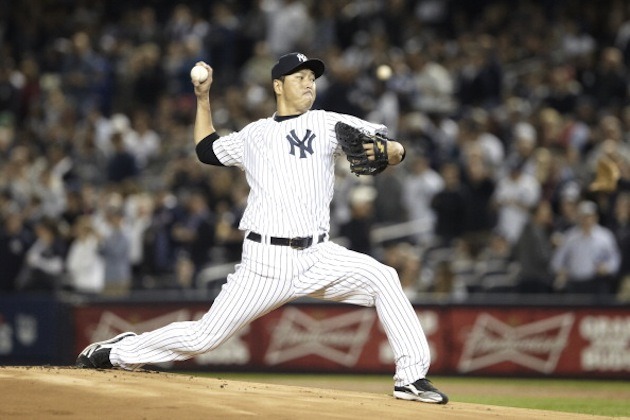
Four players were brought in (or brought back, as the case may be) on 1yr deals, including the two big-name pitchers who replaced the two pitchers from the All-Star break list who were signed to extensions. Hiroki Kuroda adapted well to the pressure-packed environment of Yankees baseball, but I have it on good authority that he would prefer to pitch on the west coast. Edwin Jackson was passable for the Nationals, but the journeyman appears likely to be headed for his seventh team in six years. Jonathan Broxton's fantasy value took a hit when he traded his save opportunities with the Royals for hold opportunities in front of Aroldis Chapman with the Reds, but I'd say he's pretty successfully reestablished himself as a dominant reliever. And the fact that Eric Chavez has started a playoff game for the Yankees says more about the utter un-clutchitude of A-Rod than it does about Chokey's prowess on the field - although he did churn out a surprising 12 HR as one of the main players in New York's DH rotation.

Looking ahead, I'd say that Michael Bourn and A.J. Pierzynski are good bets to re-sign - as the Braves look to remain perennial contenders, I think they'd be loath to part with their marquee top-of-the-order table setter, and I don't think any other team would want Pierzynski. Swisher (who replaced Encarnacion after becoming eligible at 1B from all that work he got subbing for Mark Teixeira) is basically a lock to return - free agency for the Yankees is basically just a period of renegotiation. After his October meltdown(s) expect Jose Valverde to be in a similar position to Broxton going into last off-season. Greinke got off to a shaky start to his time in southern California, but he had a solid finish and the Angels certainly don't balk at the big free agent deal. I wouldn't be surprised if they brought him back and let Dan Haren walk rather than pick up his $15.5mm option - I would be surprised if they kept both pitchers around for 2013.

Your fans are all praying for a speedy recovery
and to see you back on the mound in 2013!
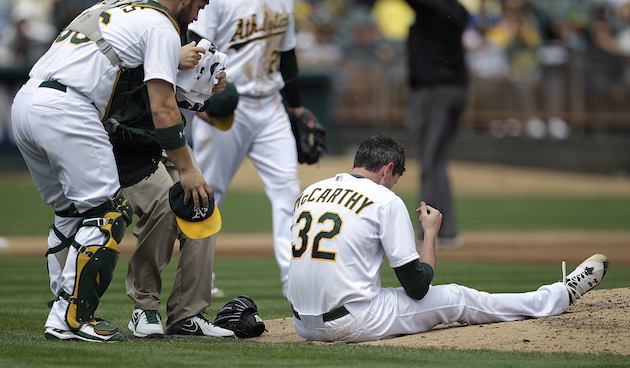
There's a couple of honorable mentions I feel like I should... mention. Shane Victorino will hit the market with the Dodgers, and it's a good bet he'll return. I don't see Ichiro on the Yankees as anything more than a rental since Brett Gardner will likely be returning to the Bronx Bombers next year. Carlos Pena will likely try to bring his sub-Mendoza line average to a team other than the Rays. Mariano Rivera is a lock to return to the Yankees if he deems himself able to pitch. And then there are a couple of A's pitchers coming off no end of uncertainty: Brandon McCarthy has been making good progress in his recovery from a brutal line drive to the head, while Bartolo Colon has yet to prove he can survive in the majors with just the hormones that his 40-year-old body can produce on its own. I'd say incentive-laden deals are in store for these two, the former back with the A's, the latter with a young club desperate for some veteran leadership (see the pre-2012 A's...).

This year's free agent class lacks the star power of Albert Pujols, Prince Fielder, Jose Reyes, CC Sabathia (although see above regarding Yankee free agents), C.J. Wilson et al. But there are some very solid players out there who have the potential to make some new teams very happy. I'll be following all these free agents and more as soon as they're allowed to file on the day after the World Series. Until then, keep watching the games and try not to be too disappointed at the dearth of interesting teams left out there...

Friday, October 12, 2012

The Number One Seeds: Analysis

Well, the bad news is that one quarter of the teams that made it to the big final year-end tournament have been eliminated, among them my first and third priorities of teams I'd like to have seen win the World Series. The good news however, is that all four division series made it Game 5, providing fans with a full 20 out of 20 potential first-round games! If anyone knows somebody who works at the Elias Sports Bureau, go ahead and ask them when the last time was that this happened.

As it turns out, the top seeded teams in each league (the ones with the distinct pleasure of facing the winners of the first inaugural Wild Card Games) are now on the brink of elimination, just like everybody else. I won't go into detail on their respective opponents, because I've already done write-ups on the Wild Card teams, but here's an in-depth look into the playoff lineups of the teams who led their leagues in wins this year:


The Nationals won the most regular season games of any team (just edging out the freshly-eliminated Reds by one), but 15 of those wins came behind the arm of Stephen Strasburg (1,861 points / 66.5 ppg) who will not appear in Washington's playoff run due to a controversial decision by GM Mike Rizzo. No one can know if Strasburg would have gotten shelled any less than Jordan Zimmermann or Edwin Jackson (his technical replacement, Ross Detwiler, actually pitched quite well facing elimination) had he taken the hill in his playoff debut, but unless the Nats can continue their run into October, the decision to sit the organization's best pitcher for the city's first playoff berth in 79 years will surely haunt the franchise for many years to come.

3B stalwart Ryan Zimmerman played well despite battling injuries - a theme the Nats will have to get used to for the next 7 years, since he doesn't become a free agent until 2019. But the real stories this year revolve around the impressive debut of Bryce Harper (if you don't count his performance in the playoffs) and the breakout success of Ian Desmond (my pick of him in the 20th round really solidified my fantasy team). Jayson Werth missed a lot of time with a broken wrist, but he really took ownership of that leadoff role upon his return, from which spot in the lineup he hit the key walk-off HR that forced today's Game 5.

A couple of ex-Athletics form the battery of today's game: Gio Gonzalez was sent over in the offseason trade that netted the A's both SP Tommy Milone and C Derek Norris (along with SP Brad Peacock, but we don't like to talk about his 2012 season in AAA). The remaining guaranteed year+OPT on Kurt Suzuki's 3*-yr extension he signed with the A's prior to 2011 was transferred to the Nationals in a waiver-wire deal in early August. The Nats' bullpen got a late boost with the return of closer Drew Storen from the devastating elbow injury that forced him to the 60-day DL.


The Yankees will have to play a day game following a (late, due to 13-innings) night game this afternoon to decide who advances to the ALCS. That news does not bode well for the aging squad, who were already feeling sore and banged-up to begin with. Case in point: manager Joe Girardi wasn't able to get his best offensive players on the field the last two games because he had to use the DH slot to rest first A-Rod and then Jeter. At least he found a spot for Game 3 hero Raul Ibanez in today's lineup - even if it's at the expense of quarter-of-a-million dollar man Alex Rodriguez (which means that the Yanks will start another ex-Athletic at 3B: none other than Eric "Chokey" Chavez!).

Andy Pettitte pitching for New York in 1997 (L) and 2012 (R)
As further proof that the Yankees are stuck in 1997, just look at their Game 2 starter: 40-year-old Andy Pettitte, who the Yanks lured out of "retirement" for the second time this year. I like Pettitte as a pitcher, but I can't say I approve of the Yankees' relationship with him, treating what should be his retirement years as if he's in their own personal farm system. But if the man wants to play, let him play, I guess. I think Hiroki Kuroda is a more effective pitcher at this point in his career, and we'll see what happens to both of them when they hit free agency after this season.

The Bronx Bombers also failed to get younger when they traded for Ichiro Suzuki in a deadline deal. The 38-year-old outfielder can still swing the bat (he hit .322 in 67 games since heading east) and plays a better defensive LF than Brett Gardner's last fill-in (Ibanez). Robinson Cano put up another offensive season for the ages while Curtis Granderson quietly surpassed 40 HR for the second straight year and CC Sabathia led the pitching staff as only a 6'7" 290lb giant of a lefty can. Rafael Soriano didn't miss a beat taking over the closer role after Mariano Rivera went down with a freak batting practice injury. I hope the Yankees re-sign him next year (is there really any doubt?) because he deserves a better end to his career than a torn ACL sustained while shagging fly balls.


So those are the top seeded teams in the game right now, each playing to stay alive in games today. I'm glad I was able to pull myself out of an A's-loss-related funk long enough to get these out while both these teams are still in contention. Before I sink back in, I have two grievances with the Athletics' performance in the ALDS to get off my chest.

1) Where in the name of all that is holy were Jonny Gomes and Chris Carter?
These two power righties hit 32 home runs between them and spent significant time at the No. 2, No. 4 (Gomes) and No. 5 (Carter) spots in the batting order, all high profile offensive positions, and yet only one of them got as much as a single plate appearance in the division series - during the 8th inning of the Game 5 blowout. I know their platoon splits dictate that they should play primarily against lefty pitchers, but the A's faced Phil Coke three times in close/late situations, and yet the only pinch hitter Bob Melvin could muster was... his backup catcher. Carter is under team control for at least another 5 years, but Gomes - who was a huge part of the A's' magical season, providing excellent energy and always being the first out of the dugout after a walk-off win (unless he was responsible for the win himself) - becomes a free agent after the World Series. I would love to see him return, but if it were me, I don't know if I'd want to re-sign with an organization that showed me absolutely no love when the games mattered most.

2) How come no yellow jerseys?
When the A's clinched the AL West title against the Rangers last week, they were wearing their sweet alternate throwback yellow jerseys that they unveiled last year, and yet they didn't show up for even one game in the ALDS. HOW'S A TEAM SUPPOSED TO FIND SOME LUCK IN BORING HOME WHITES!?!?

That is all. Now I can finally put this disappointing finish to the season behind me. Who's ready for Free Agent season!?!?

Monday, October 8, 2012

NLDS CIN vs. SFG Analysis

Woah there, Cincinnati, slow down! We don't want TWO out of the four division serieses to be over before they started. The Reds have taken the first two from the 2010 World Series champion Giants; and just when I was about to voice my outrage at the new format that puts the BETTER-seeded team on the road for the pivotal first two games of a best of five series - a format that put the A's at a HUGE disadvantage this weekend (in hindsight they might have been better off pulling an "Olympic Badminton" and throwing one of those last three games against Texas, taking their chances with Baltimore in the Wild Card round, knowing that they'd get to start the next series with the Yankees at home... but I digress). Playing in the Bay Area didn't bother the Reds, who are traveling home today in a great position.


C: Ryan Hanigan vs. Buster Posey
Hanigan, who profiles more as a backup than a starter, was supposed to give way to Devin Mesoraco, Baseball America's #16 ranked prospect. But the catcher of the future only managed 54 games so the Reds had to make do. Posey meanwhile could be heading for an NL MVP award to put on the mantle next to his ROY from two years ago. His amazing season, in which he won the batting title* and led the league in OPS+, is even more impressive since it came on the heels of a brutal career-threatening leg injury sustained in a home plate collision.
ADVANTAGE: GIANTS

1B: Joey Votto vs. Brandon Belt
Votto is one of the most fearsome hitters in the game right now, and he's been rewarded for his greatness with a couple of contract extensions that run through 2024. He didn't put up fearsome power totals this year, as he missed a bunch of time getting arthroscopic surgery to repair a torn meniscus in his knee (although he still managed to lead the league in BB and OBP), but he's back at full strength and ready to contribute in the playoffs. Belt can... play left field in a pinch? That's all I've got.
ADVANTAGE: REDS

2B: Brandon Phillips vs. Marco Scutaro
Phillips is another Red to get a long-term extension, so the right side of Cincinnati's infield is set for at least another six years. Scutaro actually produced similar value in terms of fantasy points in his season he split with the Rockies and Giants, but he did it with base hits and plate discipline as opposed to power and speed. "Dat Dude" has the talent set more suited to change the outcome of a game.
ADVANTAGE: REDS

3B: Scott Rolen vs. Pablo Sandoval
I haven't been following the Reds very closely this season, but one of the few stories I did catch wind of was Todd Frazier's emergence as a solid rookie 3B. Why then did he give way to oft-injured veteran Scott Rolen for the playoffs? The world may never know. In the meantime, Sandoval has had his share of injuries himself in what is becoming an unpleasant trend for the Kung Fu Panda. When healthy though, I'd rather have his bat in the lineup.
ADVANTAGE: GIANTS

SS: Zack Cozart vs. Brandon Crawford
Crawford is your stereotypical one dimensional all-field-no-hit player, while the rookie Cozart is a much rarer two dimensional all-field-some-power player. According to Baseball Reference, both players contributed 2.0 dWAR (with the glove) and 0.9 oWAR (with the bat) despite the fact that Cozart out-homered Crawford 15 to 4. Neither player excels at getting on base (.304 OBP for Crawford, .288 for Cozart) and they both strike out far too much (Cozart K'd 113 times, Crawford 95), but you all know how chicks dig the long ball.
ADVANTAGE: REDS

LF: Ryan Ludwick vs. Gregor Blanco
Remember when Ludwick had that breakout 2008 season with 37 long balls and a .966 OPS? Well this year he put up his highest totals in those categories since then (26 and .877 respectively). He's even been batting cleanup in front of All-Star Jay Bruce. Blanco was a non-roster invitee who's only playing this position because his teammate (and the guy who actually led the NL in AVG) made some poor career choices and got himself suspended.
ADVANTAGE: REDS

Jay Bruce Jay Bruce #32 of the Cincinnati Reds hits a two run double scoring Joey Votto #19 and Chris Heisey #28  in the eighth inning of Game Two of the National League Division Series against the San Francisco Giants at AT&T Park on October 7, 2012 in San Francisco, California.CF: Drew Stubbs vs. Angel Pagan
Despite 14 HR and 30 SB, Stubbs had an incredibly disappointing season, embodied by a .277 OBP. Pagan has provided an invaluable spark at the top of the order after coming over from the Mets in an offseason trade. Despite getting on base .061 points more effectively than Stubbs, Pagan actually stole one fewer base... but that's only because he finished his at-bat on third base a league-leading 15 times.
ADVANTAGE: GIANTS

RF: Jay Bruce vs. Hunter Pence
Pence was involved in his second high-profile trade deadline deal in as many years. But unlike last year when he carried the Phillies on his back to the tune of a .324 AVG, .954 OPS, and 2.2 WAR, this year he rode the Giants' coattails into the playoffs with a .219 AVG, .671 OPS, and 0.1 WAR. Bruce on the other hand has developed into the middle of the order pure power threat we expected, with his second straight season of 30+ HR, but an AVG in the .250s. He'll be a part of this Reds team almost as long as Phillips and Votto.
ADVANTAGE: REDS

SP1: Johnny Cueto vs. Matt Cain
How about Johnny Cueto finally coming into his own for a full season this year: 19 wins (3 more than Cain), 2.78 ERA (.01 lower than Cain), and a league-leading 33 starts. I certainly appreciated his performance after drafting him to my fantasy team in the 14th round. But Cueto threw only 8 pitches before being forced to exit game 1 with back spasms. His uncertainty for the rest of the series coupled with the magic of Cain's perfect game this year settles the score for this matchup.
ADVANTAGE: GIANTS

SP2: Bronson Arroyo vs. Madison Bumgarner
cain NLDS Preview: SF Giants With Advantage Over RedsThe game in which these two faced off against each other already happened, but if I were doing projections, I would never have expected 7 shutout innings from Arroyo against 4.1 innings with 4 ER for Bumgarner. Overall though Maddy is a more talented pitcher with a significantly higher upside.
ADVANTAGE: GIANTS

SP3: Homer Bailey vs. Ryan Vogelsong
The penultimate start of the best season of Bailey's career was a no-hitter, the seventh of the year. Vogelsong has done his best to prove that his comeback last season after four years out of the majors was no fluke. At 26 years old I think Bailey has more potential than the 34-year-old Vogelsong, but for one game I don't think the difference is too great.
ADVANTAGE: PUSH

SP4: Mat Latos vs. Tim Lincecum/Barry Zito
Game 4 starters haven't been announced yet, so we don't know if Latos will return on 3 days rest after coming to Cueto's rescue with 4 IP of relief in game 1. Likewise we don't know if Bruce Bochy will trot out the veteran Zito or pull two-time Cy Young winner Lincecum out of the bullpen, where he was relegated after an uncharacteristically pedestrian season. Whoever his opponent is, Latos's bounceback after a disastrous April (right after I dropped him from my fantasy roster) gives him the clear upper hand.
ADVANTAGE: REDS

RP: Aroldis Chapman vs. Sergio Romo
We've all heard the stories about the 105 mph fastballs, the somersaults off the mound, the time off in September due to shoulder fatigue, but one thing is for sure: Aroldis Chapman is one of the most dominant left-handed relievers to play the game of baseball ever. Romo might have similarly impressive facial hair, but Brian Wilson he ain't - and even if The Beard weren't injured, there's no way he'd compete with the Cuban Missile.
ADVANTAGE: REDS


As with the A's-Tigers series, this one is all but in the books. It's nearly impossible to come back from such a deficit, even heading into home-field advantage. But I wouldn't count out even these Lincecum-less Giants until the last pitch. Because as a baseball great once said, "It ain't over 'til it's over."