Wednesday, September 21, 2011

Developed Teams 2011: Tampa Bay Rays

Remember way back in the beginning of September when the Rays trailed the Red Sox by upwards of 7 or 8 games in the Wild Card race? Well in the recent weeks, they've pulled to within 2 games, and are in very real danger of making the playoffs. In celebration of their upstart success, here's a team made up of players developed by the Tampa Bay Rays:


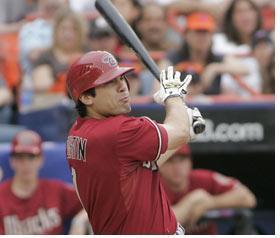
Hamilton, during his "working
through some issues" phase
This is one of the most solid top two-thirds of a lineup you'll find anywhere, real or fantasy. We all remember what Carl Crawford was capable of doing just one year ago - i.e. serving as one of the most electric table-setters in modern leadoff history. B.J. Upton has developed into a legitimate power/speed threat after finally settling into a position. We all know about Josh Hamilton's MVP award, batting title, and former career-threatening drug habits. Evan Longoria hits home runs and does commercials (he's a double threat!). Aubrey Huff has slowed down a bit, but let's not forget (let's not forget, Dude) how he all-but carried the meager offense of the world champs last year. And Delmon Young took a few big steps back after a potential breakout season last year, but hopes of heading back to the playoffs after a trade has seemingly put some bounce back in his step.

The glut of outfielders makes for a somewhat imbalanced bench, but there really wasn't anything else to choose from. All the developed infielders are on the field in the starting lineup, with the exception of another first baseman, which doesn't help anybody. It's cool to have an established power hitter in Gomes and a future star in Jennings, but I'm sure any fantasy developed manager would like to have a little more versatility out there. But remember that this team has only been around for 13 years, so it's impressive they have such a star-studded roster as it is.

Speaking of stars, check out that rotation - every member of which still pitches for the Rays today. It includes rookies and All-Star starters, and includes some of the best young pitching talent under 30. The bullpen has a few question marks, including the role of closer, which is occupied by the rookie who was projected to close until the acquisition and subsequent rebirth of Kyle Farnsworth. But Wheeler is a veteran presence and Veras has proven his adequacy. But then there's the corps of spot starters, all of whom seem to have settled nicely into that role in real life, after tasting slight success in major league rotations.

Overall, this is one of the most well-rounded teams out there. If there was such thing as a Developed Team Tournament (hint hint for those friends of Rob Neyer who put together the virtual showdowns between those various All-Time Teams), I'd definitely put the Rays among the top contenders. That is, if every member of the infield stays healthy and the bench depth isn't tested at all. That could prove problematic. But in terms of top-shelf talent on paper, these youngsters will be hard to beat.

Monday, September 19, 2011

Developed Teams 2011: San Francisco Giants

Last week, I profiled a developed team of the AL Champion Texas Rangers.  So what better time to introduce their opponents (and eventual defeaters) in the 2011 World Series, the San Francisco Giants:


An offense that earned the nickname "Torture" last year does not improve much when we look at players the Giants have developed, with only two offensive threats gracing the field.  Conversely, the pitching staff excels across the board, whether it's the starting staff (featuring two-time Cy Young winner Tim Lincecum and the exact staff who backed him in the 2010 post-season) or the relief corps ("Fear the Beard" indeed...).  It's especially interesting that all the Developed Giants' best players are still with the team, so it's not as if they're bringing lots of talent through the minors and letting it get away.  The best player on this squad who left for greener pastures is undoubtedly Joe Nathan, despite the fact that he spent all of 2010 recovering from Tommy John surgery.  He joins two other capable closers in the Giants bullpen: Brian Wilson and David Aardsma (who, incidentally, hasn't pitched at all in 2011 due to hip/Tommy John surgery).

But where to go from here?  The more I try to write about this lineup, the more depressing it looks.  I mean, look at that infield.  Ishikawa may be good with the glove, but he's far below replacement level at first (or would be if he were even in the majors at this juncture).  Pedro Feliz is a proven veteran, but one who's spent most of his time at third (a spot occupied by Pablo Sandoval, one of the two aforementioned threats).  Emmanuel Burriss has good speed on the basepaths and Matt Downs has swung the bat pretty well for Houston, but neither are what you'd call top shelf talent.  Kevin Frandsen has spent all of 2011 in AAA, where he hasn't exactly put on a show.  Cody Ransom has put on a show in AAA... but it's led to just 12 sad games in the majors so far.

The outfield isn't much better: Fred Lewis never really developed into anything special, Nate Schierholtz profiles as more of a late-inning defensive replacement, and John Bowker hasn't yet shown that he can hit in the majors.  Eugenio Velez is only on the roster because he was the only other player who had played in the outfield.  Strangely enough, the position at which the Giants have the most stability is catcher, with Buster Posey and Yorvit Torrealba both having spent time as well-qualified starters for good teams.

But, ah, that pitching staff.  We all know about the top four guys, all of whom played key parts in the Giants' World Series title last year.  Cain is right there behind Lincecum, Sanchez has been bit by the injury bug, and Bumgarner still has his best years ahead of him.  And while Kevin Correia has struggled a bit, despite his All-Star appearance, he's actually pretty decent for a fifth starter.  In the 'pen, the quality doesn't drop off even beyond the three guys who've made their living closing games: Sergio Romo's ERA is so miniscule you'd have trouble finding it and Scott Linebrink has contributed to one of the league's best relief staffs on the Braves.  If pitching and defense really is the key to winning championships, this club has the late-inning hardware to deal with the low-scoring games that come with that strategy.

Next week, in my effort to profile all the 2011 playoff contenders before the 2011 playoffs begin, I'll be looking at the Tampa Bay Rays, who are doing their best to edge out the Wild Card leading Red Sox.

Friday, September 16, 2011

Developed Teams 2011: Texas Rangers

Back to Baseball!  After a long hiatus due to Burning Person, work travel, and the shock of returning to the de-fault normal world, I'm finally ready to resume filling the pages of the Internet with the wealth of statistical knowledge I have stored in my head and on my lists.

I now see that it would be foolish to try and complete a developed list of all 30 teams by the end of the season, but I can at least finish all the teams likely to make the playoffs.  To that end, here's a developed team of the AL West-leading Texas Rangers:


This team has a lot of two things - namely first basemen and starting pitchers - and not a lot of anything else.  To start from a position of strength:  Mark Teixeira is clearly one of the elite hitters of the last decade, possibly even of his generation.  What's more, he played the majority of his career for the Rangers (his first 4+ seasons, soon to be eclipsed by the Yankees).  Carlos Pena, on the other hand, played only 22 games in Texas before bouncing around to five other teams - and most people in baseball were surprised that that number didn't become six at this year's trade deadline.  Mitch Moreland, the Rangers' current starter at 1B, has played some games at 3B, right? Oh, wait, that was Chris Davis, who didn't make the team.  Moreland played some RF... but sometimes you have to take the non-traditional path to make these types of projects work.

And those are only the first basemen to make the starting lineup.  We've also got the Indians' starting (but injured) DH Travis Hafner (who played one more game for Texas than did Pena) and the Mariners' starting 1B Justin Smoak (acquired in the Cliff Lee deal just last year).  Not a very versatile infield bench, but believe me, if there were any better choices, I would have made them.  I submit as evidence the starting SS Joaquin Arias and the only player developed by Texas actually listed as a 3B (Mike Lamb), neither of whom has played in 2011.

If you look closely, you'll notice someone else who hasn't played in 2011 at the top of the order.  But look at what Scott Podsednik did last year with the bat, split between KC and LAD.  The veteran, who stole more bases than his advanced age last year, got a deal with Toronto, but missed making the roster due to injury.  Julio Borbon hasn't played much this year, after being slotted as the starting CF, but on the other side of the field, Laynce Nix has swung the bat very well for Washington.  On the bench, I chose to go with the proven speed of Jason Bourgeois rather than the potential power of John Mayberry Jr.

Now let's check out the starters.  We all know about John Danks's struggle to win games earlier this season, and Colby Lewis has been so-so.  But C.J. Wilson has brilliantly followed up his first season as a starter with an All-Star appearance, 16 wins, and an ERA just north of 3.  Edinson Volquez started on Opening Day for the Reds, but has struggled so much with his command that manager Dusty Baker sent him to AAA for 13 starts in 2011.  R.A. Dickey and his knuckleball have led to good peripherals, but the Mets haven't been able to win him many games.  And that's just the starting rotation.

Alexi Ogando has been a great starter since following Wilson's lead in moving from the bullpen this season (although his stamina over a full season is still something he needs to work on).  Derek Holland's moustache has brought success to the lefty, who currently is sitting on 14 wins.  And Aaron Harang has taken the first step towards turning his career around with 13 wins for San Diego after three straight seasons of 6 wins apiece in Cincinnati (moving from a hitter's park to a pitcher's park might have something to do with that...).  Not included in this roster:  former playoff pitcher (and more recent trade bait) Tommy Hunter, former 17 game winner (and current minor league fodder) Scott Feldman, and of course veteran Doug Davis.

There was talk of moving Neftali Feliz to the rotation, but when Ogando cut in front of him, Feliz was forced to remain the closer.  He hasn't been as dominant as in his Rookie of the Year season, which also included a trip to the World Series, but quite frankly a club could do a lot worse.  Joaquin Benoit has shown almost equal flashes of brilliance and mediocrity as a setup man, and in 2011 he's been about on par with workhorse Nick Masset.  Darren Oliver is with Texas now, and he was developed by Texas, but he's had a circuitous route back to his original team - one that's taken the veteran through seven other clubs, plus an additional stint with the Rangers in the early part of the Millennium.

The only two key players from this roster I haven't mentioned by name are former star Ivan Rodriguez and current star Ian Kinsler.  In my opinion, these two players perfectly bridge the gap between the successful Rangers in the end of the 1990s and the successful Rangers in the start of the 2010s - except this current team also includes a competent pitching staff and a front office led by one of the team's and the game's most famous pitching legends.  We'll just have to wait and see if they can repeat last year's long and deep trip into the post-season.

Tuesday, August 23, 2011

Developed Teams 2011: Detroit Tigers

With the first-place Tigers having just swept the second-place Indians in a crucial three-game series, the upstart team's chances of holding onto contention just dropped another peg. In honor of keeping the momentum going, here's an entry on the Detroit Tigers:


The first thing you'll notice is the lack of an impact bat in the middle of the order.  Yes, Curtis Granderson is enjoying an historic year, but seasons of 40-30-120 with an OPS close to 1.000 are hardly the career norm for Grandy.  Alex Avila made a trip to the All-Star game this year, but he's far from a proven major leaguer.  Matt Joyce and Brennan Boesch are shaping up into solid young power threats, but they project more as very competent sidekicks than heroes in their own right.  Cameron Maybin has been very impressive this year, but, as I've said MANY times before, these lists are based mostly on pre-season rankings.  Hence the presence of Ryan Raburn, who has a lot of Fantasy value, which is probably mostly because of his versatility.

In addition to Raburn, there are a few key players plagued with disappointing seasons.  Brandon Inge actually went down to AAA for a spell to work on his swing before his return this weekend.  Omar Infante has regressed to his career norms after an enigmatic All-Star selection last year, but the Marlins are losing a lot of his value by letting him play all 114 of his games this year at 2B, rather than shifting him around the diamond as the Braves (and the Tigers before them) used to do.  Andres Torres has reminded us all why last year was his only full season in the majors.  And his teammate Cody Ross has some pop in his bat, but one good October does not a serviceable regular make.

What appears to be a one horse race for supremacy of the pitching rotation is actually a one-two punch, if we take 2011 stats into account.  Justin Verlander is obviously the leader here, in terms of stuff, style, and consistency, but Jair Jurrjens is dominating opposing hitters the way he did in 2009.  Let's hope he's not developing into a sine wave type player, alternating good years with bad ones.  After those two, however, there's very little in terms of substance, at least in 2011.  Rick Porcello still shows a lot of promise, especially at the tender age of 22.  French and Oliver should be on very short leashes, considering their performances in the minors this year.

The bullpen has it all: a current workhorse closer (Cordero), a former closer (Rodney), a career setup man (Frasor), a veteran LOOGY (Miller), and an oft-injured potential star (Zumaya).  However, there is not enough collective star power to make up for the lack of starting depth and a patchwork offense built around questionable pieces.  If only this were a few years ago and John Smoltz could have bolstered that rotation...

Friday, August 19, 2011

Developed Teams 2011: Milwaukee Brewers

The Brewers are a double-relevant team to feature next for this project, as they are both currently in first place in their division and recently played host to my most recent foray to a Major League Baseball stadium.  Miller Park marked ballpark #16, which officially pushed me over the halfway point in my quest to visit the home parks of all 30 Major League teams.  So let's see how this NL Central-leading team would fare with a roster made of only players developed over the years:


First, notice the impressive glut of power hitters in the middle of this order.  Then, observe how many of these hitters are still with the team - pretty much all the ones that matter.  Weeks, Braun, Fielder, and Hart have 10 All-Star appearances and four Silver Sluggers between them, and all are under 30 years of age... that's enough talent to build TWO lineups around.  Bill Hall has been a moderate power threat as recently as last season, but he's currently languishing in the Giants' minor league system as a superutility player.

Michael Brantley and Matt LaPorta are two players who have developed into regulars after going over to Cleveland in 2008's CC Sabathia deal and subsequently making their debuts for the Indians.  Looking at the shortstops, I feel I have to once again clarify that I put these lineups together using pre-season rankings and 2010 stats.  J.J. Hardy has bounced back to a great season with the Orioles after a disappointing last year with the Twins (23 HR, .507 SLG), but would it surprise you that Alcides Escobar was ranked nearly 100 places higher than Hardy over the off-season (193 to 280)?  I guess that's why you have to play all the games to find out who will actually perform.

After you're done marveling at the wealth of offense on this club, make sure NOT to scroll down to the pitching staff.  Because if you did, you'd see a rag-tag bunch, only ONE of whom has pitched in the majors in 2011.  That would be staff ace Yovani Gallardo, the pitcher I saw shut down the Dodgers in my recent visit.  Parra has mostly pitched in relief for AAA Nashville, Ben Sheets - once the face of the franchise - remained unsigned after an injury riddled tour with the A's in 2010, Rogers is quickly losing promise.  Only Dana Eveland has shown some semblance of success, pitching rather well in 23 starts for the Dodgers' AAA affiliate in Albuquerque.

The first three pieces of the bullpen are very solid indeed.  John Axford's breakout performance has pushed veteran closer Francisco Rodriguez to a setup role.  Mike Adams was widely credited as the best non-closer reliever who was traded this trade deadline.  And everybody needs a LOOGY, so why not have one with a Yale degree like Craig Breslow?  Carlos Villanueva is a pretty dependable swingman.  But after that, you have nondescript guys and prospects (such as Jeremy Jeffress who went to Kansas City along with Lorenzo Cain in the deal that netted Milwaukee Zack Greinke this off-season).

Predictions: lots of high-scoring games.

Tuesday, August 9, 2011

Developed Teams 2011: New York Mets

The other day, I happened upon a game on TV featuring the Mets... and what better reason to feature their developed lineup? And what more introduction do I need than that, seeing as you already must know the drill by now?


I'll say this for the Mets: they've been able to hold on to most of the top shelf talent they've developed. Which could be the sign of good management, who was able to lock up their best young homegrown players... or it could be an indication that they didn't develop a whole lot of top shelf talent that was worth trading away. YOU DECIDE!

A.J. Burnett - the developed pitcher with the best career - was a difficult one to place: he was drafted by the Mets and spent three years in the minors before being traded to Florida in the deal for Al Leiter. Although he only spent two years in the Marlins system, he pitched more innings for them before his debut (147.0 < 239.2) and pitched in higher levels (Rk, A- < A, AA). But there's something about someone getting traded as a prospect, even a low-level one, that seals the bond between that player and his original team. Also, just think of where this rotation would be without him!

Mike Pelfrey looks like he's on his way towards a sine wave career (alternating good and bad seasons) and Jonathan Niese still has a lot to prove with just one full season under his belt prior to 2011. Kazmir was once a top prospect, but he hasn't adjusted well to life on the west coast. Nelson Figueroa has been playing the journeyman for nine seasons, and just when he was slated to spend his first season in a major league rotation at age 37, he totally dropped the ball. Again, if we were going by 2011 stats, Dillon Gee would TOTALLY be in the rotation (he's certainly given my fantasy team a shot in the arm as a waiver claim) and Mejia would be... not on this list, as he hasn't appeared in a major league game, as of press time.

The biggest name to have left the Mets after being developed is the hottest closer (not) on the market, Heath Bell. In what has since turned out to be a lopsided trade, Bell was sent to the Padres in 2006, along with Royce Ring, in exchange for Jon Adkins and Ben Johnson. But who could've known that the former 69th round draft pick would have blossomed like he did? Bell's actually got a pretty solid bullpen complementing him out there: Lindstrom has closed before and represented his country in the World Baseball Classic as recently as 2009. Takahashi has flourished as both a swingman (in the NL) and a straight reliever (in the AL). And Dotel was just part of a major trade last month at the ripe age of 37. Aaron Heilman - once highly touted enough to have his name bandied about in a proposed trade for Barry Zito (along with his developed teammate Lastings Milledge, another flameout) - now is simply struggling in the bullpen.

The top four guys in this batting order, when healthy, can compete with the most stacked lineups in the league. However Reyes with his hamstrings, Davis with his ankle, and Wright with his back have all settled down for a long summer nap, courtesy of long stays on the DL for each of them. Wigginton was an All-Star last year, but that was largely because he played for a team that needed an All-Star. Carlos Gomez hasn't yet developed into the star we thought he would. And Daniel Murphy needed all of last year in the minors to figure out his life. With not much help off the bench (Jay Payton, in fact, is still technically a Free Agent), the club's stars will be under more and more pressure to stay healthy.

So there you have it: you have Met the Mets! I think my next venture, as we approach playoff season, will be looking at some teams that are actually in first place in their divisions and have legitimate shots at playing in October.

Sunday, August 7, 2011

Developed Teams 2011: Cleveland Indians

Were you able to work out the identity of the other surprise Central Division contender who I mentioned in my last post? I didn't think it would be hard, but then again, I consider myself a sort of 'amateur expert' on this stuff. It should be no secret, however, that the other team I was referring to is the Cleveland Indians.


The pitching staff, which features CC Sabathia as headliner, looks a lot like the pitching staff to which CC belongs in real life - not a lot going on after the legitimate Ace. His fellow 1st round pick in the rotation, Jeremy Guthrie, now playing with Baltimore after being claimed on waivers, has some halfway decent peripherals to go with his 5-15 record, and Fausto Carmona has historically had two rotten seasons for every good one. His current rotation-mate in Cleveland, Josh Tomlin, is having a very good season, flashing some great control in just his second major league campaign.

UPDATE 8/8: When I posted this yesterday, I had listed J.D. Martin as the 5th starter, based solely on his pre-season rankings (seeing as he has spent 2011 as a swingman in AAA Syracuse), assuming that in real life, he'd compete with the two long-relief types I talk about below. However, later on, I realized a glaring omission in the statistics I had compiled for this project: namely the omission of Bartolo Colon. Maybe he slipped under my radar because he missed the entire 2010 season - but he shouldn't have because he was projected to start for the Yankees, and so far he's done a pretty nice job. The 5th starter spot is officially his, as noted in my revised graphic, above.

Jeanmar Gomez and David Huff both put up pretty good numbers for AAA Columbus, but have each made just a handful of starts for Cleveland this year.

Cleveland has developed a pretty deep bench of relievers, but they're notably lacking a proven 9th inning force. Mujica was good enough to be the centerpiece of a trade for a good young center fielder, so that gives you an idea of his talent, but he's logged only 2 Saves in his career. Pretty much the rest of the featured staff are young and effective setup men still with the Tribe (Lewis is in the minors and Laffey was traded just this off-season). And let's not forget Frank Herrmann, who has become a regular in 2011, and notable washed-up-but-once-solid veterans Danys Baez and David Riske.

The lineup's most notable features are two of the best sluggers from the '90s, Jim Thome and Manny Ramirez. Thome is currently a part-time DH, pursuing his 600th Home Run with the Twins, and Manny unceremoniously retired from the Rays after his second positive test for PED's. When healthy, Grady Sizemore has the ability to be a centerpiece for any lineup, either at the top or in the middle. Victor Martinez, while his skills behind the plate have been questioned, has leadership ability and intangibles galore. Just ask his current teammate on Detroit, Jhonny Peralta - the two All-Stars are doing their part to keep the Tigers in first place.

Peralta pushes Marco Scutaro off his normal position of SS, but he's had enough experience as a utility guy to be able to play anywhere in that infield. Before his struggles this year, I would have said that Kevin Kouzmanoff has the ability to provide great defense and middling power at the hot corner. And Russell Branyan can always be counted on to belt a few home runs, no matter the circumstances. Izturis is a great sparky presence off the bench and Ben Francisco is good enough to start in the outfield in the event of Manny suddenly becoming ineligible for some reason (I can't imagine why). Ryan Church doesn't currently have a team, but I figured with Manny out there in left, this squad would need as much outfield protection as they could get.

Friday, August 5, 2011

Developed Teams 2011: Pittsburgh Pirates

There are currently two total surprise teams who are in contention for the Central Division lead in their respective leads. These are both teams I like and want to see succeed. So in light of that, I have decided to profile them next in my developed teams project. The first of those teams is the Pittsburgh Pirates.


Rather than go by the developed players still with the club (of which there are a respectable seven, with one returning after a stint with other clubs), I'd like to go down the lineup as if I was introducing them before a game. I'll do a brief scouting report and go over some of their history. That might help keep this fresh. Oh, just for tradition's sake, there are a respectable seven developed players still with the team, one of which has returned after stints with other teams.

Leading off, we have Rajai Davis, who brings a lot of speed to the table and not much else - he leads the league in SB this year, but has only 1 HR and a negative defensiveWAR playing mostly Center Field. Luckily these Pirates have someone better to whom they can hand most of the AB's as the captain of the outfield: All-Star Andrew McCutchen. At age 24, the former 1st round pick has the potential to continue developing into a power-speed threat and a franchise player - plus he has really improved his fielding up the middle. Between those two is another first rounder, Neil Walker, who burst onto the scene last year and has put up some respective, if not eye-popping, numbers.

We all know how Jose Bautista has found one of the most impressive power strokes in the game last year in Toronto. What we also (mostly) know is that h started his career as a utility infielder in the Pirates' system, even though he bounced around a couple of other major league teams as a Rule 5 pick before putting on a Pittsburgh uniform. Looking at his minor league career, it's clear which team did the developing. You'll notice that Aramis Ramirez is at 1B on this team, which is strange because he's never played even an inning at first base in his major or minor league career. Well, we couldn't have both him and former first-round pick Pedro Alvarez both manning the hot corner (and the best developed first baseman on the squad, Steve Pearce, has only had a couple of cups of coffee so far in the majors), so someone had to shift. Since neither of them play particularly well in the field, I figured it was a wash as to who made the move.

Jeff Keppinger appeared in a non-developed related lineup I posted about just the other day, and although he hasn't played a lot of SS the last couple of years, that's where he's listed on MLB 11: The Show, so it all works out. Ryan Doumit gets the nod due to his 2010, and Jason Kendall gets the back-up job because of what he's meant to the team over the course of his (mostly early) career, although if we were going by more recent performance it might have made more sense to include Ronny Paulino. Also Nyjer Morgan is in that top bench spot - signifying the guy who would most likely DH in an interleague situation. Based on last year's/his career numbers, I would have liked to include Jose Guillen in a more substantial role, but seeing as he remained unsigned this year and is ostensibly retired, it just didn't seem right.

The starting staff is a little enigmatic, filled with mid-level talents and questionable players in general. Bronson Arroyo had put up decent numbers, although nobody quite knew how, given his stuff, but the truth might be just about catching up to him at age 34. Tom Gorzelanny, although he was picked in the 2nd round, has never really projected as anything more than a number 3 or 4 starter. Paul Maholm has shown flashes of competence, but the 1st rounder hasn't racked up enough strikeouts to be really effective. Zach Duke has been given a new lease on life by the Diamondbacks, but he's in the process of squandering that away. And Chris Young has been good, but he hasn't avoided injury since, well, ever.

The bullpen is a different story, with two top-shelf closing talents available in Leo Nunez and Matt Capps. The bullpen is stacked with lefties, with Burnett and Gonzalez (who are both struggling a bit this year), and Joe Beimel (who is not only a hometown hero, but the subject of a very catchy bullpen-related tune during his time co-setting up for Takashi Saito with Jonathan Broxton on the Dodgers). Their long reliever, veteran and all-around good guy Tim Wakefield, has alternated between starter and swingman for most of his career, and it looks like he'll settle in with the latter for his twilight years.

So there you have it. If you can guess which team I'm choosing next time (it's not hard), drop me a line in the comments section. I like reading comments...

Thursday, August 4, 2011

Trade Deadline Analysis

It's not that I don't like my Developed Teams Project... it's just that newsworthy events keep happening in and around the Baseball world, and I'm drawn to write about those rather than stick to an arbitrary deadline I've set for myself for finishing all 30 teams before the playoffs. Such as the much more exciting, very real, non-waiver trade deadline that just passed this Sunday. Lots of people changed teams that day. Not as many as some people thought. But still it's been pretty exciting following all the action. Here's a 25-man roster (cuz I like those) made up of all the players who moved this deadline:


So, yeah, that's what it would look like if I were in charge. Rather than go through the above image, I'd like to go through position by position, using the numbered guide (which is how you mark the positions while you're keeping score, if you're curious).

1 Starting Pitcher
MLB: 5
Prospects: 14

Believe it or not, those five above were the only Major League caliber starters who changed hands on/before this deadline. Fister has surprisingly been the most successful, but this wouldn't be the first unexpectedly dominant starter Detroit has picked up from Seattle in recent years. (I'm looking at you, Jarrod Washburn, 2009... and we all remember how well that turned out, right?) The most celebrated pitcher on this list (Jimenez) has put up the least impressive numbers, having fallen from his incredibly fluky 2010. But we should have all seen that coming. I mean, who goes 15-1 before the All-Star Break? WHO DOES THAT?!!? Hopefully he picks things up and keeps the dark horse Indians in contention.

Bedard came back from a nonexistent 2010 to draw attention from a first-place team. It's fortunate that Boston made that deal, since it looks like Clay Buchholz is going to be out for the rest of the season. Edwin Jackson should be getting used to the late-July move routine, after a 2010 deadline deal sent him to Chicago from the Diamondbacks. Speaking of the Diamondbacks, if they are able to hold off the defending champion Giants and make it to the playoffs, Jason Marquis will have been to the post-season at least once with every team he has played for except the Nationals. I mean, that's the case already, but still...

For those of you not familiar with minorleagueball.com, John Sickels ranks each club's top 20 prospects for each year. Of those 14 predominantly minor-league starters who were traded during the 2011 deadline frenzy, 11 of them were ranked by Sickels. Four have B+ ratings: Drew Pomeranz and Alex White, who went from CLE to COL in the Jimenez deal; Zach Stewart, acquired by CHW in the 3-way deal that sent Edwin Jackson to STL; and Robbie Erlin, who helped TEX acquire Mike Adams from SD.

Three more have B ratings: Zack Wheeler, traded straight-up by SF to NYM for Carlos Beltran; Jarred Cosart, who moved from PHI to HOU in the Hunter Pence trade; and Joseph Gardner, another piece of the Jimenez extravaganza. (Looks to me like Colorado got quite a return on their investment. Whether or not these three pieces will be ready to complement Tulo and CarGo before their long-term deals expire remains to be seen.)

C and C+ are average, so no need to mention them here. I will mention Charlie Furbush, 1) because he's got a cool name, and 2) because he has spent some time pitching in the majors for DET before getting sent to SEA for Fister.

1.1 Closer
MLB: 1
Prospects: 2

Just Francisco Rodriguez as the sole Closer of note here, and as this deal happened well before the deadline, I'll assume you've already heard all about it. A couple of guys who have racked up a few saves in the minors, but nobody ranked by Sickels, so we'll leave it be.

1.2 Reliever
MLB: 10
Prospects: 8

Wide open market for relievers this year. Adams and Uehara will help TEX in their push to repeat as AL champions. David Pauley has been a surprising success, and Brad Ziegler's crazy delivery has continued to work for him. TOR gave up two of its big pieces (Frasor and Rzepczynski, which I've learned is pronounced zep-CHIN-ski, according to ESPN) in the same 3-way deal, but got a very promising major league ready player in return, so I endorse that decision heartily. Octavio Dotel also left in that same trade, but he barely missed the cut.

Zep and veteran Trever Miller were the only two lefties moved, while Brian Fuentes and Craig Breslow stayed put in OAK. Tommy Hunter was also traded in the Uehara deal, despite pitching in the playoffs for TEX last year. He spent some time starting in the minors this year, but only appeared in relief in the majors. I wonder if he'll ever get back on track to be a viable starter. It could only help the Orioles.

2 Catcher
MLB: 0
Prospects: 2

Neither of the two catchers (Tim Federowicz nor Julio Rodriguez) were ranked by Sickels in 2011, although Fed did get a mention in Boston's "Others of Note" section. Seems like a very lackluster centerpiece for the Dodgers to get back for Trayvon Robinson, their organization's #3 ranked prospect, who went to SEA to help BOS get Bedard. Maybe it was a future salary dump by Ned Colletti, in preparation for the McCourt divorce proceedings to affect the team for years down the line...

3 First Base
MLB: 1
Prospects: 5

Derrek Lee has been disappointing for BAL, but we'll see if going back to the NL Central and joining a surprising contender (PIT) will pump him up a little bit. Two of the "prospects" listed here (Chris Davis and Brandon Allen) have spent disappointing time in the majors, but are currently tearing up AAA. Not much for them to prove in the minors; now they just have to man up and perform - for BAL and OAK respectively. The only ranked prospect is Jonathan Singleton, who draws a B+ and status as Philadelphia's #2 prospect. Hopefully he'll go some of the way to making Houston a respectable franchise at some point down the line (he's currently in A+ level).

4 Second Base
MLB: 2
Prospects: 0

Orlando Cabrera played 2B for CLE, but will likely move over to SS for SF, since the other guy on this list (Jeff Keppinger) will likely step in the second-sack position. What makes Cabrera better than Tejada is anybody's guess, but thankfully for the Giants, neither of these two were the top acquisition by their team this year.

5 Third Base
MLB: 4
Prospects: 1

The Royals traded both Wilson Betemit and Mike Aviles this year, which was to be expected with one of the best 3B prospects in the game (Mike Moustakas) hot on both of their heels. (Never mind that he's currently hitting under .200...) Jerry Hairston is listed at 3B, but he's also played a fair amount of LF this year, and hopes to help MIL with his diversity. Mark Teahen was basically a throw-in for TOR in the Jackson-Rasmus deal. And the lone prospect, Francisco Martinez (C+ by Sickels), goes from DET to SEA in the ever-present Fister deal.


6 Shortstop
MLB: 1
Prospects: 2

Yup, Rafael Furcal is it, he of the .197 AVG in his injury-plagued first half with the Dodgers. Yamaico Navarro (C+), late of the Red Sox, can play every infield position and might give Yuniesky Betancourt a run for his money in KC sooner rather than later.  Zach Walters (of Note) was tearing up A ball when he was traded as part of the Marquis deal, but might have to settle for a utility role with WAS if he comes up soon, as they seem pretty set at all three infield positions.

7 Left Field
MLB: 3
Prospects: 2

A couple of starters at this position were moved at the deadline - one who was projected to start for the Reds (Gomes) and one who emerged as a surprise contender for the Blue Jays (Patterson). Incidentally, the guy Patterson replaced in the projected lineup (Rivera) was also moved, and he's currently picking up some starts at first base for the Dodgers. Speaking of the Dodgers, they sent their organization's #3 prospect (Trayvon Robinson, B) to the Mariners in the Erik Bedard deal, and didn't get nought back but a handful of unranked prospects from the Red Sox. To round out the list, I feel like I should mention Thomas Neal (B+, SF's #5 ranked prospect) who went to Cleveland for Orlando Cabrera.

8 Center Field
MLB: 3
Prospects: 1

Perhaps no team did as good a job filling a glaring void as the Braves did when they acquired speedy leadoff center fielder Michael Bourn. The Blue Jays will enjoy Colby Rasmus, as he's a tremendous young talent, but they have plenty of offense. As for the other two not mentioned above, Jordan Schafer played in the majors for Atlanta, but he won't make a difference on baseball's worst squad, in this year or the next. And Erik Komatsu, (C+, MIL's 10th ranked prospect) was exchanged for superutility player Jerry Hairston.

9 Right Field
MLB: 5
Prospects: 4

Right Field is where most of the magic happened this deadline. Hunter Pence is one of the most promising young players in the game and Carlos Beltran is a proven veteran who has just this season found a burst of new life. We know how Beltran reacts to the late-season rental dynamic - he went to the NLCS with the Astros after being acquired in a pre-deadline deal in 2004 - but we'll see if Pence brings his game to the next level (i.e. superstardom) while playing for a contender. Ryan Ludwick, on the bench above, will hopefully give the Pirates the additional offensive shot in the arm they need to keep fighting for their division.

The other two major league quality RF'ers are Kosuke Fukudome (who hopes to play Ludwick's role for the Indians) and Casper Wells (a ready-to-play prospect shipped from DET to SEA for Doug Fister). Neither of the minor leaguers at this position were ranked, but three of the four (Chih-Hsien Chiang, Alex Castellanos, and Bill Rhinehart) are tearing it up stats-wise in AA-ball.

Wednesday, July 27, 2011

Developed Teams 2011: Arizona Diamondbacks

My grand plan was to profile the Diamondbacks in honor of their fair city playing host to the 2011 All-Star Game. But that was over two weeks ago and we're now closer to the Trade Deadline than the mid-summer classic. However, it's better late than never, and The Plan will continue as promised... if a little behind schedule.


For such a young team - having existed for just 13 short seasons - they have a remarkable store of talent. Their offensive prowess is evident from the list above, even if the key middle-of-the-order bats didn't spend considerable time actually playing for the Diamondbacks. Dan Uggla was picked up by the Marlins Rule 5 style before his debut, and put up very impressive power numbers for the Fish. Carlos Gonzalez was a major piece of a blockbuster trade to the A's while still in the minors (the same trade in which the D-Backs parted with Brett Anderson, btw). Carlos Quentin played about a full season's worth of games over his first two seasons in Arizona before having his best years in the south side of Chicago.

Of the recently-developed Diamondbacks still with the team, the breakout performances of Justin Upton and Miguel Montero have more than overshadowed Stephen Drew's disappointing production. Mark Reynolds just left the team last year, and we know he can mash, but he also can strike out a Major League record amount of times. The guys on the bench are nothing spectacular - Cust and Barajas are the only two who have spent any significant time starting for a Major League team. The rest are solid backups, which is more than some teams I've looked at for this project can say.

What really amazes me about the D-Backs is the abundance of pitching that has come out of their system over the years. Not all of it is top-shelf talent, but using just the players included on MLB 11: The Show's rosters, the 'Backs have 29 pitchers to their name. It's interesting that the game's youngest team (tied) has developed twice as many pitchers as the game's oldest team (bonus points if you can name that team. Hint: they already have an entry in this project).

As I said, not all of them are that high-caliber. Their three highest-ranked pitchers (according to MLB.com's preseason rankings) fall between 100 and 120: one is a potential star who's shown flashes of brilliance but can't escape injury (Brett Anderson), another has the exact same description, just replace "injury" with "mediocrity" (Max Scherzer), and the third is currently playing out the veteran star closer fantasy (Jose Valverde).

Brad Penny has had a nice career for himself (he's another guy who started his Major League career with Florida after lingering in the Arizona farm system), and Chris Capuano has been living comeback to comeback. It was of course an act of purest optimism to have put Brandon Webb on that list at all, seeing as he hasn't pitched since 2009. But the Sports Illustrated baseball preview had his name there, and MLB has him as the next-highest ranked pitcher after the above three I already mentioned, so I figured, whatever.

After Valverde, their bullpen gets a little weak, but thankfully they have enough surplus starters to back them up, even if everyone not mentioned above has struggled mightily this year. But, as I've mentioned many times before, this team was put together with pre-season rankings, since that's when I started compiling these lists, believe it or not. And since it's taken me so long to get through THIS much of the project, imagine how much more complicated it would have been while trying to keep up to date with all the stats...