Showing posts with label Projected Lineups. Show all posts

Saturday, May 30, 2020

Gemini - 2009 Ten Year Retrospective

After analyzing the 2019-20 versions of Aries and Taurus, I went back 20 years to see how those signs measured up as represented by All-Star Baseball 2001 for the Nintendo 64 (Aries here and Taurus here). I will likely follow suit with Gemini, but first I'm making a stop at the halfway point and doing a ten-year retrospective for the Gemini Twins of 2009. I'm not quarantining with my PS2, so I won't be able to accompany this post with screenshots from MLB 10: The Show. Instead you'll have to be content with starting lineups and rotations represented by my patented baseball database in spreadsheet form.


Starting with the top fantasy point-scorer on the team, 2009 was the year that Ben Zobrist burst onto the scene as an All-Star super utility player, seeing time at every position on the diamond except for pitcher and catcher. Ironically enough, he's best utilized at his primary position of second base in this lineup, since new Philly Raul Ibanez and Houston Astro Carlos Lee have the corner outfield spots locked up (not to mention starting DH Jason Kubel, who spent plenty of time on the grass as well). Speaking of Carlos Lee, when I put together my preliminary Astrology All-Decade teams, I cheated somewhat by putting the Panamanian outfielder at first base for most of the latter half of the 2000's (the decade, not the millennium), even though he didn't start playing first base regularly until 2010. The emergence of Cuban slugger Kendrys Morales for the Angels makes '09 one of the rare years in that time frame where Gemini had a decent hitter actually qualify at first base.

Speaking of putting players at positions for which they didn't technically qualify, that was the case with Jhonny Peralta at third base for most of his Gemini career, given that he was a shortstop first and foremost. Peralta normally ceded his primary position to Jose Reyes - 10 out of 12 times 2006 thru 2017 - although various leg injuries kept the longtime Mets shortstop from action in '09, opening the door back up to his predecessor Miguel Tejada (the Gemini shortstop from 2000 thru '05). In case you're not familiar with the color-coding of my lists, the green in the position column next to Matt Wieters indicates that 2009 was the uber-prospect's rookie year, although it's clear to say he didn't measure up to the expectations. Meanwhile the cyan shading on Scott Hairston's name columns means that he changed teams during the season (traded from the Padres to the A's), although Hairston is only manning center field due to Josh Hamilton's missing a large portion of 2009 with rib and abdominal injuries.


How's this for a parallel: current Gemini ace Jacob deGrom won the NL Cy Young Award in 2018 and 2019, while GEM09 ace Tim Lincecum won the same award in 2008 and 2009. Creepy, right? Unlike the Twins teams teams of the recent years, however, The Freak didn't have a star-studded supporting cast of starters backing him up in 2009. Jake Peavy actually had the next best per-game performance, but that came in an injury-shortened season that he split between the Padres and the White Sox. As for the rest of the rotation, Andy Pettitte was well past his prime during his return engagement with the Yankees, Carlos Zambrano was perhaps better known for his prowess with the bat, winning his third Silver Slugger trophy in 09, and Joe Saunders was little more than an innings eater for the Angels.

The 2009 Gemini bullpen was actually quite impressive, even in the last year before longtime closer Craig Kimbrel's MLB debut. Jonathan Broxton was in full swing closing games for the Dodgers, having taken over from Japanese import Aquarian Takashi Saito the year prior. Rookie of the Year closer Andrew Bailey was one of the few bright spots on a third place Athletics team, although his career never took off as hoped. Cubs ninth inning specialist Kevin Gregg wins the battle for the third spot, but there are two more bona fide save-getters behind him on the depth chart: Mike Gonzalez of the Braves and Kerry Wood who settled in as the Indians closer after redefining himself as a reliever with the Cubs in 2008.

Tuesday, May 26, 2020

Gemini - 2019 Fantasy Astrology Baseball Recap

Well, the karmic wheel has turned to Gemini, and there is still no concrete hope of Major League Baseball resuming any time soon. Due to this coronavirus-related delay, rather than look at the Gemini Twins Fantasy Astrology roster through the lens of projected 2020 rankings. So instead, I'm doing a retrospective look back at the top performing Gemini's of 2019, much like I did with Taurus earlier this month.


The three core offensive players in this lineup are all eligible at third base, but only two of which are represented in my patented collage made from the pre-2019 and 2020 issues of Lindy's magazine. Anthony Rendon, fresh off a World Series championship with the Nationals (his only team up until now) signed a giant free agent contract to star opposite Mike Trout in Anaheim. Yoan Moncada recently started delivering on his former top prospect status, the same year that the White Sox moved him from the keystone to the hot corner - he'll serve as the Gemini DH with the presence of Rendon. And fellow Cuban Yuli Gurriel has primarily been a first baseman here in the states, but he spent some time at third for the Astros while Alex Bregman was covering short for the injured Carlos Correa.


Working around the fringes of the roster, I've played a bit fast and loose with some positional qualifications in order to compile the highest-scoring group of players. The above pencilled-in lineup features an outfield of David Fletcher and Corey Dickerson in the corners flanking Avisail Garcia, who played some center field with the Rays last year, but not enough to qualify. This configuration would leave shortstop entrusted to Eric Sogard, a primary second baseman with Toronto and Tampa Bay in 2019, but who has seen action all around the infield in his career. If you want to be a stickler for center field eligibility, Harrison Bader would replace Sogard in the lineup, with Garcia moving back to his customary right field, and Fletcher shifting to shortstop. If you consider this layout from a simulation standpoint (as opposed to focusing strictly on fantasy points), Bader's stellar defense might offset the offensive gap between him and Sogard, especially if the latter's newfound home run stroke turns out to be mostly smoke and mirrors.


But Gemini's strength in recent years has been the pitching rotation, and this year is no different. Jacob deGrom is coming off two straight Cy Young awards, and 2019 All-Star Game MVP Shane Bieber almost equalled him in fantasy points in his breakout season. Aaron Nola fell off from his otherworldly 2018 performance, but he still scored essentially the same amount of points as emergent (Minnesota) Twins ace Jose Berrios. Those four are all represented in my collage, leaving only Zack Wheeler pictureless - although he's certainly not penniless, having signed a big free agent deal with the Phillies in the offseason.

Speaking of the Phillies, their closer Hector Neris leads a weak bullpen, points-wise, although it's certainly not lacking for upside and name recognition. Matt Barnes came this close to being Boston's new closer, before the 2019 breakout of Leo Brandon Workman. Speaking of Red Sox closers, Craig Kimbrel was this sign's top reliever for 8 of the past 9 years, but an extended stay on the free agent market last offseason didn't do him any favors before he signed with the Cubs. And 2016 postseason hero Andrew Miller never quite recovered from his overusage that year, but the talent and the track record are certainly there.

As far as pitching depth goes, Gemini also boasts sign-stealing whistleblower Mike Fiers, Padres youngster Joey Lucchesi, deGrom's current and Wheeler's former Mets teammate Steven Matz, Angels promising lefty Andrew Heaney, and Indians graduating rookie Aaron Civale. This impressive pitching staff looks like it won't get too much support from a top-heavy but weak lineup, although remember that Gemini was a tiebreaker away from winning the fairly shallow Air Division last year, and anything can happen in the playoffs. In a simulation environment, however - where the teams are divided by quality instead of element - there's no chance that the Twins will overtake the absolutely stacked Sagittarius Archers in the Positive Mutable Division. Who knows, maybe baseball will still be happening by the time Sagittarius rolls around if a delayed start pushes the season into the winter...

Saturday, May 9, 2020

Taurus - 2019 Fantasy Astrology Baseball Recap

Last week, in honor of it being Taurus season, I posted a video about the how the Taurus Bulls Fantasy Astrology Baseball squad might look, as simulated by MLB The Show 20. I was going to follow up that video game-centric analysis with one focused on head-to-head fantasy baseball. But then it got depressing, looking forward to an MLB season that very well might not happen - and the depressing part is that it probably SHOULD not happen, given our country's response to the coronavirus. So instead, I opted to take a more retrospective look, focusing on the 2019 Taurus Bulls, as viewed through maximizing the fantasy points the players scored last year (as opposed to projecting the top points totals that the players will score in the coming year). Enjoy more of my patented color-coded Excel spreadsheets, and images from Lindy's magazine baseball previews.


In the video, I praised speedster Jonathan Villar's versatility, but the ironic thing is that he is best served in this team's DH slot. Looking down the positions he qualifies for, Jose Altuve is a fixture at second base (unless the aftermath of the sign-stealing-scandal is that he's simply not that good without cheating, but that seems unlikely), and Corey Seager had a decent, if injury-shortened, season at shortstop. It doesn't even make sense putting him in center field, like the Marlins were planning to do when they acquired him pre-pandemic, since Victor Robles plays spectacular defense, while doing just enough with the bat to land among the Taurus top nine 2019 point scorers. Narrowing our focus to the top five, Robles will be flanked in the outfield by Austin Meadows and Michael Brantley, the same as in the game simulation - ditto with Matt Chapman at third, whose top-flight glove is just a bonus where fantasy points are concerned.

Across the diamond, things get a little interesting. Going strictly by points, Joc Pederson should get the nod at first base, thanks to his newly (and barely) gained eligibility there. However, two spots under him, we get Miguel Sano, who scored fewer overall points (1,585), but had a huge advantage in points-per-game (15.0), showing that he mashed the ball during the brief stretches when he was healthy last year. He also hadn't yet officially transitioned over to first base, but I tend to lean more towards ability than eligibility when determining these retroactive rosters. Speaking of players who are good when healthy, the top-RATED Taurus on MLB The Show doesn't even factor into this roster because of injuries, but Aaron Judge racked up 14.3 PPG when he was on the field in '19. Also worth mentioning, the highest points per game amongst Taurus batters belongs to slugging outfielder Aristides Aquino (15.8), while '19 rookie utility player Tommy Edman actually surpassed Seager with 12.9 PPG.


Four of the top five starters projected by The Show also appear on this roster, although not in the order presented here: Lynn and Stroman are the one-two, but John Means is rated below Trevor Richards, despite a roughly 15-point differential in points per game. Ironically, Homer Bailey, who himself averaged more than 40 PPG, is rated below Zack Godley, who barely cracked 11. Other 40-pluses in the Taurus player pool include graduating rookie Jordan Yamamoto of the Marlins (42.0), and still-rookies Tony Gonsolin (45.0) and Jose Urquidy (41.6). The bullpen does include three players who served as closers for at least part of the 2019 season, but the top-scoring alignment only includes two of them: Emilio Pagan and Mychal Givens, with Sam Dyson earning the nod over Shawn Kelley, who put up a line of 699 / 13.7 as the part-time ninth-inning option for the Rangers, in his last season before threatening to retire.

Sunday, April 26, 2020

Taurus - All-Star Baseball 2001 Retrospective

We're now about a week into Taurus season 2020, the first Taurus season in MANY years when we didn't have baseball to watch. I'm prepping something new and different for the analysis of the 2020 Taurus Fantasy Astrology Baseball squad, using the custom uniform creator in MLB The Show 20. But in the meantime, here's what the Bulls roster looked like two decades ago, to celebrate the 20-year anniversary of All-Star Baseball 2001!


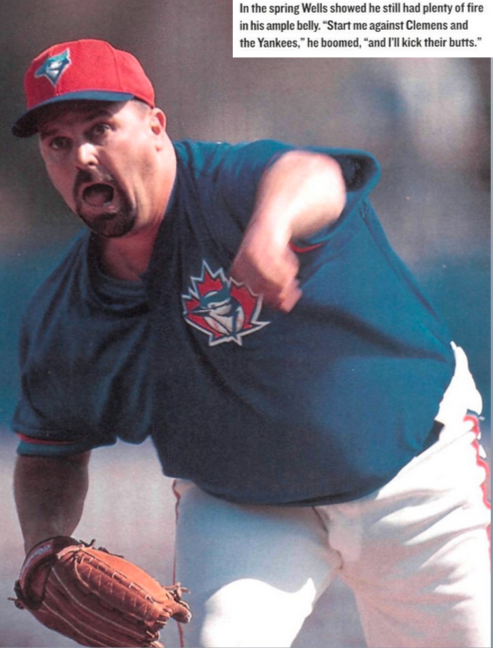
I'm starting with the pitching staff, since I found a good photo of David Wells from the Sports Illustrated baseball preview issue for the 1999 season (the year on which ASB01's statistics are based, it's a long story). Wells was newly acquired by the Blue Jays prior to that season, and he serves as a very serviceable number two starter on this Taurus team, even though he didn't reprise his ace-like numbers from 1998, when he was with the Yankees (2,234 overall fantasy points in 98 vs. 1,562 in 99). The staff ace is John Smoltz (with a team leading 1,773 pitching points), who in real life was part of Atlanta's vaunted Big 3 with Greg Maddux and Tom Glavine (who are both Aries). The starting staff features two more lefties in addition to Wells: Sterling Hitchcock of the Padres (1,487 points) and Mike Sirotka of the White Sox (1,250), although they do not show up in that order in the game's rotation, since I leaned heavily into ASB01's letter grade player rating system when I was arranging the rotation.

This preference given to the game's player ratings over fantasy points from the previous season is why veteran starter Todd Stottlemyre gets the nod in the game, despite just 687 fantasy points in 1999, his first with the Diamondbacks. Many other starting pitchers outscored Stottlemyre in 99, including Charles Nagy (1,158 points), Steve Woodard (1,137) and the enigmatic Hideki Irabu (1,124), but you can't argue with that sweet B+ rating (the other three had to settle for B's). The Taurus bullpen was led by a closer/setup pairing from the Detroit Tigers: Todd Jones (1,372 points) and Doug Brocail (929). Those two were supported by Mets setup reliever Turk Wendell (821) and situational Phillies lefty Rheal Cormier (just 472 points, but it's important to have a weapon against those tough left-handed hitters).


While NL MVP Chipper Jones was the team's top batter in 1999 (with an eye-popping 3,057 fantasy points), AL Rookie of the Year Carlos Beltran was a close second (2,381). What's more, the SI Royals team preview features a nice "Next Up..." blurb previewing his award-winning first full season. Just think, Beltran was THIS close to landing his first MLB managerial gig exactly 20 years later... Despite being a centerfielder by trade, Beltran shifts to left field in this Bulls lineup to make room for Chipper's Braves teammate (and namesake) Andruw Jones (2,211), who took home his second of what would be ten consecutive Gold Glove awards in 99. Actually, if I had to do this lineup over again, I would probably put Beltran in right field, leaving left field for Hall of Famer Tony Gwynn (just 1,446 points in an injury-shortened 99 season), and reserving the DH spot for Ben Grieve.

Speaking of Ben Grieve (1,764 points), the lumbering A's slugger set the AL Rookie of the Year stage for Beltran, winning the award in the previous season in 1998. His career never really panned out, especially considering the offensively-charged environment of the turn of the millennium. Elsewhere on the diamond, you probably couldn't imagine a bigger waste of defensive excellence than putting the slick-fielding Omar Vizquel at first base, but when your other starting shortstop option is Hall of Famer Barry Larkin, you could do a lot worse. Also, the only players who had first base eligibility in the Taurus player pool were Frank Catalanotto (834 points) and John Vander Wal (738). On an interesting cusp-related note, between the time I took the above screenshot of the Taurus lineup and now, when I'm writing this post, I did a deep dive into the birthdates of some players who were on the cusp of two different astrological signs, and I discovered that catcher Chris Widger - born 5/21/1971 in Wilmington DE, and who I had previously identified as a Gemini - was in fact a Taurus (according to helloastrology.com). Widger outscored projected Taurus starter Brook Fordyce by a narrow margin of 1,041 to 991 fantasy points in 1999, but since they both have a flat B rating in the ASB01 game engine, I don't know if I would have made that change if I discovered the discrepancy sooner. As far as the bench is concerned, we have Miguel Cairo (1,223 points) backing up speedster Eric Young Sr. (1,615) at second base, slugging third baseman Ken Caminiti (1,090) as another potential option at first base (he played 33 games there for the Braves in 2001), and yet another Jones (Jacque, 999) as a centerfield capable backup outfielder.

Sunday, April 12, 2020

Aries - All-Star Baseball 2001 Retrospective

When I first fired up my copy of MLB The Show 2020, I was mostly looking forward to using it as a simulation engine to flesh out my patented Fantasy Astrology Baseball lineups. This project is temporarily on hold, because I’m currently obsessed with my Road to the Show created character, Krys Regnom, #24 (an anagram for RyskMonger42, get it?), but that’s a story for another time. I was particularly excited about this year’s version of MLB The Show because it marks the 20-year anniversary of my second favorite baseball video game of all time: All-Star Baseball 2001 for the Nintendo 64. While the title would suggest that we won't hit that milestone until 2021, ASB01 was actually released prior to the 2000 MLB season, based on stats from 1999. (Remember that the naming conventions of sports games were a little wonky until 2006 - that's why you have both MLB 2006 and MLB 06: The Show released in back-to-back years for the same franchise.)

I just recently took an in-depth look at the Aries Rams projected lineup for the 2020 season. And since we’re still several days from the end of the current Aries season, I’m now jumping back 20 years to look at how the Aries roster looked, through the eyes of the ASB01 game engine. As with any video game based simulation, the batting lineup and pitching rotation will be based less on real world production, and more on the game’s player rating system, which uses letter grades, rather than the 1-100 scale from the more modern games. Also, since I don’t have the capability of capturing footage directly from my N64, you’ll have to make do with photos of my TV screen.


Wow, it’s crazy how far video games have come since the year 2000, huh? Actually, it’s kind of to be expected, isn’t it? Either way, since we don’t get a heckuva lot of information from these screenshots, I’ll supplement them at the bottom with an excerpt from the database I use to compile these rosters. But for now, marvel at the innocent simplicity of how these lineup screens were arranged. You could scroll to the right to view more stats, but they didn’t let you look at player attributes - for that, you had to navigate to the Scouting Report or Player Movement sections. The Switch Lineup button only differentiated between AL and NL ballpark (i.e. DH or no DH), so you didn’t have to slog through setting different lineups vs. right-handed or left-handed pitchers. Also, in addition to the 25-player active roster, each franchise only had 10 spaces for minor league players, rather than full rosters for Triple-A and Double-A, plus another 15 A-Ball spots. Times sure were simpler back then...

But enough about the inner workings of 20-year-old video games. What kind of firepower were the Aries Rams working with back in 1999-2000? The short answer is: not a whole lot, at least not relative to the superpowered offensive climate of the time. Third baseman Scott Rolen (an actual real-life Phillie at the time) garnered a coveted A+ overall rating, and he’s supported by a couple of A- players in Jeromy Burnitz and Brian Jordan. But those latter two outfielders and Rolen’s real-life teammate Rico Brogna at first base were the only three hitters to top 2,000 fantasy points in 1999, and all three barely even eclipsed that threshold. For context, only one other sign had fewer 2,000-point batters: the Gemini Twins have only two, but they both scored 3,000 points (hello Jeff Bagwell and Manny Ramirez). Of course, leadoff hitter Marquis Grissom just missed 2,000 with his power/speed combo, and both Rolen and David Justice would have approached that milestone with full seasons.

Of course, fantasy point totals aren’t the only way to evaluate a player, especially in a multi-level simulation like a video game. Justice has the contact-hitting profile that goes well as a tablesetter at the top of the lineup, even if he lacked the home run power of some of the bigtime point-scorers. Alex (S.) Gonzalez was putting up his usual decent production in 1999, before a torn labrum cut his season short. Bret Boone on the other hand was still a couple of seasons from breaking out with the 2001 Mariners. On the other side of the ball, Brad Ausmus gets the starting nod because of his sterling defensive reputation, even though according to his blurb from Sports Illustrated's pre-2000 baseball preview, Jason Varitek is also "a good glove man and handler of pitchers." Speaking of defense, Rolen earned eight Gold Gloves in his career, and his backup, not-yet-21-year-old Adrian Beltre, is no slouch himself. Rounding out the bench (which is not shown on the starting lineup page) is speedy infielder Quilvio Veras and slugging outfielder Glenallen Hill.


On the pitching side, this team was a lot more impressive than on offense. While you might not see the gaudy point totals reminiscent of today’s aces, remember that the juiced ball era of the late 2010’s pales in comparison to the juiced PLAYER era of the late 1990’s, driving pitching point totals down across the board. For example, while they averaged just under 1,600 points between them, the duo of Greg Maddux and Tom Glavine was rightly feared across the league. Shane Reynolds was the ace of a very talented Houston Astros pitching staff (then in the National League). Jon Lieber was a very serviceable workhorse in his first year with the Cubs. Veteran Bret Saberhagen pitched well when healthy, but it's a bit of a stretch to include him here, since he missed the entire then-upcoming 2000 season due to injury. Since I allow two additional starters to serve as long relievers, the righty-lefty combination of Masato Yoshii and Wilson Alvarez are also on the roster.


Since ASB01 doesn’t show the bullpen on the Starting Rotation screen (although it does give you letter grade ratings for each starter’s individual pitches, which is pretty neat), you can refer to the above chart for the team’s remaining relievers. Although Antonio "El Pulpo" Alfonseca is technically the closer, Indians fireballer Steve Karsay is the highest-rated reliever on the roster. He also ended up serving as Cleveland's ninth-inning specialist in 2000, the only year reaching 20 saves. Interestingly enough, Mike Trombley racked up saves in '99 with the Twins, but lost the closer's role to Ryan Kohlmeier when he went to the Orioles... not that there were many save opportunities for that club.


I took these screenshots just before the release of MLB The Show 2020, so I won't have too much time to fire up the old N64 and do many 20-year-old simulations. But depending on how long the 2020 season is delayed (if it happens at all), I might revisit these lineups as the karmic wheel spins.

Friday, March 20, 2020

Players Missing from MLB The Show 20

Ever since MLB 20: The Show came out on Tuesday, I've been poring over the default rosters, compiling a database of where all the players are located in terms of batting orders and pitching rotations. Or rather, I've been adding that information to my existing database, built on 40-player rosters, non-roster invitees, and players with MLB experience in 2019. And I came across some rather disturbing discrepancies: 20 players among MLB.com's top 800 fantasy players (including three members or MLB.com's top 100 prospects) were omitted from the game's player pool. Here's the full list, starting with offensive players, followed by pitchers.


Gavin Lux, MLB's #2 prospect, is projected to start at second base for the heavily favored Los Angeles Dodgers (whenever the season ends up starting). Since he's absent from the game's code, utility player Enrique Hernandez gets the virtual nod at LA's keystone. Going by fantasy ranking, next up is Nationals infield prospect Carter Kieboom (#21 on MLB's top 100 prospects list), who has a good chance to take one of Washington's non-Trea Turner infield spots - either second or third base, depending on where new acquisition Starlin Castro ends up. Without Kieboom in the game, fellow newcomer Asdrubal Cabrera is in the starting lineup at the hot corner for the defending World Series champions. The next two players on the list are both imports from Japan's Nippon Professional Baseball: Shogo Akiyama was brought in to join a crowded Reds outfield mix, while Yoshitomo Tsutsugo was brought in to join a crowded Rays DH mix. Since neither player has any MLB experience, I guess it's sensible that the game's developers wanted to wait on creating player models for them until they got a chance to see them play in the states. I don't know, is that how programming for sports video games works?

None of the other missing offensive players ranked below 600 on MLB's top 800, so they're unlikely to make a major impact in 2020, but there are some notable names. Jake Fraley is looking like the favorite to grab one of the starting corner outfield jobs in Seattle until Mitch Haniger is ready to return. Abraham Toro could have some added utility to an Astros club mired in turmoil, since he made his MLB debut long after the time period covered in the sign-stealing scandal. Willi Castro could see some time in the unsettled infield mix for the rebuilding Tigers. The Rangers acquired outfielder Adolis Garcia in a minor trade, after he was designated for assignment by the Cardinals. And the lone non-rookie player on this list, Luis Rengifo, was ALMOST included in a trade from the Angels to the Dodgers (centering on LAD outfielder Joc Pederson), but those talks were scuttled after Boston bowed out of the original configuration of the Mookie Betts blockbuster.


Moving to the pitchers - and, quite honestly, the whole reason I first realized something was amiss - burgeoning Athletics left-hander A.J. Puk (#60 on MLB's top 100 prospects list) is nowhere to be found in the game's player pool. While it's true the Puk managed little more than a cup of coffee in his major league debut last season, after spending most of the year recovering from an injury, the same is true of Jesus Luzardo, ANOTHER A's prized lefty (#12 on the prospects list), and he's firmly entrenched as Oakland's number two starter. Six spots behind Puk on MLB's fantasy rankings, we have Josh Lindblom, a former fringe major leaguer who became a star pitching in the Korea Baseball Organization, and is now attempting a stateside return. Much like famed KBO slugger Eric Thames on the offensive side, Lindblom is attempting said comeback with the Milwaukee Brewers, yet he doesn't appear anywhere on their virtual rotation. The Dodgers were hit particularly hard by these omissions, as they lost not only their top infield prospect, but also one of their best pitching prospects in Tony Gonsolin, although their rotation still looks stacked, even without the cat-shirt enthusiast. Going out of order here, the only dedicated reliever on this list is James Karinchak, who spent some time as a closer in Cleveland's minor league ranks in 2019.

I skipped to Karinchak above because I want to group the next two pitchers together. Kwang Hyun Kim and Shun Yamaguchi both spent their careers to date pitching in overseas leagues - the former in the KBO and the latter in the NPB - but are scheduled to make their major league debuts whenever the season gets underway. Both pitchers are also looking at rather unsettled roles: had the season opened as planned, Kim was all but assured a spot in the Cardinals' rotation, due to an injury to Miles Mikolas. But with the delayed start to the season giving the returning expat additional time to recover, Kim could be ticketed for starting his MLB career with a bullpen role. Yamaguchi has actually had success as both a starter and a reliever in Japan, and given the lengths to which Toronto went to improve their pitching staff in the offseason, it was always rather unlikely that Yamaguchi would start the year in the rotation. In the lone Fantasy Astrology reference I'll make in this post, both of these pitchers represent the Cancer Crabs, a sign that has historically lacked depth in the starting pitching department.

Of the final five pitchers on this list, three are veterans (i.e. non-rookies) who didn't see any time in the majors last year due to injury. Kendall Graveman and Chad Kuhl are both recovering from Tommy John surgery (the former was given a make-good deal by the Mariners, while the latter remains with the Pirates), while Cardinals lefty Austin Gomber was pitching in the minors when he went down with biceps and shoulder issues in May. The other two are lower level prospects who could see extended opportunities due to health issues elsewhere on their respective clubs. The Indians acquired Logan Allen (alongside Franmil Reyes and Yasiel Puig) in a trade with the Padres (and the Reds) at last year's July 31st deadline, and he could help Cleveland fill in for injured hurlers Mike Clevinger and Carlos Carrasco. Patrick Sandoval struggled in both the majors and the minors last year, but the Angels will likely need him to step up early in the year due to uncertainty surrounding Shohei Ohtani (as a pitcher, anyway) and Griffin Canning.

Saturday, December 28, 2019

All-MLB Player Union Rep Team 2019-20

In honor of Netflix's The Irishman - which, if you haven't defied Martin Scorsese and streamed it on your phone yet, centers on Jimmy Hoffa's tenure atop the International Brotherhood of Teamsters - I'm going to take a deep dive into the players at the forefront of Major League Baseball's collective bargaining union: the MLB Player's Association. The terrific website MLB Trade Rumors dot com recently profiled the known player representatives for each team, with the caveat that some information is incomplete and/or subject to change. But given this snapshot, I thought it would be fun to organize these labor-minded players into a projected roster and see what it might look like. Here's the list, with player entries taken from my MLB 2019 database, sorted by position:


The first thing to notice is the abundance of shortstops in the player pool. What, a guy is named the "captain of the infield," and all of a sudden he thinks he can speak for his team in labor matters? The next thing I want to mention are the six stray players at the bottom. The first group is former player reps who no longer play for the team that they once represented. The second group are pension committee reps (with one alternate) who aren't also affiliated with a team. So without further ado, let's analyze a potential All-Player's Union Roster!

At the front of the starting rotation, Max Scherzer has not only been one of the most successful player of the last decade (because all-decade stuff is cool for another four days, right?), but also one of the most outspoken, making him a good leader for both on and off-field issues. Following him is recently-acquired Yankees lefty James Paxton, the man known as "Big Maple," due to his large stature and Canadian ancestry, who provides the perspective of a north-of-the-border hurler. Another pair of lefties, Marco Gonzales, of Paxton's former Mariners team, and Andrew Heaney, who plays in Anaheim, are just starting to come into their own. It would be a lot easier to round out this rotation if we could dip into the former player reps - Chase Anderson used to represent the Brewers, but he was traded to the Blue Jays this offseason. Otherwise we'd have to bank on a super-early return to health for Pirates once and future ace Jameson Taillon's elbow.

The pool for the all union bullpen (can we just start calling this team the Unions?) is made up of 75 percent Geminis. Matt Barnes was once considered the Red Sox closer heir-apparent, after the departure of Craig Kimbrel, but before the emergence of Brandon Workman. Andrew Miller was once considered one of the game's top lefty relievers, but could his chronic overuse in the 2016 postseason have hampered his future potential? There's no choice but to draw from the Executive Sub-Committee here, where Collin McHugh adds some length to the staff, as he has had both starting and relief experience in his career with the Astros. However, McHugh is only an Alternate member of the Pension Committee; full member Cory Gearrin was little more than a bit player in terms of 2019 fantasy points.

Not only do the Unions have access to three catchers, but the top two are uniquely suited to a platoon arrangement - Tucker Barnhart is a left-handed hitter known for his defensive prowess, while Tyler Flowers is a bat-first righty. Rounding out Gearrin's co-rep on the pension sub-committee, veteran free agent Chris Iannetta would be great to have in the proverbial labor minor leagues - or just as a third catcher. A roster can have a little third catcher, as a treat. Going by POS and PTS, Phillies slugging first baseman Rhys Hoskins would be the best bet to put up the most points at his customary position. You'll notice that there are technically no qualified second basemen in the player pool, but we can draw from our bumper crop of shortstops. My best solution would be to move Athletics MVP candidate, and highest-scoring All-Union player, Marcus Semien to the keystone, with Indians trade candidate Francisco Lindor remaining at short.

Speaking of Lindor, the Puerto Rican-born "Mr. Smile" is one of only three Latin American born players in the All-Union talent pool. The other two: both Venezuelan shortstops: Rangers veteran Elvis Andrus (from Maracay) and Marlins superutility type Miguel Rojas (Los Teques). Moving around the horn to third base, Kris Bryant is the top eligible point scorer there (no matter when he eventually becomes a free agent), but if you've skipped ahead to the dearth of outfield options, you'll see that he's needed in the grass. The good news is that leaves the hot corner for Justin Turner, whose 2020 position could be in flux, depending on whether the Dodgers score a big trade for an infielder. (Maybe Lindor, anyone? What would be the competitive advantage of hoarding player union reps?)

At the end of the official team reps, you'll see Michael Conforto of the Mets, the only eligible primary outfielder - who luckily also has secondary eligibility in center field, where he needs to play. Bryant can occupy another corner (let's call it right field), but how do we round out the outfield mix? Should we return to shortstop? Surely either Andrus or defensive whiz Nick Ahmed has the athletic ability to handle left field, despite a TOTAL lack of MLB experience for each one. We could look at Hoskins's 2018 as the primary left fielder in Philadelphia, but  we can all agree that experiment didn't go too well - even though that arrangement would leave 1B in the capable hands of the veteran lefty Daniel Murphy. But a more traditional solution lies in the former player reps. Gold Glove left fielder Alex Gordon used to speak for the Royals, before he hit free agency, and the consensus is that he'll either retire, or re-sign with Kansas City, in which case he would presumably return to his union rep role because why not? I hope the Aquarius outfielder comes back, because, to paraphrase Hanibal Lector, the league's more interesting with Gordon in it.


If you take into account Taillon's injury, which will likely keep him out of action until the summer, there are exactly enough confirmed union-related MLB'ers to make a 25-player roster. (Never mind that the limit is going up to an even (yet somehow infinitely less satisfying) 26 players next year.) I have no idea how a team like this would perform in a simulation against the rest of the league. (I recently had to uninstall MLB19 to make room on my PS4 for MK11, so I can't run the numbers myself.) But with so many players accustomed to life at the negotiating table, I'll bet the clubhouse chemistry would be off the charts... in one direction or another.

Friday, December 6, 2019

All-Star Baseball 2001 - 20 years later

As I was rooting around the video games in my old room at my parents' house this Thanksgiving season, I realized that we are approaching the 20-year anniversary of the second-greatest baseball video game of all time: All-Star Baseball 2001 from Acclaim Sports. While the title would suggest that we won't hit that milestone until 2021, ASB01 was actually released prior to the 2000 MLB season, based on stats from 1999. (Remember that the naming conventions of sports games were a little wonky until 2006 - that's why you have both MLB 2006 and MLB 06: The Show released in back-to-back years for the same franchise.) Since my Nintendo 64 miraculously still works, and we still have a lot of offseason ahead of us, I thought this would be a good opportunity to extend my Astrology Baseball project into the previous decade... not to mention the previous MILLENNIUM.

In addition to featuring state of the art polygonal graphics and a hauntingly catchy menu song, ASB01 provides letter grades for each of the 1,092 players in the game, with just 32 of which earning the coveted A+ mark. I'll go over each of those players here, noting which sign they belong to, and touching on the overall Astrology landscape as baseball prepared to enter the 2000's. This should be enough to tide you over until I manage to create Astrology-themed rosters and simulate an entire season, using patented Controller Pak technology.


Three different signs had exactly five players with A+ grades, but I'm starting with Scorpio because their crop of A-plusses is by far the most impressive. Red Sox ace Pedro Martinez actually finished second overall in '99 fantasy points, but he did lead all MLB in points per game (minimum 40 innings) en route to the AL Cy Young award. I guess the game developers didn't think Pedro's real-life pitch mix was scary enough, because they replaced his changeup with a devastating screwball, which breaks just like his curve, but in the opposite direction. Joining Martinez in the Scorpions rotation is Phillies starter (and generally despicable human being) Curt Schilling, whose points-per-game average would have put his total in the 2,200 - 2,300 range if he had pitched a full season. (Five years before the "bloody sock" incident, Schilling was plagued with shoulder inflammation in '99 that eventually led to offseason surgery.)

Moving to the offensive side, the October/November team is led by centerfielder Ken Griffey Jr., who missed his third consecutive 50-home run season by just two, although he still led the AL in that category. In the game, Griffey appears on the roster of the Cincinnati Reds, following a February 2000 trade from the Seattle Mariners in exchange for Mike Cameron and Brett Tomko, among others. Another offseason trade victim, outfielder Shawn Green took his power/speed combo (42 HR, 20 SB) from Toronto to Los Angeles, in what was the first blockbuster trade that I remember having an effect on my baseball life. ("With Raul Mondesi on the Blue Jays, we won't hear any more chants of RAUUUUUUUL at Dodger Stadium!?") In a roster-construction note, when I build these simulated lineups, I will likely put Green at first base, even though he didn't play there regularly until 2004, because SCO also has the likes of Griffey, Sammy Sosa (the sign's fifth A+ player), Gary Sheffield, Dante Bichette, and Johnny Damon available for the outfield/DH slots.


Sagittarius has the same amount of A+ players as the sign that precedes it on the calendar, but SAG's group totaled about 2,000 fewer fantasy points than SCO's in 1999. That's not to take anything away from Rangers catcher Ivan Rodriguez, who won the AL MVP award that year, with a 35-HR, 25 SB season. Pudge also took home the seventh of his ten consecutive Gold Gloves, and the sixth of six consecutive Silver Sluggers behind the plate. Or Rockies slugging right fielder Larry Walker, who led the NL in all three "triple slash" categories (.379 AVG, .458 OBP, .710 SLG) as well as OPS (obviously). Of course, Walker only made it into 127 games that year, and the rarefied air of the pre-humidor Coors Field might have had something to do with his production, but he's a top tier talent nonetheless. Rounding out the A+ hitters for the Archers is Astros second baseman Craig Biggio, whose inclusion really dates the piece, given that his son Cavan just made his debut this past season for the Blue Jays at his father's old position. Speaking of Sagittarius dads, Ivan's son Dereck Rodriguez came up a season prior as a pitcher for the Giants, but he struggled through a sophomore slump in 2019.

Moving to the pitching side, we have two Hall of Famers who were teammates on the Yankees for eight years. Last year, Mariano Rivera became the first player to be unanimously voted into the Hall following a career as one of the most effective and decorated relief pitchers of all time. While the ASB01 engine does not include a cut fastball, which was Mo's signature pitch, the game still finds ways to make him just as unhittable as he was in real life. Starter Mike Mussina was still with the Orioles, his original team, when this game was released, but he would sign a free agent contract with the Yankees the very next year, and stay there through his retirement in 2008. Despite finishing out the back half of a Hall of Fame career in New York, would you believe that 1999 was the last time Moose made an All-Star team in his career?


Of the five Leo players who earned an A+ rating from All-Star Baseball 2001, the majority of them have dealt with serious performance enhancing drug issues in their illustrious careers. Going by 1999 fantasy points, Mariners shortstop Alex Rodriguez nearly cracked 2,500 points on the year, despite playing in only 129 games due to knee surgery. Later he would be suspended the entire 2014 season stemming from his ties to the Biogenesis scandal. Giants left fielder Barry Bonds also suffered through an injury-shortened 1999 season, as he was limited to 102 games after surgery to repair a torn triceps tendon and bone spur. While his career didn't extend into the era where it was actually illegal to use steroids, his well-publicized link to them has kept Bonds and his thicc neck out of the Hall of Fame, despite holding the all-time records for home runs and walks. Yankees starting pitcher Roger Clemens is the most curious A+ player in the game, as his 1999 season (his first in New York) was decidedly pedestrian: a 14-10 record, 4.60 ERA, 7.8 K/9, and 4.3 BB/9 over 30 starts and 187.2 innings. I guess he was still dining out on his consecutive AL Cy Young awards in '97 and '98 with the Blue Jays. As far as his ties to PED's, Clemens was famously named in the 2007 Mitchell Report, which was released just months after what would prove to be The Rocket's final season.

Now moving to the (ostensibly) clean players, we have Boston shortstop Nomar Garciaparra, who won the AL batting title in 1999 (the first of two consecutive times he would take home the crown, but we couldn't possibly know that at the time this game was released). When putting these rosters together, Nomar's presence will push A-Rod over to third base, where he would later play for the majority of his time with the Yankees, starting in 2004. Interestingly enough, this Lions team will likely consist of an all-shortstop infield, as Edgar Renteria of the Cardinals will occupy second base. Leo's final A+ player is Astros closer Billy Wagner, who leads a lights-out bullpen that also includes A-grade relievers John Wetteland, Troy Percival, and Jeff Zimmerman, not to mention B+ closer Danny Graves.


Remember how Pedro Martinez finished second overall in 1999 fantasy points? He was eclipsed only by NL Cy Young winner Randy Johnson, in his first year with the Diamondbacks (but his 35th year representing Virgo). The Big Unit would go on to win the next three Cy Youngs, in addition to taking home a World Series title in 2001, where he shared WS MVP honors with fellow ASB01 A+ starter Curt Schilling. During this simulation, Johnson will pitch to an A+ catcher (and fellow Hall of Famer) Mike Piazza, who finally settled in New York for '99 after splitting the previous year between the Dodgers, Marlins, and Mets. To round things out, Virgo has two A+ outfielders who had polar opposite career tracks: Albert Belle was known for his volatile personality and played for three different teams in his career ('99 was his first with the Orioles), while Bernie Williams had a charming, soft-spoken demeanor, and spent his entire playing days with the Yankees.


Remember how Barry Bonds has been frozen out of the Hall of Fame despite holding a monumental home run record? The same is true for Libra slugger Mark McGwire, who was the first major leaguer to hit 70 home runs, which he did in 1998, breaking Roger Maris's long-standing record of 61* in the process. (There's not footnote corresponding to that asterisk, it was just a reference to the Billy Crystal TV movie of the same name.) There was never really any doubt that Big Mac was juicing, but the ASB01 developers don't care how you become great, just whether or not you have A+ level talent. Joining him in a power-packed Scales lineup is outfielder Juan Gonzalez, who went from the Rangers to the Tigers in a blockbuster trade following the game's platform '99 season. Libra's last A+ player actually did make it into the Hall of Fame, as there are no steroid accusations tainting the career of longtime Padres closer Trevor Hoffman, despite a '99 season that was more excellent than otherworldtly.


Three different signs had two A+ players, but only Gemini boasts two 3,000 point scorers among them. Astros first baseman and leader of the "Killer B's" Jeff Bagwell had such a great 1999 (he played in all 162 games and had a 40-30 season, while leading the NL in runs and walks) that he pushes fellow Hall of Fame first baseman Frank Thomas to the DH slot. Speaking of the Hall of Fame, Indians right fielder Manny Ramirez has been the victim of a PED-related freezeout, similar to Bonds, McGwire, Clemens, et al. Despite Aquarius's status as a perennial fantasy astrology bottom-feeder, the sign does boast some impressive talent at the top of its depth chart. Roberto Alomar was at the top of his power/speed game in '99 (although the jury is out on whether Manny's PED influence might have spread around the Cleveland clubhouse) and Vladimir Guerrero was in his prime as one of the game's best pure hitters. Aries has the curious distinction of having two A+ players who each failed to eclipse 1,800 fantasy points in 1999: Phillies third baseman Scott Rolen played in only 112 games after his season ended in August because of a back injury, but Hall of Fame Braves starter Greg Maddux has no excuse, having pitched 219.1 innings over 33 starts.


Of the four signs that had just one A+ player each, Taurus leads the charge with NL MVP winner Chipper Jones, one of six players who scored more than 3,000 points during the 1999 season. In a funny side note, despite Chipper's career-high 45 home runs and 1.074 OPS that season, the Braves third baseman was not named to the All-Star team, the only time he was snubbed between 1996 and 2001. Yankees shortstop Derek Jeter was the face of the All-Star Baseball video game franchise from 1998 through its end in 2005. 1999 was arguably the Cancer Crab's finest season, as Cap'n Jeets put up career highs in runs, hits, homers, and all three triple-slash line categories. Speaking of people who are the face of things, Pisces pitcher Kevin Brown made the cover of the 1999 Sports Illustrated baseball preview issue, after signing a seven-year, $105 million contract with the Dodgers, the first ever nine-figure contract in MLB history. Rounding out ASB01's A+ players is Mariners designated hitter Edgar Martinez, who didn't have a phenomenal '99 season (although he did lead the AL in OBP) and offers nothing in terms of defensive value (he managed only five games at first base that year), but it's nevertheless fascinating that all 12 astrological signs have at least one A+ representative.


So there you have it, a 20-year retrospective into the underlying statistics behind All-Star Baseball 2001, one of the best baseball video games of all time. As it happens, in the same trip back home where I rediscovered my N64, I also found a copy of MLB 10: The Show for PS2 lying around. Remember, by the time of that game's release, the titles of baseball video games had changed to reflect the year of the upcoming season, which means I have the means to do both a 20-year AND a 10-year retrospective as we approach the 2020 season. I guess I know what I'm doing with my weekend now...

Monday, March 18, 2019

Astrology 2019 Projected Lineups - Air Division

We're rounding things out with the Air Division, the home of former powerhouse Libra, winners of _ previous Fantasy Astrology championships, but whose reign of terror ended last year when they didn't even win the division. Actually, the Scales technically didn't NOT win their division, as they finished with an identical record as Gemini, but ESPN's proprietary "points for / points against" system awarded the Twins with the victory; they would eventually go on to win the championship. But as Libra is slated to be on top once again this year, let's start with them. As a reminder of the scoring system, signs gets 5 points for each Tier I player in their talent pool, continuing in descending order, finishing off with 1 point per Tier V player. And the color coding is as follows: Green = Tier I, Blue = II, Yellow = III, Red = IV, Purple = V


Despite the presence of only one Tier I batter, this outfield is by far the strongest in the astrology landscape, due to its incredible depth. AL MVP Mookie Betts leads the charge, and he's followed closely (albeit one tier town) by the owner of the richest contract in MLB history Bryce Harper, who hopefully doesn't show any lingering effects from being hit by a pitch on the ankle just a few games into his first Spring Training with the Phillies. The defensive prowess of the team's lone Tier III batter Starling Marte means that he would hold down center field in real life or a simulation, but Harper qualifies there as well for 2019, despite his poor defensive performance. Tier IV's Eddie Rosario and Andrew McCutchen could serve as a pretty serious DH platoon, while Tier V Aaron Hicks will provide yet more center field insurance when he comes off the DL. In the middle infield, Xander Bogaerts and Robinson Cano would make a fine double play combination, depending on whether the latter has truly cleaned up his PED act.


The Libra rotation has the curious distinction of being filled entirely by Tier IV starters; or it will be once Mike Foltynewicz is healthy enough to take the field. Until then bounce back candidate and former Team USA ace Chris Archer and lefty strikeout artist Robbie Ray will lead the pack. Those two will be followed by the most expensive pitcher in the sport (in terms of AAV) Zack Greinke and burgeoning Cardinals top of the rotation presence Jack Flaherty. In the bullpen, Dodgers star Kenley Jansen is hoping for a smooth recovery from offseason heart surgery, for both professional and general health reasons. Still playing out the extension he signed with the A's, Sean Doolittle flashed numbers that were superior to his Tier III standing, but staying on the field is always a challenge with him.


The fact that Gemini "won" the Air Division last year has almost everything to do with its pitching staff, and very little to do with a fully uninspiring offensive group. Pending free agent Anthony Rendon tops the bunch, and only a very deep crop of third basemen drops him all the way down to a Tier III standing. I don't  know if he's first-round-pickable, but he's definitely extension material for a Nats team that has come to terms with multiple Scott Boras clients before him (but then again, they also just let the biggest one walk away). Even a Tier IV placement for catcher Jonathan Lucroy assumes that he'll return to the solid offensive production that marked his early career, although even if he doesn't, I'm still salty that the A's allowed him to go to their in-state, in-division rivals rather than re-upping him after his magnificent work handling an unproven pitching staff. It's still unclear whether Luis Urias will gain shortstop eligibility, but until that happens, Brock Holt can hold down the fort.


NL Cy Young Award winner Jacob deGrom headlines a deep and exciting starting staff that quite litrally carried this team into and through the Fantasy Astrology postseason last year. Recently extended Phillies ace Aaron Nola was no joke either, and it remains to be seen if new Mets GM Brodie Van Wagenen will follow suit with his former client. Staying with the extension theme, Jose Berrios declined the latest offer from the Twins (Minnesota) to lock up their young ace long term, but that development might make the Puerto Rican hurler that much more motivated to perform. The success of the Twins' (Gemini) bullpen is heavily predicated on when (whether?) Craig Kimbrel signs with a team prior to the 2019 season. New Cardinal Andrew Miller has been a high-leverage relief stud in the past, but he's coming off an injury-plagued season, and there's no guarantee that he'll see save opportunities with flamethrowing Virgo Jordan Hicks slated for the closer's role. Tier V reliever Jose Alvarado could end up getting the bulk of the ninth inning appearances for the Rays, but it's hard to count on any pitcher who plays for a team that's actively upending traditional roles throughout their staff.


Bringing up the rear, as they always seem to do in the Fantasy Astrology league, is Aquarius, a sign with only four tiered players on their entire roster - one less than the Libra starting rotation alone. Mutli-positional threat Whit Merrifield is a true fantasy asset for any team, and his ability to play the outfield alleviates a fairly significant roster logjam (allowing Tier III second baseman Rougned Odor to get into the lineup), but he's not necessarily the kind of player you want to headline your team with. It's possible that the White Sox's acquisition of Aries benchwarmer Yonder Alonso will keep Jose Abreu fresh with more at bats as the DH, but it's also possible that the DH penalty exists, in which case the Water Carriers would really be in trouble.


Speaking of being in trouble, this sign's only tiered pitcher found himself on the receiving end of a whopping 75-game domestic violence suspension last season, but despite that, Roberto Osuna is slated to close games for the heavily favored Houston Astros in 2019. Interestingly enough, another domestic violence suspension server, Addison Russell, is also a member of the Aquarius talent pool. Since there are no more tiered players to talk about, let's examine an astrological divisional oddity: the fact that Aquarius, a sign with Water in its nickname, resides in the Air division. This is actually quite logical if you think about it: although Water Carriers do interact with water, they must do so in an environment surrounded by air. If they were in water, there would be nothing to carry, and the bucket (or other receptacle) would just be floating around, and thus not able to be carried. Maybe someday there will be a bunch of elite players born between the months of January and February and we'll be able to focus only on the baseball accomplishments of this sign, but 2019 ain't that year.